When we travel to a world-class resort, the immediate sense of relaxation we feel isn’t accidental; it is the result of intentional design that prioritizes ease, sensory comfort, and a seamless connection to the surroundings. In my work across Central Texas, I’ve found that you don’t need a commercial-sized budget to capture this feeling. By adopting a hospitality mindset, you can bridge the gap between a standard residence and a restorative retreat, turning the place where you live into a destination of its own.
A resort-style home begins with the psychology of space and what I call the “path of travel.” In luxury hospitality, the transition from one room to another is always fluid and unobstructed. At home, you can replicate this by evaluating your visual clutter and simplifying what lives in high-traffic areas. Resorts feel peaceful because every item has a dedicated place, allowing the architecture to breathe. When you remove the friction of navigating around misplaced furniture or “catch-all” piles, your home begins to feel like it is guiding you toward rest rather than reminding you of a to-do list.
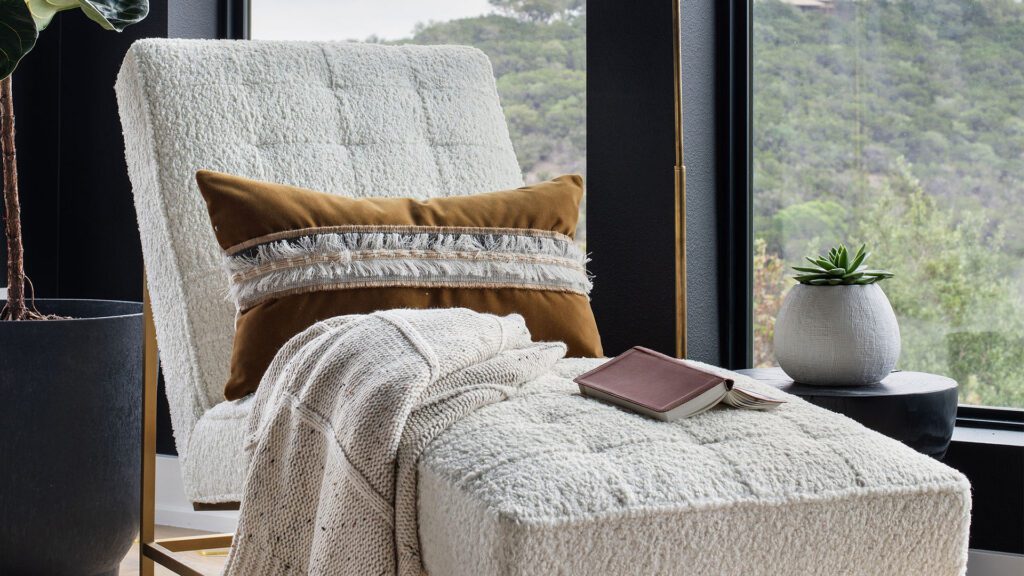
To truly ground this experience in our unique Hill Country environment, we must lean into “honest” and tactile materials. The hallmark of a high-end retreat is a palette that feels both organic and modern. Replace synthetic textures with materials that age beautifully and feel significant—white oak, natural stone, and heavy linens. By keeping your color story neutral and rooted in earth tones like creams, soft greys, and warm woods, you create a “quiet” backdrop. This reduction in visual noise is the secret to allowing the mind to decompress after a long day in the Texas sun.
One of the most effective ways to manifest this lifestyle is by transforming daily routines into rituals, particularly in the primary suite. In professional design, we focus heavily on the sensory transition. You can achieve this by swapping standard, harsh lighting for warm-dim LEDs that mimic the soft glow of a spa. Even the simple act of decanting toiletries into uniform vessels or focusing on the “tactile reveal”—the sensation of a plush rug or a perfectly weighted throw—elevates the space. When the environment is curated, the act of preparing for the day becomes an act of self-care.
Finally, a true resort lifestyle in Central Texas requires us to harmonize our “in-between” spaces. Our outdoor living areas should never feel like an afterthought; they should be an extension of the interior footprint. By using consistent flooring levels and similar color stories across your threshold, you effectively “erase” the walls. When the breeze moves through a doorway and the view is framed by soft, flowing textiles, the boundary between nature and shelter disappears. Ultimately, creating a resort-style home is about choosing quality over quantity and intentionally designing a life that feels as good as it looks.
Any content, resident submissions, guest columns, advertisements, and advertorials are not necessarily endorsed by or represent the views of Best Version Media LLC (BVM) or any municipality, homeowners associations, businesses, or organizations that this publication serves. BVM is not responsible for the reliability, suitability, or timeliness of any content submitted, inclusive of materials generated or composed through artificial intelligence (AI). All content submitted is done so at the sole discretion of the submitting party.