Thirty years ago, the standard kitchen featured stock cabinets, decorative valences, laminate countertops, a microwave proudly mounted front-and-center, and perhaps most memorably, a tambour-door bread box tucked into the corner. Today? The bread box has vanished, the microwave is hidden or non-existent, and the kitchen itself has transformed into something far bigger than a place to simply cook dinner.
According to Chicago-based, women-owned design-build firm, Design + Build Renegades, the evolution of the kitchen over the last three decades says a lot about how our lives have changed.
“When you think about kitchens from the ‘90s, there was often a lot of unnecessary detail that tried to make standard materials look more custom,” explains co-owner, Jenna vonRentzell. “People valued decorative elements and matching aesthetics more than functionality.”
Her business partner, Cara Brosten, agrees, laughing at some of the trends that defined the era. “The microwave was always on display. And the bread box! The tambour door was everywhere.”
But while kitchens in the 1990s certainly had personality, they functioned very differently than kitchens today. Back then, storage was often limited to standard cabinetry, drywall backsplashes were common, and were far smaller and less central to family life.
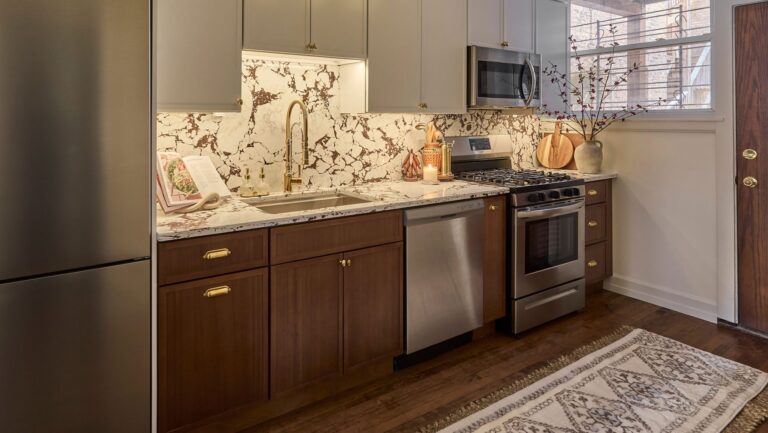
Today, homeowners value functionality above all. “People ask for drawers everywhere now,” says Brosten. “Built-in pantries, appliance garages, oversized and multi-functional islands, integrated storage inserts, beverage fridges, induction ranges—there are so many more tools available to make kitchens functional.” These appliances used to be considered ‘industrial.’ Even tile or stone backsplash wasn’t always considered a standard and now it is.
Many of those shifts reflect broader lifestyle changes. Kitchens have always been gathering places, but today they often serve simultaneously as a cooking space, homework station, entertaining hub, snack center, and social headquarters.
“Larger appliances and multifunctional spaces cater to collaboration,” vonRentzell says. “You might have different refrigerator compartments for kids’ snacks, separate appliances for reheating food, and multiple people using the kitchen at once throughout the day.”
The rise of HGTV, Pinterest, and social media has also shaped expectations around kitchen design. “There’s this idea now that kitchens should always look perfectly tidy and organized,” Brosten says. “But a lot of good design today is really about creating ways to hide things.”
That emphasis on concealment and simplicity marks a stark contrast from the ornate, heavily decorated kitchens of previous decades.
Often generational differences show up during renovations. “Older generations often think more about décor and ornate details,” says vonRentzell. “Display plates above cabinetry, themed aesthetics like an Italian villa kitchen. Millennials tend to want minimal, functional spaces where things can be tucked away.”
Still, not every modern trend automatically makes for good design. “For a long time, open concept became synonymous with ‘good kitchen design,’” Brosten explains. “But the truth is, a good kitchen is one that relates well to the home itself and to the people using it.”
And some design principles remain timeless no matter the decade. “A sink by a window, symmetrical cabinetry—those things continue to feel classic,” says vonRentzell. “When the layout allows for it, they never really go out of style.”
As for the features that create the most functionality? “Accessible customizations that aren’t so ‘custom’ anymore,” explains vonRentzell. “Things like spice racks, garbage cabinets incorporated into the cabinetry, undercabinet lighting, and storage inserts which are pretty standard now.”
One thing that likely won’t change anytime soon, however, is the kitchen’s role as the emotional center of the home. Even as styles, materials, and appliances continue to evolve, kitchens remain where people gather, connect, snack, celebrate, and inevitably stand during every party, regardless of how nice the living room is.
Any content, resident submissions, guest columns, advertisements, and advertorials are not necessarily endorsed by or represent the views of Best Version Media LLC (BVM) or any municipality, homeowners associations, businesses, or organizations that this publication serves. BVM is not responsible for the reliability, suitability, or timeliness of any content submitted, inclusive of materials generated or composed through artificial intelligence (AI). All content submitted is done so at the sole discretion of the submitting party.