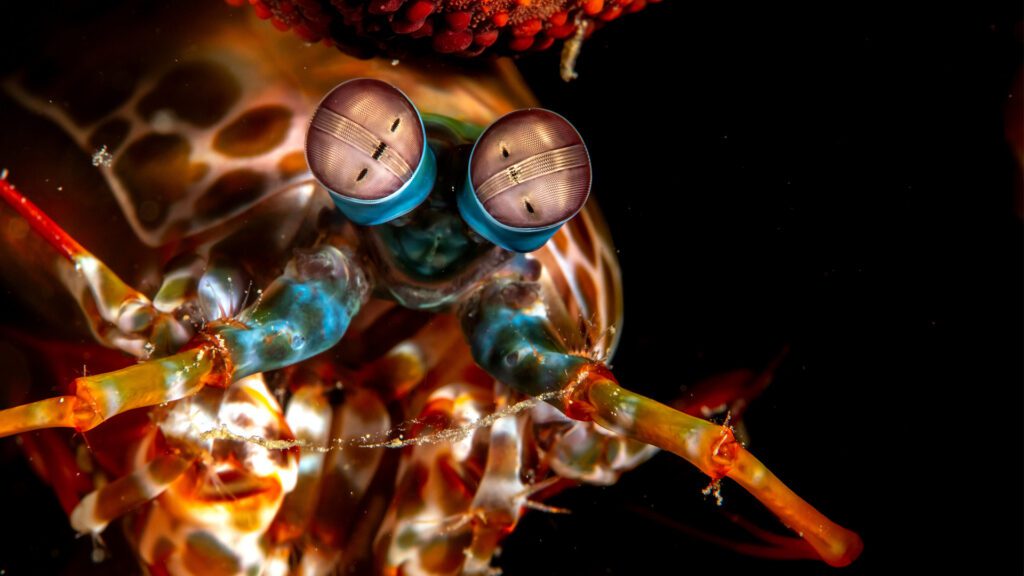
When people think about the most advanced visual system in nature, they often assume it belongs to humans, eagles, or maybe even sharks. Surprisingly, one of the most extraordinary eyes ever discovered belongs to a marine animal most people have never heard of: the mantis shrimp.
I find the science behind vision fascinating because it constantly reminds us how incredible the eye truly is. The mantis shrimp is one of the best examples of that awe. Humans have three types of color photoreceptors in our eyes: red, green, and blue. Those three channels allow us to see millions of colors. The mantis shrimp has up to 16 different photoreceptor types. Researchers have discovered that these animals can detect ultraviolet light, polarized light, and color ranges far beyond human capability. Even many advanced imaging systems used in science and aerospace technology operate with fewer spectral channels.
Its eye structure is equally remarkable. Each eye is divided into specialized regions that work together to analyze visual information. Unlike humans, which require both eyes working together to judge depth, mantis shrimp can perceive depth using only one eye. Scientists describe this as trinocular vision within a single eye. Each eye also moves independently, giving the animal an enormous field of awareness of nearly 300 degrees.
What’s even more fascinating is how efficiently this animal processes information. Despite having a brain roughly the size of a grain of rice, the mantis shrimp reacts with incredible speed and precision. The University of Queensland found that most visual processing occurs directly in the eye rather than sending every piece of information back to the brain for analysis. In technology terms, this resembles “edge computing,” where data is processed locally for faster response times. Modern engineers use similar principles in autonomous vehicles, robotics, and advanced camera systems. Nature developed it over millions of years.
The deeper I study vision science, the more respect I gain for the complexity of the human eye. Our eyes constantly process motion, color, contrast, depth, and focus with extraordinary speed and precision. Most people never stop to think about the miracle happening every second they are awake. Vision is one of the most advanced biological systems ever created. The intricate design and unparalleled visual capabilities of nature, exemplified by the mantis shrimp, inspire awe and remind us of the endless wonders still waiting to be explored.
Any content, resident submissions, guest columns, advertisements, and advertorials are not necessarily endorsed by or represent the views of Best Version Media LLC (BVM) or any municipality, homeowners associations, businesses, or organizations that this publication serves. BVM is not responsible for the reliability, suitability, or timeliness of any content submitted, inclusive of materials generated or composed through artificial intelligence (AI). All content submitted is done so at the sole discretion of the submitting party.