Industry Insider Facts on Dog Hair
Lots of topics can get a room full of dog groomers talking all at once, Shaving a double-coated dog breed is one of them. What’s the big deal?
Let’s start with the origin of dogs, and the function of their coats.
The most primitive breeds, the Arctic and Spitz breed family, have a famously dense triple coat. Part of the coat does shed out when daylight hours increase in Spring, and returns when the daylight hours decrease in the Fall. A profuse coat remains year-round. It is composed of a longer, heavy-duty outer coat that repels dirt, water and dust. Over a downy lightweight undercoat that acts as insulation. Think of wearing a camisole under an oxford shirt. It works well as a uniform for a reason. The two parts function together to regulate body temperature, control moisture, and protect from excessive sunlight, dirt, and wild brambles in the woods.
If you were to remove the outer coat and parts of the undercoat, you can create a situation where the dog is more vulnerable to heat stroke and sunburn. Also more vulnerable to brambles.
In groomer education classes, shaving a double or triple coated dog breed has long been flagged as detrimental to the dog’s optimal health and comfort. In my salon, if someone requests an all-over haircut on a heavy-coated dog, we boil it down to three caveats:
1. The hair may not grow back. Alopecia is an unattractive skin condition of bald patches. It has been linked to both genetics and environmental incidents like shaving or wounds. It can manifest at any time depending on the triggers. Maybe your Chow Chow has been shaved down twelve times without any noticeable difference, but comes out with bald patches after the thirteenth time. Alopecia has been linked to thyroid disorders, as well as clipper irritation, and unknown causes.
2. Your dog’s shedding may double or triple in volume. The reason for this is that most adult dogs have 7-25 hairs per follicle. Of these, maybe 2-3 are the heavier topcoat hairs which grow very slowly. If these are cut short, they can get “stuck” at the follicle aperture, while the finer undercoat hairs are able to continue to squeeze out. And the volume of those may increase as the coat tries to compensate and provide that protection needed for the dog’s skin.
3. Your dog’s coat may change color. From time to time, we see a dog that got a cut or scrape or bite. Or it was clipped. And the hair grows back in a different, usually darker color. Or on a black dog, there may be a white patch where the follicles experienced a “shock” that reprogrammed the color.
If you are okay with the potential ramifications of the shavedown, some groomers will proceed. Some will still refuse because they do not want to cause the long-term damage to the dog’s comfort and health that may occur. Once you start shaving your dog down, you may have no choice but to continue shaving it down for the rest of its life, as the patchy thin coat may look really bad, or the super dense undercoat may practically knit itself into a sweater as it grows out, impossible to comb through.
What if my dog isn’t an Arctic or Spitz breed? Even Beagles, Labradors, Golden Retrievers, and Pugs come to the groomers requesting a shave.
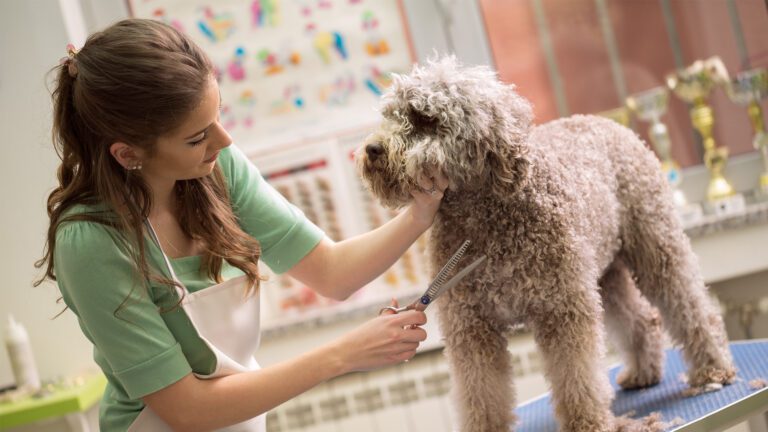
If you are wanting to reduce the shedding, you can reduce shedding by 40-60% by bathing, conditioning and deshedding the dog every 4-6 weeks. Professional groomers can be very helpful in this aspect, not to mention they are able to trim and buff nails at the same time.
If you feel your dog is extremely uncomfortable in the heat, it is important to remember that dogs don’t sweat to cool down like people do. They mainly cool down by panting, though some are able to sweat a little bit through the pads of their feet. Because of this, their coat is vital. The best strategy is to make sure you are able to run a comb through your dog’s coat, nose to tail weekly, removing packed and matted coat. If you were to remove the outer coat and parts of the undercoat, you create a situation where the dog is actually more vulnerable to heat stroke and sunburn. The healthy, unmatted coat under the top coat acts as insulation against extreme heat and helps the body temperature regulate itself. Keep your dog indoors or in shaded areas, and don’t leave it in the car on a sunny day. In some cases, a groomer can trim an “Air Conditioning” path from the dog’s armpits to groin with a “5F” or “2 comb” to allow the dog to cool down more efficiently on tile floors or air-conditioning vents. In this less visible area, most people don’t mind about the three caveats listed earlier.
There are rare cases, where a dog simply needs a shavedown for medical reasons or the owner’s lifestyle necessitates it. If this is your case, just discuss it with your groomer. What matters to most groomers is the health and comfort of your pet.