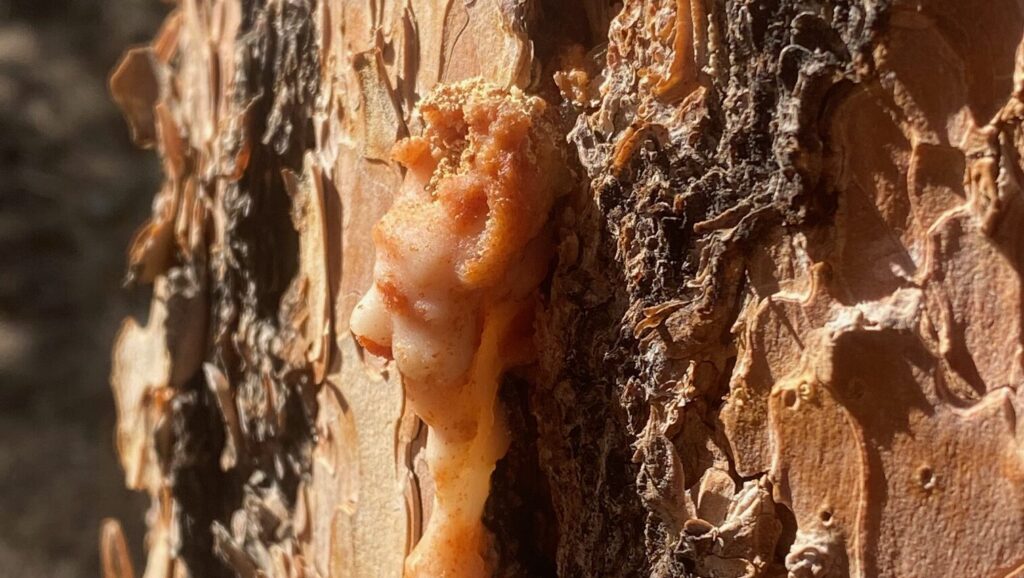
Rumor has it that due to our warm winter, pine beetles will emerge early this year and worse, undergo two cycles of the egg-laying process that kills our trees by the hundreds each year. As an I.S.A. Certified Arborist since 1999, I can assure you that it’s not true.
Beetle kill misinformation has been swirling around social media and if we’re going to save our trees, we need to combat it with facts. It’s important to know the real expectations for the beetle cycle this year, what treatments can save your trees and how to find a qualified arborist.
So, the warm winter isn’t going to give pine beetles a head start in killing our trees? No. The Colorado State Forest Service released a statement noting, “our Forest Health team has not recorded any evidence that beetles are currently emerging … Should beetles begin to emerge [early], it will likely only be by 1–2 weeks.” Last year, beetles were active from July through September.
This is reassuring. What’s also reassuring are your options for protecting your trees. My business, founded here in Evergreen in 1978, has dealt with these insects using proven treatments for preventing beetles: spraying, verbenone and injections.
Spraying has the longest track record of use and effectiveness. It’s the process of coating insecticides along the bark of trees. This protective barrier should be applied along the entire length of the tree until it tapers to six to eight inches in diameter. It’s vital to apply before late July.
Verbenone is a synthesized pheromone that tells the beetle not to attack the tree and is easily applied in small packets on a tree’s north side at six feet above the ground. The downside? Unlike spraying, verbenone begins to decrease in efficacy when the beetle population peaks. We encourage verbenone to be used as a secondary treatment alongside spraying or when there are obstacles to spraying, such as getting the right equipment to the trees.
Injections are the newest treatment and have two years of efficacy when applied during a period of high soil moisture. This option, however, does not have the same proven track record as spraying. It’s also much less cost-effective for homeowners with lots of pine trees and during droughts, when soil moisture has to be supplemented for the tree to uptake the chemical. It’s best used for high-value trees in areas too sensitive for spraying (i.e., near water).
Verify that any arborist you hire has the right credentials. They should be licensed by the Colorado Department of Agriculture and employed at a licensed company. Check for certified arborists at treesaregood.org and for businesses with the appropriate licensure on the Pesticide Applicator Search on the Colorado Department of Agriculture’s website.
Know the facts. Use the right preventative treatment for your trees. Make sure anyone you hire has the right credentials. This is how you do your part to protect our pine trees.
Any content, resident submissions, guest columns, advertisements, and advertorials are not necessarily endorsed by or represent the views of Best Version Media LLC (BVM) or any municipality, homeowners associations, businesses, or organizations that this publication serves. BVM is not responsible for the reliability, suitability, or timeliness of any content submitted, inclusive of materials generated or composed through artificial intelligence (AI). All content submitted is done so at the sole discretion of the submitting party.