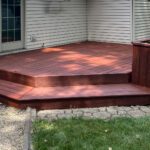
Summer is the perfect time to protect and refresh your deck, but choosing the right stain can have a major impact on both appearance and future maintenance. Before buying the first product you see, it’s important to understand how different stains perform over time.
First, weather conditions are just as important as product selection. Most stains perform best when temperatures are between 50°F and 90°F, humidity is moderate, and no rain is expected for at least 24 hours. Staining in direct sunlight or on hot deck boards can cause uneven penetration and lap marks, while high humidity can slow drying times.
The biggest decision is often between oil-based and water-based stains. Oil-based stains penetrate deeply into the wood and typically fade over time. While the color may lighten over time, they are usually easier to maintain because a new coat can often be applied after cleaning and light preparation. Water-based stains generally retain their color longer and dry faster, but they tend to form more of a film on the wood’s surface. As they age, they can peel or flake if moisture becomes trapped beneath the coating.
This becomes especially important when it’s time to change products. If a water-based stain begins peeling, extensive sanding or stripping may be required before refinishing. That additional labor can significantly increase the cost of restoration. Oil-based stains are generally more forgiving when maintenance coats are applied before the stain completely fails.
Opacity also affects maintenance. Transparent stains showcase the natural beauty of the wood but provide the least UV protection and typically require the most frequent reapplication. Semi-transparent stains remain the most popular option because they balance wood visibility with improved protection. Semi-solid stains offer more color consistency and longer life while still allowing some grain to show through. Solid stains provide the most coverage and UV protection but can eventually peel if the coating loses adhesion, making future maintenance more involved.
The best stain isn’t always the darkest or most expensive—it’s the one that matches your deck’s condition, your maintenance expectations, and your long-term goals. Understanding these differences before staining can save significant time and money in the years ahead.
Justin Stecz . That 1 Painter Michiana . 219 N. Dixie Way Suite 205, Roseland, IN
(239) 297 1415 . justin.stecz@that1painter.com . that1painter.com
Any content, resident submissions, guest columns, advertisements, and advertorials are not necessarily endorsed by or represent the views of Best Version Media LLC (BVM) or any municipality, homeowners associations, businesses, or organizations that this publication serves. BVM is not responsible for the reliability, suitability, or timeliness of any content submitted, inclusive of materials generated or composed through artificial intelligence (AI). All content submitted is done so at the sole discretion of the submitting party.