The Big Picture
Milton Montessori thrives under the leadership of dedicated educators who truly embody the Montessori philosophy. I am honored to serve as the Educational Coordinator, working alongside an exceptional team that includes Blanca Rincon, our lead teacher in one of the Toddler classrooms at the Bethany Bend Campus, and Mrs. Joni Linch, who leads one of our Primary classrooms at the Kelly Mill campus. Each member of our team brings unique personal experiences, deep expertise, and a profound passion for Montessori education.
Blanca Rincon, originally from Spain, holds an infant and toddler American Montessori Society (AMS) certificate and began her Montessori journey over a decade ago. Her search for a non-traditional educational path for her daughter led her to discover Montessori’s focus on independence—not just as an educational method, but as a way of life.
Joni Linch (known affectionately as Mrs. Linch to her students) discovered Montessori by chance during her student teaching. She was instantly captivated by the hands-on learning style and beautifully designed materials, prompting her to pursue Association Montessori Internationale (AMI) training. Her commitment to Montessori philosophy spans various impactful roles, from school administration to primary education.
We firmly believe that the core mission of the Montessori method is to support the development of the “whole child.” Our principles focus on self-directed learning within a thoughtfully prepared environment, ensuring a seamless continuity across age groups through a shared philosophy and cohesive curriculum.
Setting the Foundation: The Infant/Toddler Classroom
In our youngest classrooms, Montessori principles may surprise those who are new to seeing them applied to children under the age of three. The environment is meticulously tailored for toddlers, featuring low, accessible shelves and a strong focus on practical life skills such as pouring and self-dressing. Here, children benefit from unrestricted movement, entirely free from the confines of high chairs or playpens.
Navigating toddler emotions requires a patient, deeply understanding approach. Our teachers validate feelings, offer limited but empowering choices, set firm yet gentle boundaries, and treat toddlers as capable communicators. This respectful approach helps children develop emotional self-regulation and learn to effectively express their needs.
The Next Step: The Primary Classroom
As children transition into the Primary classroom, they enter to amulti-age setting where three-to-six-year-olds learn alongside one another. This mixed-age dynamic creates a beautiful community workflow: older students reinforce their own knowledge by mentoring younger peers, while the younger children gain inspiration and motivation by observing more advanced tasks.
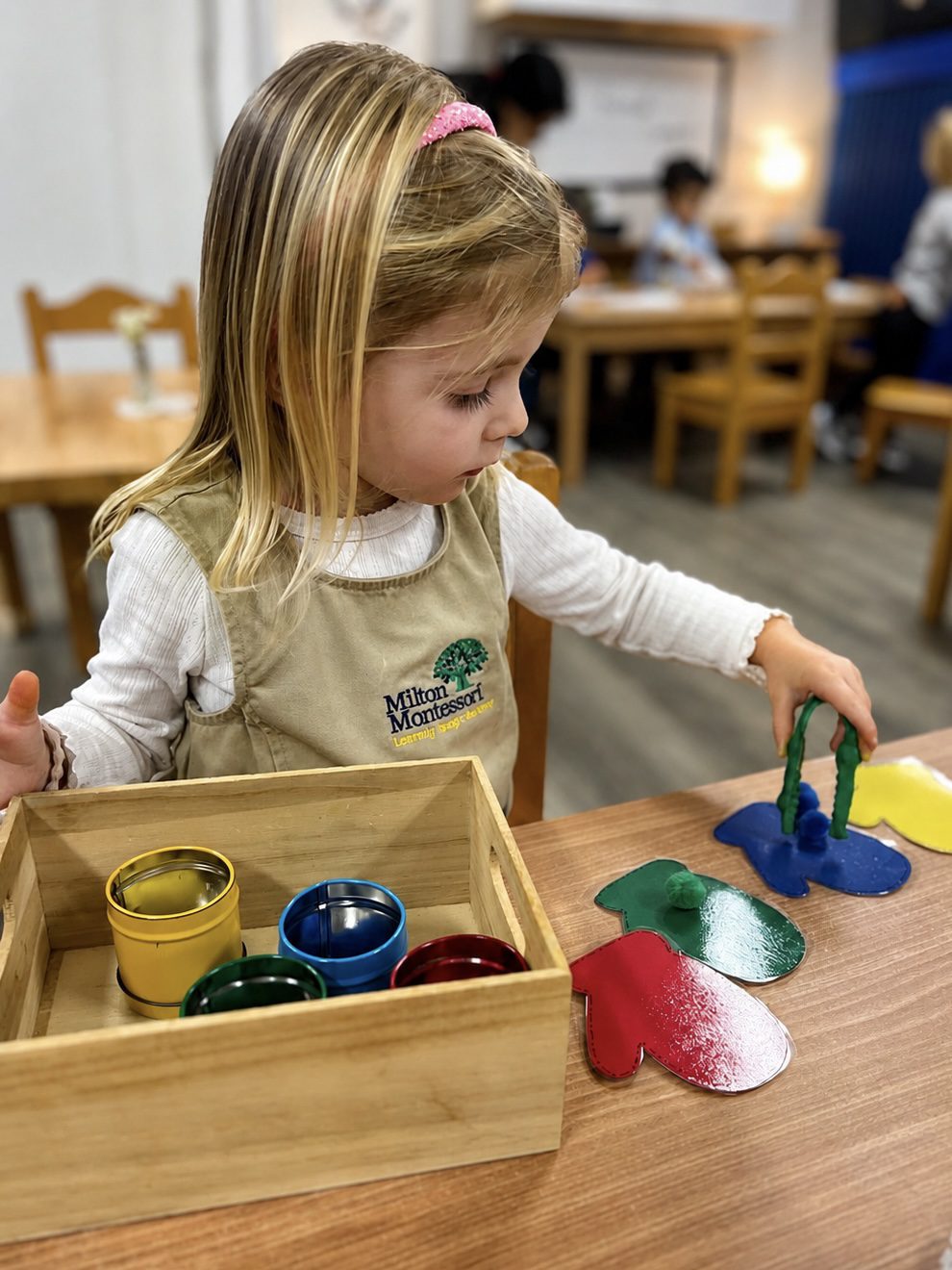
Primary classrooms introduce complex concepts like mathematics and literacy through tactile, hands-on materials. For example, the iconic Montessori math beads and sensorial materials allow children to physically hold and manipulate abstract concepts, making learning deeply engaging, tangible, and joyful.
Collaborative Care and The Home Connection
The transition from the Infant/Toddler room to the Primary classroom is seamless, ensuring children feel confident and secure in their new surroundings. Behind the scenes, our educators collaborate extensively to assess readiness, ease transition anxiety, and gently prepare children for the next level. We encourage parents to weave Montessori principles into their daily home life. Simple adjustments, such as setting up accessible snack stations, arranging toys neatly on low shelves, and actively involving children in age-appropriate household chores—can effortlessly extend the Montessori magic beyond our school walls.
Future Preparation and Academic Success
As children complete their Primary years, parents often wonder how they will adapt to traditional elementary schools. The Montessori foundation equips children with robust problem-solving skills, high adaptability, and intrinsic self-motivation. Our students excel in future academic environments because they have learned how to learn, rather than just what to memorize. In lieu of traditional testing, Montessori classrooms assess progress through rigorous, detailed teacher observations and meticulous tracking of material mastery. This individualized approach ensures that no child is left behind or held back, beautifully celebrating each student’s unique educational journey.
Next Steps and How to Connect
For parents who want to learn more about Milton Montessori’s approach. We invite them to schedule a tour to observe our classrooms firsthand and gain true insight into our daily practices.
Families ready to embrace the Montessori method will find comprehensive enrollment information on our website at miltonmontessori.org. Our online portal includes application forms, and direct contact details for the admissions office. Milton Montessori is ready to welcome your family into a community deeply dedicated to raising joyful, independent learners.
Any content, resident submissions, guest columns, advertisements, and advertorials are not necessarily endorsed by or represent the views of Best Version Media LLC (BVM) or any municipality, homeowners associations, businesses, or organizations that this publication serves. BVM is not responsible for the reliability, suitability, or timeliness of any content submitted, inclusive of materials generated or composed through artificial intelligence (AI). All content submitted is done so at the sole discretion of the submitting party.