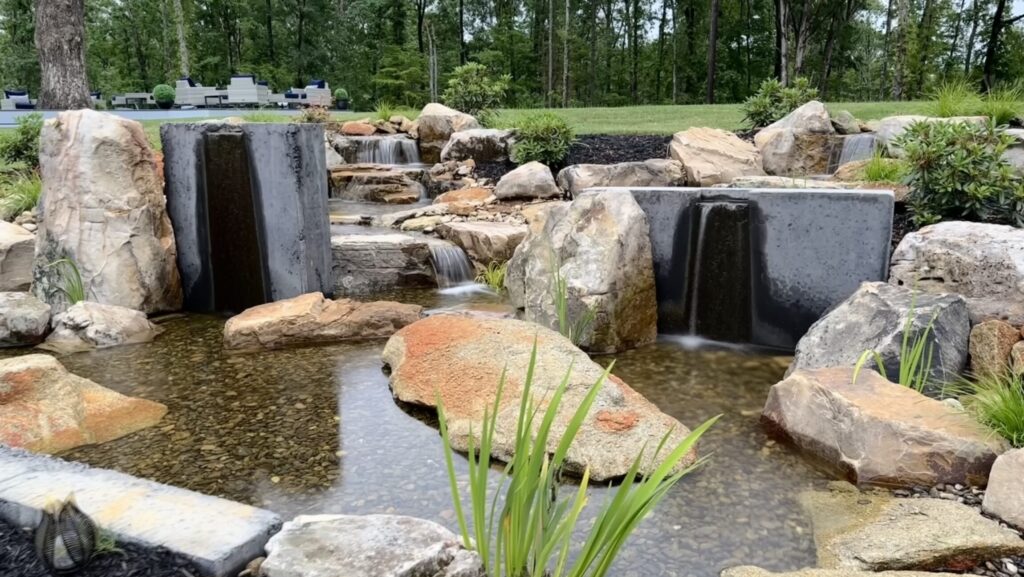
Most people think of a backyard pond as something beautiful to look at. And it is. But a well-built, well-planted pond is doing something much bigger: it is creating a living system, a small working piece of nature, right outside your back door.
Here in Western North Carolina, we are surrounded by some of the richest natural ecosystems in the Eastern United States. When you add a thoughtfully designed pond to your property, you are not just adding a decoration. You are adding a habitat.
What Makes a Pond an Ecosystem?
A true ecosystem pond is not a container of water with fish in it. It is a balanced, self-sustaining community of living things: fish, plants, beneficial bacteria, insects, frogs, birds, and the microscopic organisms that make the whole system work.
The key is biological filtration. Water flows through a bog filter, a chamber packed with gravel and plant roots, where colonies of beneficial bacteria break down fish waste and organic material before the water recirculates. This is exactly how a healthy stream cleans itself. The bacteria do the work. The plants assist. The fish play their role. You get crystal-clear water without a single chemical treatment.
When that balance is right, the pond essentially runs itself. We have clients who have maintained clear, healthy water for years on nothing more than a weekly bacteria dose and an annual professional cleanout. Build it correctly, plant it thoughtfully, and let biology do its job.
Plants: Function First, Beauty Second
Aquatic plants are working members of the ecosystem. Their root systems absorb excess nutrients from the water, starving algae of what it needs to grow. Their leaves shade the surface, keeping temperatures cooler. And they provide shelter and habitat for fish, frogs, dragonflies, and beneficial insects.
In a full-sun pond, aim for 60 to 75 percent of the water surface covered by plants. Water lilies do most of the heavy lifting, their broad pads shading the water and blooming from late spring through early fall. At the edges, cardinal flower, water iris, sweet flag, and horsetail reed create the transition from water to land while attracting hummingbirds, butterflies, and native pollinators. Your pond edge becomes a wildlife corridor.
A well-planted water feature connects your property to the living world outside the fence line.
Why This Region Is Uniquely Suited
Western North Carolina sits in one of the most biodiverse temperate regions in the world. When you add a planted pond to a property in Asheville, Hendersonville, or the surrounding mountains, you are not introducing something foreign to the landscape. You are extending it.
Fireflies hover over a pond on summer evenings. Frogs arrive within weeks of filling. Herons and hawks treat it as hunting ground. Native bees visit the marginal plantings. One of our clients described it simply: before the pond, she had a nice yard. After, it felt like it belonged to something bigger. That is exactly right.
The Koi Connection
Koi are active participants in a healthy ecosystem pond. They graze on algae and debris at the pond floor, contributing to the biological balance. Over time, they develop individual personalities, learn their owners, and will eventually eat from your hand. People often describe the relationship as something they did not expect: a genuine connection with a living creature that has become part of their daily rhythm.
A Feature That Keeps Improving
A properly planted pond does not peak on the day it is finished. It improves every season. Plants fill in. Fish grow. The surrounding planting develops canopy and structure. By year three, it looks like it has always been there, because in every meaningful way, it has.
If you have been thinking about adding a water feature to your property in the Asheville or Hendersonville area, we would love to talk through what an ecosystem pond could look like on your specific site. Spring is our busiest season, and our schedule fills early.
Any content, resident submissions, guest columns, advertisements, and advertorials are not necessarily endorsed by or represent the views of Best Version Media LLC (BVM) or any municipality, homeowners associations, businesses, or organizations that this publication serves. BVM is not responsible for the reliability, suitability, or timeliness of any content submitted, inclusive of materials generated or composed through artificial intelligence (AI). All content submitted is done so at the sole discretion of the submitting party.