
Have you ever thought about all the things your body effectively does without you having to think about it?
Your heart beats approximately 60 times per minute without you consciously guiding it. Your blood vessels contract and relax to maintain approximately 120/80 mmHg of pressure within the vessel without you thinking about it. Your postural muscles hold enough tone to keep you upright without your constant attention. And these all fluctuate based on the demands of your body moment to moment. Your autonomic nervous system (ANS) is what guides these systems.
The pathways that these messages travel are not part of our conscious (frontal brain) nervous system (thought), but originate from lower down, in our hindbrain (brainstem) or in plexuses within the spinal cord. They then travel through peripheral nerves to every muscle, organ, and cell in your body. The divisions within the (ANS) are termed the sympathetic nervous system (SNS) and parasympathetic nervous system (PNS). SNS is often referenced as fight or flight and is thought of as the gas pedal of the ANS. It is what is activated to help you run away from a bear. Messages from here originate in the sympathetic plexus along your thoracic (midback) spine. Your PNS is often called your rest and digest (and heal) division and is activated when you are digesting a meal or sleeping. The PNS messages to most of the body travel along the vagus nerve or originate in the sacral plexus at the base of the spine.
If something is terribly wrong with these systems, you would likely end up at a neurologist’s office. When your dysfunction is not serious enough to go to your medical doctor, there are practitioners who can help.
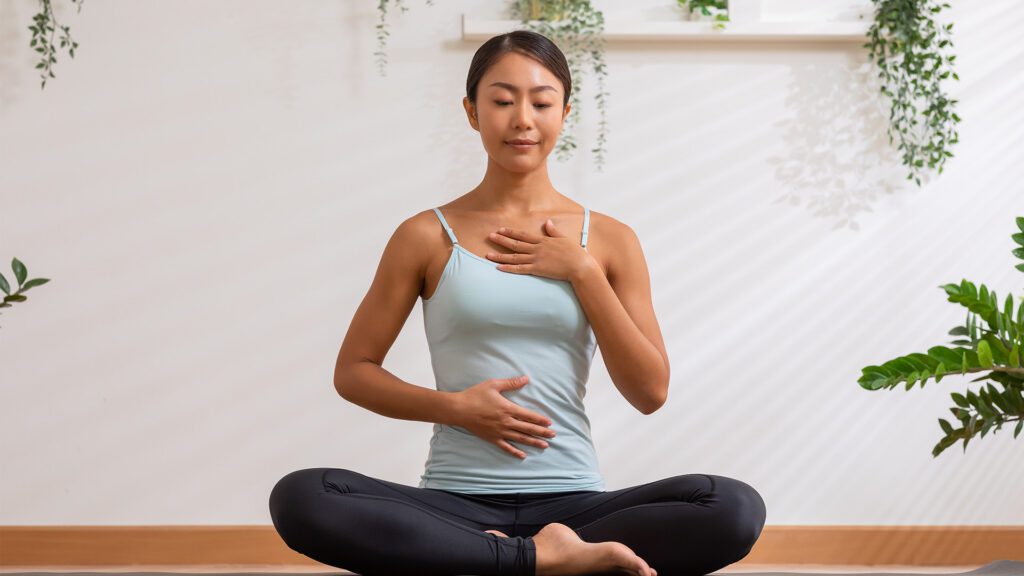
The philosophy of nervous system-mediated care as done by chiropractors, craniosacral therapists, and osteopaths, is that the tone of the nervous system (how much PNS vs SNS) can be altered through manual modalities or adjustments directed to the spine or skull. They can also teach you things you can do at home to practice nervous system regulation, such as breath-work or contrast (hot/cold) therapy. If you were able to improve the function of the system that controls everything, what areas of your life would improve?
Muscle meditation nervous system exercise
Grab a firm ball (tennis or lacrosse balls work great) and a space on the floor. Lie on your belly and put the ball in the meaty part of your thigh, roll around until you find a tender or tight spot. Once you find it, stay there and focus on taking long, slow breaths, visualizing the muscle softening around the ball with each exhale, and relax your jaw. Quads are a “fight or flee” muscle; they help you run away from a stressful encounter. By putting pressure on them, you are creating a sympathetic stimulus (pain), but by slowing your breathing, you are overriding with the parasympathetic system – telling your body there is no danger and you can relax. Over time, this practice can help change how your body holds tension and reacts to stress. You can use it on any muscle you hold chronic tension in – calves and upper traps are often good contenders.
Any content, resident submissions, guest columns, advertisements, and advertorials are not necessarily endorsed by or represent the views of Best Version Media LLC (BVM) or any municipality, homeowners associations, businesses, or organizations that this publication serves. BVM is not responsible for the reliability, suitability, or timeliness of any content submitted, inclusive of materials generated or composed through artificial intelligence (AI). All content submitted is done so at the sole discretion of the submitting party.