
Over the years, I’ve dedicated much of my career to understanding weight management and the complexities surrounding long-term weight loss. Maintaining weight loss is a significant challenge and sustainability requires getting to the root cause. One of the most common, yet harmful, practices many people fall into is weight cycling, also known as “yo-yo” dieting. This pattern of repeatedly losing and regaining weight has been shown to be more harmful than consistently carrying excess weight.[1]
GLP-1 agonists (e.g., drugs like Ozempic) have been hailed as a potential solution to obesity but, while effective for some, they don’t always address the root cause of the issue. Increasing evidence suggests that weight loss plateaus after about one year on the medication[2] and, if discontinued, weight regain is common.[3],[4] More so, up to 40% of weight loss on these medications is in the form of lean mass, not fat.[5] To make things worse, if weight is regained it tends to be disproportionately fat.[6] If you are significantly overweight and/or have struggled with your weight your entire life, GLP-1 agonists may be a worthwhile consideration; but if instead you have started gaining weight midlife, other factors may be at play.
Hormone balance is crucial. Testosterone specifically helps regulate muscle mass and fat distribution, playing a central role in body composition for both men and women. Testosterone levels decline midlife, (among other hormones for women), contributing to that middle-aged weight gain many people experience. Testosterone therapy can be an effective solution for sustainable weight loss, but perhaps even more importantly, improved body composition.
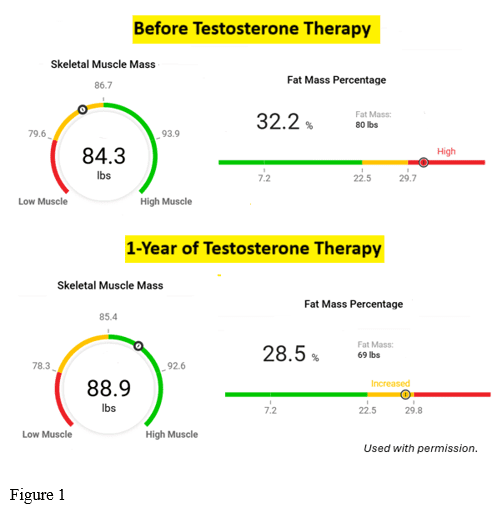
Anecdotally, in my practice, testosterone therapy generally results in simultaneous fat loss and muscle gain even without significant diet or exercise changes (see Figure 1), with further improvements occurring when combined with such lifestyle modifications. This contrasts with typical weight loss, which generally involves the concession of muscle mass. Such changes may be overlooked when relying solely on weight measurements, as composition can shift significantly while maintaining the same body weight. This is where body composition analysis becomes especially valuable and why we have made it an essential component to our program’s model. But don’t just take my word for it, there was a study done on older men in which participants gained almost 10 pounds of lean mass (muscle) and lost almost 10 pounds of fat mass over a three-year period on testosterone therapy. This means that they were essentially the same weight but had undergone remarkable improvements in body composition, particularly impressive given the challenge of building muscle with age.[7] All this to say that when we talk about “weight loss” what we are often getting at is “fat loss.” Body composition is a key driver of health and should be a primary factor in decision-making. Trading fat for muscle is an excellent strategy and may just be the metabolic key to maintaining a healthy weight long-term.
Submitted photo
Regardless of the method, healthy lifestyle modifications must be at the heart of any sustainable weight loss intervention. But when those alone are not enough, various solutions are available to help. Remember that the right approach may differ from person to person and sometimes the most effective method involves multiple components. If you are considering using medications, hormones, or another therapy to assist in weight loss, take the time to find a provider who will work with you to develop a plan suited to your individual needs. And remember, whatever the solution, the ultimate goal is to break the cycle.
[1] Wang H, He W, Yang G, Zhu L, Liu X. (2004). The Impact of Weight Cycling on Health and Obesity. Metabolites, 14 (6), 344. doi: 10.3390/metabo14060344. PMID: 38921478; PMCID: PMC11205792.
[2] Nordisk, N. (2024). Wegovy Package Insert. Novo Nordisk. https://www.novo-pi.com/wegovy.pdf
[3] Wilding, J. P. H., Batterham, R. L., Davies, M., Van Gaal, L. F., Kandler, K., Konakli, K., Lingvay, I., McGowan, B. M., Oral, T. K., Rosenstock, J., Wadden, T. A., Wharton, S., Yokote, K., Kushner, R. F., & STEP 1 Study Group (2022). Weight regain and cardiometabolic effects after withdrawal of semaglutide: The STEP 1 trial extension. Diabetes, obesity & metabolism, 24(8), 1553–1564. https://doi.org/10.1111/dom.14725
[4] Rubino, D., Abrahamsson, N., Davies, M., Hesse, D., Greenway, F. L., Jensen, C., Lingvay, I., Mosenzon, O., Rosenstock, J., Rubio, M. A., Rudofsky, G., Tadayon, S., Wadden, T. A., Dicker, D., & STEP 4 Investigators (2021). Effect of Continued Weekly Subcutaneous Semaglutide vs Placebo on Weight Loss Maintenance in Adults With Overweight or Obesity: The STEP 4 Randomized Clinical Trial. JAMA, 325(14), 1414–1425. https://doi.org/10.1001/jama.2021.3224
[5] Bikou, A., Dermiki-Gkana, F., Penteris, M., Constantinides, T. K., & Kontogiorgis, C. (2024). A systematic review of the effect of semaglutide on lean mass: insights from clinical trials. Expert opinion on pharmacotherapy, 25(5), 611–619. https://doi.org/10.1080/14656566.2024.2343092
[6] Wang H, He W, Yang G, Zhu L, Liu X. (2004). The Impact of Weight Cycling on Health and Obesity. Metabolites, 14 (6), 344. doi: 10.3390/metabo14060344. PMID: 38921478; PMCID: PMC11205792
[7] Page, S.T., Amory, J.K., Bowman, F.D., Anawalt, B.D., Matsumoto, A.M., Bremner, W.J., Tenover, J.T. (2005). Exogenous Testosterone (T) Alone or with Finasteride Increases Physical Performance, Grip Strength, and Lean Body Mass in Older Men with Low Serum T, The Journal of Clinical Endocrinology & Metabolism, 90 (3), 1502–1510. https://doi.org/10.1210/jc.2004-1933
Any content, resident submissions, guest columns, advertisements, and advertorials are not necessarily endorsed by or represent the views of Best Version Media LLC (BVM) or any municipality, homeowners associations, businesses, or organizations that this publication serves. BVM is not responsible for the reliability, suitability, or timeliness of any content submitted, inclusive of materials generated or composed through artificial intelligence (AI). All content submitted is done so at the sole discretion of the submitting party.