

My favourite investing movie is Margin Call. The film is set during the Global Financial Crisis of 2008 and 2009. In one of its most memorable scenes, Jeremy Irons’ character, the CEO of a major Wall Street firm, reflects on centuries of financial booms and busts as a crisis unfolds. His conclusion is simple: “It’s all just the same thing over and over; we can’t help ourselves.”
The message is that while markets evolve and new themes emerge, investor behaviour remains remarkably consistent. Each cycle is shaped by the same forces—greed, fear, optimism, and speculation. Expectations build, reality eventually intervenes, and the cycle repeats.
This dynamic is especially relevant when thinking about today’s artificial intelligence (AI) powered market. In this fast money market environment, few questions are being asked about the prices being paid, and Fear of Missing Out (FOMO) is the biggest issue on many investors’ minds. However, the more important issue that should be on investors’ minds is why the average investor fails to achieve a reasonable rate of return or expected return based on their risk level.
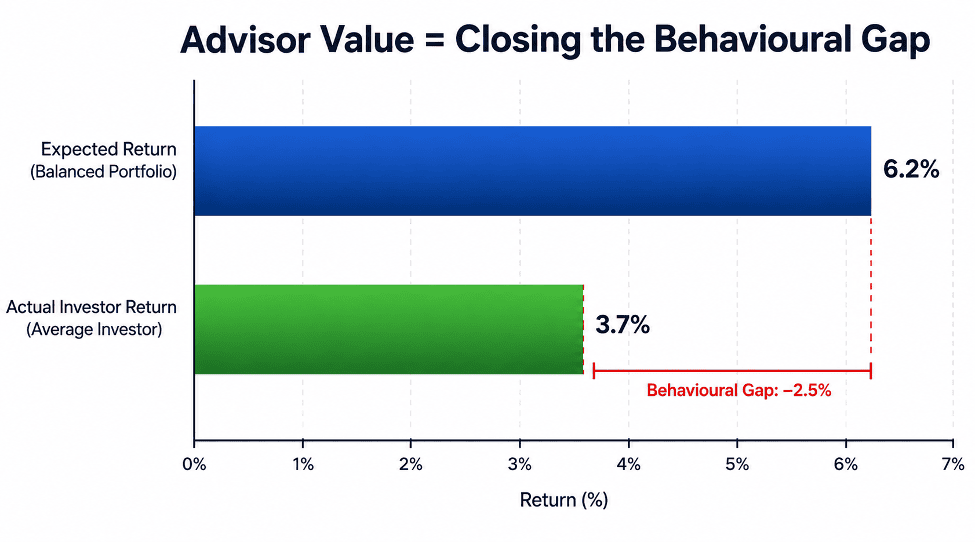
An expected return is what a diversified portfolio is designed to deliver over time, based on its underlying risk level and market fundamentals. For example, a balanced portfolio carries approximately 50 percent equities and 50 percent fixed income. A balanced portfolio’s expected return reflects the long-term compensation investors should reasonably anticipate for taking that level of risk, today say, five to six percent per year on average.
However, the returns that investors actually experience are often different.
The difference between the expected return and the investor’s actual return, is known as the “behavioural gap” and is cited in research from investment firms such as Morningstar, Dalbar, Fidelity and Vanguard. This behavioural gap impacts client returns by approximately 2.5 per year, according to research from the above referenced firms.
The behavioural gap is a result of investors making timing decisions that work against long-term outcomes—adding money after strong performance, reducing exposure during periods of volatility, or shifting strategies in response to short-term uncertainty. Over time, these decisions create a gap between what the portfolio delivers and what the investor actually earns.
It is here that the value of a seasoned investment advisor becomes most valuable to a client. While portfolio construction focuses on achieving an appropriate expected return for a given level of risk, an advisor’s value extends further: it is about helping investors actually realize that return in practice.
In other words, the advisor plays a critical role in closing the gap between expected and actual returns.
(**The chart below is an example based on industry research, in particular Morningstar’s annual Mind the Gap studies**)
(Submitted by Adam McHenry)
Ultimately, successful investing is not just about constructing a portfolio with strong potential returns. It is about ensuring that investors achieve those returns in reality. It is here that the true value of advice lies in closing that gap—bridging expectations and reality, so that long-term plans translate into long-term outcomes.
If you would like help closing your portfolio’s behavioural gap, please contact me and my team at 416-901-6500 or adam.mchenry@raymondjames.ca, or visit www.adammchenry.com.
**Disclaimers: Information in this article is from sources believed to be reliable; however, we cannot represent that it is accurate or complete. It is provided as a general source of information and should not be considered personal investment advice or solicitation to buy or sell securities. The views are those of the author, Adam McHenry, CFA, MBA, and not necessarily those of Raymond James Ltd. Investors considering any investment should consult with their Investment Advisor to ensure that it is suitable for the investor’s circumstances and risk tolerance before making any investment decision. Raymond James Ltd. is a Member Canadian Investor Protection Fund.
Any content, resident submissions, guest columns, advertisements, and advertorials are not necessarily endorsed by or represent the views of Best Version Media LLC (BVM) or any municipality, homeowners associations, businesses, or organizations that this publication serves. BVM is not responsible for the reliability, suitability, or timeliness of any content submitted, inclusive of materials generated or composed through artificial intelligence (AI). All content submitted is done so at the sole discretion of the submitting party.