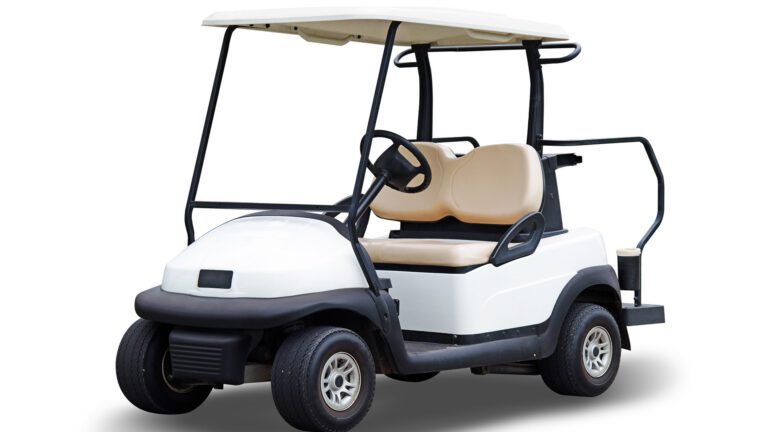
As golf cart communities continue to grow across Virginia, many residents and homeowners associations are asking an important question: What’s the difference between a golf cart and a Low-Speed Vehicle (LSV)?
While the two may look similar at first glance, Virginia law treats them very differently. Understanding those differences can help homeowners, community leaders, and drivers make informed decisions about safety, compliance, and neighborhood transportation.
A traditional golf cart is considered an unregistered recreational vehicle. It is not registered with the Virginia Department of Motor Vehicles, does not have a license plate, and is not required to carry insurance. Golf carts are also not built to federal motor vehicle safety standards. Because of this, golf carts are generally prohibited on public roads unless a local government specifically passes an ordinance allowing their use.
An LSV, on the other hand, is legally classified as a motor vehicle. Low-Speed Vehicles are registered with the Virginia DMV, carry Virginia license plates, have a 17-digit Vehicle Identification Number (VIN), and require insurance coverage. They must also meet Federal Motor Vehicle Safety Standard 500, which includes safety features such as headlights, taillights, turn signals, mirrors, seat belts, and windshields.
One of the biggest differences is where they can be driven. Under Virginia law, properly registered LSVs may be operated on public roads with speed limits of 35 miles per hour or less. No special local ordinance is required. Drivers must also possess a valid driver’s license.
These distinctions are becoming increasingly important for homeowners associations throughout the state. Many communities have restrictions regarding golf carts, but those restrictions may not automatically apply to registered LSVs.
In fact, many upscale neighborhoods, resort communities, and planned developments across Virginia have chosen to prohibit unregistered golf carts while allowing registered LSVs. The reason is simple: accountability and safety.
Because LSVs are registered with the DMV, ownership is documented and vehicles can be identified through license plates. Insurance coverage provides an additional layer of protection, while federal safety standards help ensure that the vehicles are equipped for roadway use.
For HOA boards and residents, this creates an opportunity to balance convenience with responsibility. Communities can maintain safety standards while still allowing residents to enjoy alternative transportation options for neighborhood travel.
If your community currently has rules regarding golf carts, it may be worth reviewing the language with an HOA attorney. Questions to consider include whether existing restrictions apply to registered motor vehicles, whether LSVs are specifically addressed, and whether clarification would benefit residents.
As neighborhoods continue to embrace golf cart-style transportation, understanding the legal differences between golf carts and Low-Speed Vehicles can help avoid confusion and ensure compliance with Virginia law.
The bottom line is simple: while golf carts and LSVs may appear similar, they are not the same under Virginia law. Registered, insured, and built to federal safety standards, LSVs offer residents a practical transportation option while providing the accountability and protections that many communities value.
Any content, resident submissions, guest columns, advertisements, and advertorials are not necessarily endorsed by or represent the views of Best Version Media LLC (BVM) or any municipality, homeowners associations, businesses, or organizations that this publication serves. BVM is not responsible for the reliability, suitability, or timeliness of any content submitted, inclusive of materials generated or composed through artificial intelligence (AI). All content submitted is done so at the sole discretion of the submitting party.