If you’ve ever opened a box of cigars only to find them dry, cracked, and harsh-tasting, you’ve experienced firsthand why humidors exist. A cigar humidor isn’t just a fancy box — it’s essential equipment for anyone who wants to enjoy premium cigars the way they were meant to be smoked. Here’s what you need to know.
What Is a Cigar Humidor?
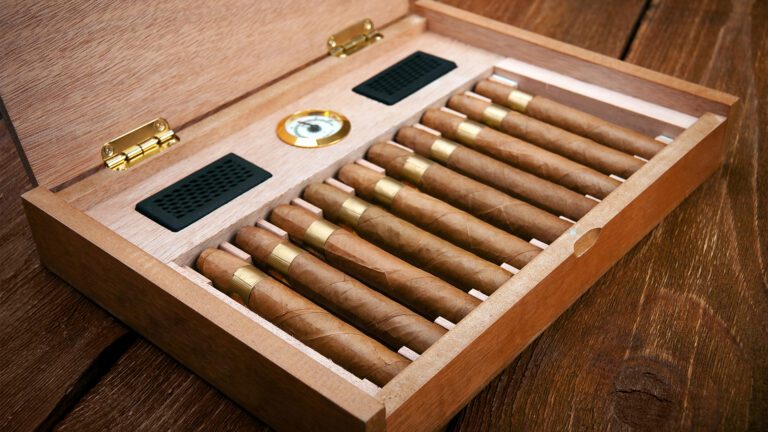
A humidor is a specially designed storage container built to maintain a consistent level of humidity and temperature for cigars. Humidors come in many forms, from small desktop boxes holding a dozen cigars to large furniture-style cabinets and even entire walk-in rooms used by retailers and serious collectors.
Despite the variety in size and style, almost every humidor shares the same core components: an airtight (or near-airtight) seal, an interior lined with Spanish cedar, and some method of introducing and regulating moisture, typically a humidification device.
What Does a Humidor Actually Do?
Premium cigars are made from tobacco leaves that need to stay within a narrow moisture range to burn and taste correctly. Too dry, and the cigar burns hot, fast, and harsh, with the wrapper prone to cracking or flaking apart. Too humid, and the cigar burns unevenly, tastes muted, and becomes a breeding ground for tobacco beetles or mold.
A humidor’s job is to hold cigars at roughly 65-72% relative humidity and around 65-70°F, the range widely considered ideal for aging and preserving tobacco. The Spanish cedar lining helps here too. It absorbs and releases moisture gradually, acting as a buffer against fluctuations, while also imparting a subtle aroma that many enthusiasts believe enhances the smoking experience over time.
Why Humidors Matter
Cigars are a living, organic product. Premium cigars are often meant to be aged, sometimes for months or years, to let the tobacco mellow and flavors develop. Without proper humidity control, that aging process doesn’t happen correctly, and the cigar’s structural integrity breaks down.
There’s also a financial angle. Premium cigars aren’t cheap, and a poorly stored collection can be ruined in a matter of weeks. For anyone who buys cigars by the box or maintains a rotating collection, a humidor is protection for that investment, not just a nice-to-have accessory.
Beyond preservation, a good humidor also makes cigars more enjoyable to smoke. A cigar at proper humidity draws smoothly, burns evenly, and delivers the full range of flavor the blender intended. A dried-out cigar simply can’t do that, no matter how well it was originally made.
Key Components to Understand
Seal and construction. The tightness of the seal determines how much work the humidification system must do. A well-built humidor with a warped lid or a poor seal will struggle to maintain humidity, no matter how good its internal components are.
Spanish cedar lining. This wood is used almost universally in humidor construction because of its moisture-regulating properties and natural resistance to tobacco beetles. It also needs occasional “seasoning” (more on that below).
Humidification system. This can range from simple foam- or gel-based humidifiers to more advanced two-way humidity-control packets (like Boveda packs) that both add and remove moisture to maintain a precise target level.
Hygrometer. A device that measures relative humidity inside the box. Hygrometers are often included or added separately to monitor humidity levels accurately.
Digital versions are generally more accurate than the analog dial versions that come standard in many entry-level humidors.
How to Use and Maintain a Humidor
1. Season it before first use. New humidors, especially wooden ones, need to be seasoned so the cedar lining can absorb enough moisture to start doing its job. This typically involves wiping down the interior with distilled water or using a humidification solution, then letting the box sit closed for a day or two before adding cigars.
2. Use distilled water only. Tap water contains minerals and chemicals that can promote mold growth or damage the wood. Distilled water avoids that risk entirely.
3. Monitor humidity regularly. Check the hygrometer every few days when starting out, and periodically after that. Aim for the 65-72% range, adjusting your humidification solution or refilling humidifiers as needed.
4. Don’t overpack it. Airflow matters. Packing a humidor too tightly with cigars can prevent even humidity distribution and make it harder for the interior climate to stay consistent.
5. Rotate your cigars. Periodically rotate cigars within the humidor, especially in larger units, since humidity levels can vary slightly from top to bottom or corner to corner.
6. Keep it in a stable environment. Avoid placing a humidor near windows, vents, or anywhere with direct sunlight or temperature swings. Consistency in the surrounding room helps the humidor do its job with less effort.
7. Address problems quickly. If you notice a sweet, musty smell or white spots on your cigars, this could indicate mold, and affected cigars may need to be discarded. Conversely, dry, brittle wrappers mean it’s time to re-season and rehydrate.
A humidor is less about luxury and more about basic care for a product that’s sensitive to its environment. Whether you keep a handful of cigars for occasional enjoyment or maintain a collection meant to age for years, the principle is the same: consistent humidity and temperature preserve both the quality and the value of what’s inside. Learning to season, monitor, and maintain a humidor properly is a small investment of time that pays off every time you light up.
Any content, resident submissions, guest columns, advertisements, and advertorials are not necessarily endorsed by or represent the views of Best Version Media LLC (BVM) or any municipality, homeowners associations, businesses, or organizations that this publication serves. BVM is not responsible for the reliability, suitability, or timeliness of any content submitted, inclusive of materials generated or composed through artificial intelligence (AI). All content submitted is done so at the sole discretion of the submitting party.