
Have you ever snapped at your partner or child over something small, frozen up when called upon in a class or conference room, or feel instantly calm the moment a good friend walks in the room? That’s your nervous system in action.
One of my favorite theories as a psychotherapist is Polyvagal Theory, developed by neuroscientist Dr. Stephen Porges. His theory offers a simple but powerful idea: your body is constantly scanning for safety or danger, and it shifts your entire state — mood, energy, even digestion — based on what it detects. It happens below conscious awareness, faster than thought.
Your Nervous System Has a Mind of Its Own — Here’s Why That Matters
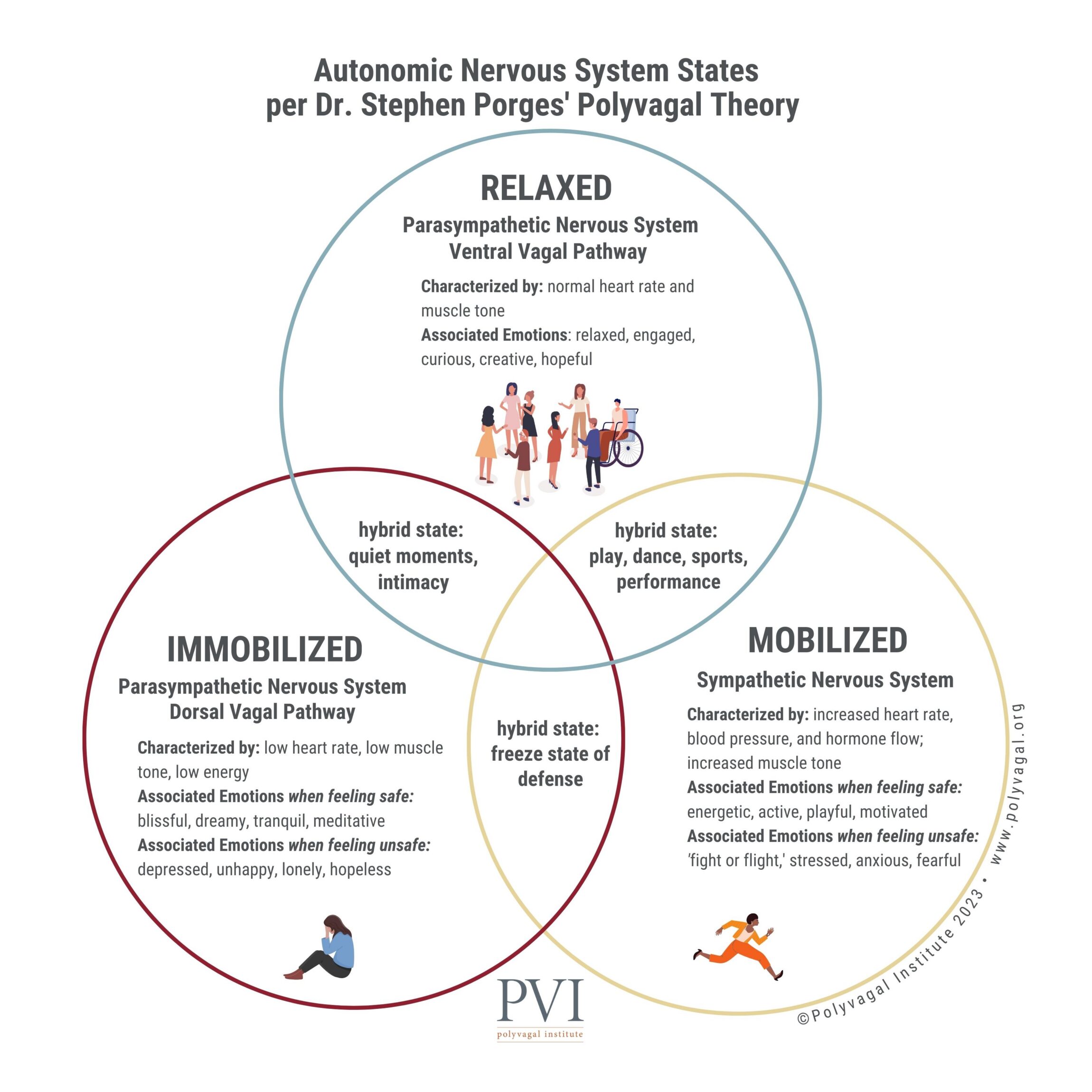
(Provided by New Approach Mental Health)
Your body moves through three modes.
- Social engagement — You feel calm, connected, and present. Conversation flows easily. You can think clearly and handle stress with flexibility. Your frontal cortex, the part of your brain that makes decisions and plans, is “online”.
- Mobilization — Your body revs up for action. Heart rate climbs, muscles tense. Digestion pauses. This is your fight-or-flight gear, useful in real emergencies – exhausting when it runs nonstop. Your frontal cortex goes “offline”. Ever wonder why you don’t remember what was said when you were angry/anxious/afraid?
- Immobilization/collapse — You shut down. Energy drops, you feel numb or disconnected. This is your body’s last-resort protection mode. Think of the opossum playing dead.
These aren’t separate switches — they blend throughout your day, creating the full range of how you feel and behave.
Why does this matter? The state of your nervous system shapes your story. When your nervous system feels safe, you’re more patient, creative, and open. When it detects threat — even a rude email or a tense silence — your body shifts gears before your mind catches up. You’re not choosing to be reactive. Your biology got there first.
So, are we prisoners of our own nervous systems? No. Here’s what you can do:
Notice your state without judgment. Feeling shut down or amped up is something to notice — it’s information. Name it: “I’m in mobilization mode right now.” Or “I am feeling scared right now”.
Use your senses. Slow exhales, humming, gentle stretching, or cool water on your face can signal safety to your nervous system. My personal favorite is four-square breathing because I can be in an amped up state, the rhythm of the breath starts fast, it eventually slows, and I feel calmer.
To do it: Inhale for four counts, hold your breath for 4 counts, exhale for four counts, hold your breath for four counts, repeat as long as necessary.
Seek connection. Even brief, positive interactions — a chat with a neighbor, laughing with a coworker — help your body find its calm gear.
Move your body. I don’t mean exercise, though I have had some of the best workouts when I’m feeling amped up! Move to a different room. Go for a walk. Play tug of war with your dog or wrestle with your kids.
Build awareness over time. Start noticing what environments, people, or situations shift you into different states. Patterns will emerge.
You don’t need to control your nervous system. Simply understand it’s always trying to protect you. Once you see that, you can start working with your body instead of against it.
Any content, resident submissions, guest columns, advertisements, and advertorials are not necessarily endorsed by or represent the views of Best Version Media LLC (BVM) or any municipality, homeowners associations, businesses, or organizations that this publication serves. BVM is not responsible for the reliability, suitability, or timeliness of any content submitted, inclusive of materials generated or composed through artificial intelligence (AI). All content submitted is done so at the sole discretion of the submitting party.