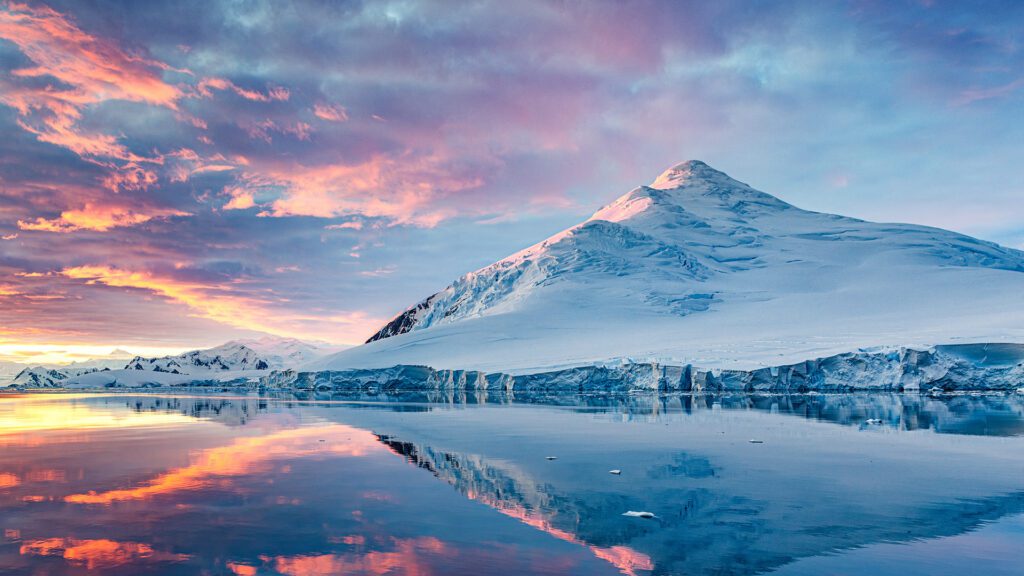
There is a silence in Antarctica that exists nowhere else on Earth.
It arrives when the ship slows and the horizon opens into a white so vast it alters your sense of scale. Glaciers calve into water still enough to hold the sky. Penguins move across rocky shorelines in colonies that seem to have no edge. A whale surfaces, exhales, and disappears again.
But whether Antarctica feels this immediate is decided long before you arrive.
Two travelers can sail toward the same continent and encounter entirely different versions of it. One steps from a Zodiac onto the shore, close enough to hear the movement of a penguin colony. The other watches from the deck as the coastline passes at a distance.
The difference often begins with the ship.
Antarctica allows no more than 100 visitors ashore at one landing site at a time, and ships carrying more than 500 passengers cannot land at all. On a larger vessel, even a favorable weather window may close before everyone has gone ashore. Smaller expedition ships can move more quickly, reach more landing sites, and change course when ice or wildlife presents an unexpected opportunity.
In Antarctica, the ship determines the distance between looking and arriving.
Its ability to navigate ice matters, too, although the technical language can obscure a simple truth: some ships can go where others cannot. A more capable polar vessel may reach deeper into ice-filled waters or remain flexible when conditions shift. The difference may reveal itself not in the ship’s specifications, but in the bay you enter while another vessel turns away.
Timing changes the continent again.
November brings untouched snow and immense sculptural ice. By late December and January, penguin colonies are alive with courtship, nesting, and chicks, while near-continuous daylight extends the hours available for exploration. In February and March, whale activity increases and the landscape begins to loosen into late summer.
Then there is the Drake Passage.
Traditional voyages leave Ushuaia and cross two days of open ocean in each direction. For some travelers, the crossing is part of the psychological arrival, a threshold between the familiar world and the polar one. Others choose to fly from Punta Arenas, preserving time and avoiding the uncertainty of the sea. Neither choice is more authentic. They simply create different journeys.
The expedition team may be the least visible decision and one of the most important. A marine biologist can turn a whale sighting into an understanding of migration and behavior. A glaciologist can make a wall of blue ice legible. The best guides do not compete with the landscape. They teach you how to see it.
Antarctica is not difficult because it lacks options. It is difficult because the options look more alike than they are.
An Antarctic voyage is beyond extraordinary. The right advisor helps ensure you have the experience you came for.
Any content, resident submissions, guest columns, advertisements, and advertorials are not necessarily endorsed by or represent the views of Best Version Media LLC (BVM) or any municipality, homeowners associations, businesses, or organizations that this publication serves. BVM is not responsible for the reliability, suitability, or timeliness of any content submitted, inclusive of materials generated or composed through artificial intelligence (AI). All content submitted is done so at the sole discretion of the submitting party.