Some of the best maintenance you can do for your home costs less than $25 and starts with a ten minute walk around the house. This month, we’re talking about ducts, which are one of the primary ways your home ‘breathes.’ The dryer, range hood, and bathroom fans all push moisture, heat, grease, and lint out through an opening in an exterior wall or up through the roof. Keeping those ducts sealed at the joints and capped at the walls protects your indoor air, your energy bill, and the framing of your home.
In homes built from the 1970s through the 1990s, duct joints were typically sealed with cloth-backed duct tape. The tape itself is the problem. Duct tape was invented during World War II to seal ammunition boxes, and it has never actually been rated for ducts. Heat first bakes the adhesive out and then the cloth peels away, causing the joints to open up. Outside, the vent cap takes decades of sun, and its damper or screen is often the first part to go. Once that happens, the duct stops being an exit and becomes an entrance.
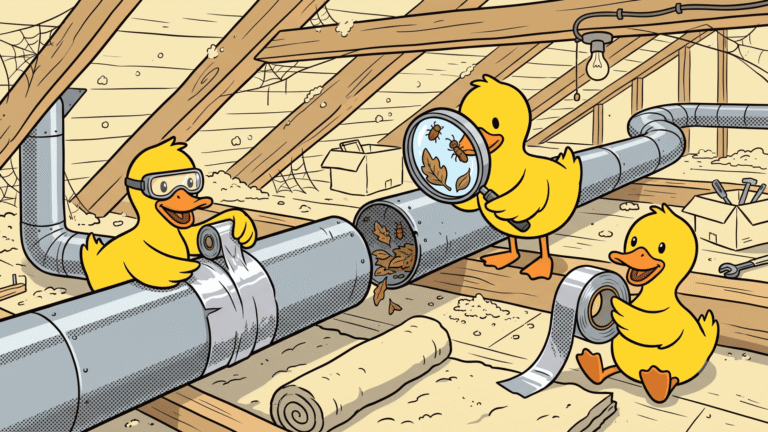
Recently, we were working through a punch list for a homeowner who had just moved into an early 1980s townhome here in North County. One item was a run of exhaust duct where the old tape had dried out and flaked away, leaving open gaps at the joints. When we pulled the failed section, it was packed with leaves, sticks, and dead insects. The vent cap on the outside of the house had lost its screen years earlier, and the duct had been collecting debris through an open hole in the wall ever since. We cleaned out the run, replaced the section, sealed each joint with foil tape, and installed a new cap with a pest screen so nothing gets in again. We finished before lunch.
These fixes are straightforward on almost every home. Duct joints should be sealed with UL 181 foil tape or duct mastic, which are made for the job and hold for decades. Crushed or torn sections should be replaced, not patched. Every exterior termination needs a working cap, and range hoods and bath fans get a damper and a pest screen. Dryer vents are the one exception. They get a louvered damper only, never a mesh screen, because lint clogs mesh. The National Fire Protection Association counts roughly 15,000 dryer fires in American homes every year. Failure to clean the duct is the leading cause, which makes a clear, sealed dryer duct the least expensive, most effective fire protection you can give your home.
To check your own home, walk the perimeter and find every place a duct exits. There is usually one for the dryer, one for the range hood, and one for each bathroom fan, either on the walls or on the roof. Run each appliance and confirm the flap opens and air actually moves. With everything off, look for missing screens, nesting material, or staining around each cap. If you can see exposed ducting in your garage or attic, look for sagging tape, crushed sections, and separated joints.
A roll of UL listed foil tape costs $15, a new louvered vent cap costs $10, and ten minutes of attention tells you whether you need either one. If you would like a second set of eyes on your home, we’re happy to take a look.
Book a service at fullhousehandyman.com, or call (760) 334-7859.
Have a question about your home? Text a photo and your question to (760) 334-7859, or email contact@fullhousehandyman.com. We answer every question we receive, and next month’s column may feature yours.
Any content, resident submissions, guest columns, advertisements, and advertorials are not necessarily endorsed by or represent the views of Best Version Media LLC (BVM) or any municipality, homeowners associations, businesses, or organizations that this publication serves. BVM is not responsible for the reliability, suitability, or timeliness of any content submitted, inclusive of materials generated or composed through artificial intelligence (AI). All content submitted is done so at the sole discretion of the submitting party.