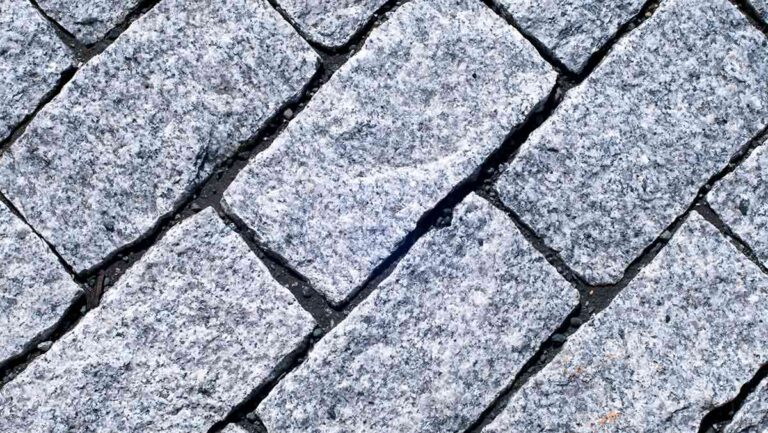
A cobblestone driveway adds centuries of timeless curb appeal, but landing the old-world look takes more than just laying down natural stone. It requires balancing stone selection, layout, and joint structure to preserve your land’s natural drainage. Here is what you need to know about building a permeable driveway that lasts for generations.
What makes a cobblestone driveway feel “old-world” comes down to three design choices working in combination: irregular stone, generous joints, and a layout that avoids strict geometry.
Irregular stone: Hand-split granite, basalt cubes, and reclaimed cobbles all carry slight variations in size and surface texture, which gives them a handmade quality that uniform machine-cut pavers cannot replicate regardless of color palette.
Joint width: A modern paver patio might be set with 1/8” joints for a tight contemporary look, while an old-world driveway typically uses uneven natural wide joints. The wider joint allows the eye to read each stone individually allowing the natural character to be showcased brilliantly.
Layout: Fan patterns, running bonds with gentle curves, and loose arrangements all evoke European street paving. Straight grids and perfectly aligned courses tend to work against the effect, even when the stone itself is appropriate.
Granite cobblestones are the most common and appropriate choice. The irregular split surface has an old-world hand-finished look and feel, and granite holds up under daily vehicle loads without cracking or fading. Individual stones can also be lifted and reset when irrigation lines, EV charger cables, or drainage need to be added later, which avoids the patch scars that accumulate on poured concrete and asphalt driveways over time.
Lyngso stocks split cubes and cobbles, including Rattan Yellow Granite, Light Gray Granite, Black Granite, Cool Grey Granite, Dark Grey Granite, Rose Grey Granite and Reclaimed Grey Granite. For projects that want a darker, denser look, Black Basalt cubes and cobbles are nearly black and pair well with lighter gravels. Although less common in driveway applications, denser limestone such as Galaxy Black Limestone Cobble Pavers, and Champagne Creek Limestone Cobble Pavers can be used if they are set in mortar, but it makes them non-permeable.
Installing a permeable cobblestone driveway requires careful planning. Our Bay Area climate is forgiving for stone driveways, since the absence of freeze-thaw cycles allows stones to stay seated longer than they would in colder regions. The base preparation, however, is what separates a driveway that lasts for decades from one that begins shifting after a few years. For most residential driveways, plan to excavate a minimum of 10”-12” and for heavy duty vehicular traffic, excavating 16” or deeper may be required. Consult a soil and drainage engineer for your final application depth as well as the depth for each layer within the excavated space. Have a drainage plan before installation begin – discuss where and how water flows under the driveway. Layer and compact larger 2 ½” ballast rock as the first base substrate and subsequently decrease the size of the crushed drain rock from 1½” to ¾” to ¼” towards the top layer. Set the cobbles on a layer of coarse paver sand. Fill the joints with complimenting gravel or decomposed granite.
Building an old-world cobblestone driveway doesn’t have to be intimidating, and choosing well matched stones, permeable base aggregates and joint materials can help create a surface that improves with age while working with the climate and water flow rather than against it.
LYNGSØ, an employee-owned company, is the exclusive garden materials retailer providing landscape gardening articles in San Carlos Living. Explore landscaping resources at lyngsogarden.com.
Any content, resident submissions, guest columns, advertisements, and advertorials are not necessarily endorsed by or represent the views of Best Version Media LLC (BVM) or any municipality, homeowners associations, businesses, or organizations that this publication serves. BVM is not responsible for the reliability, suitability, or timeliness of any content submitted, inclusive of materials generated or composed through artificial intelligence (AI). All content submitted is done so at the sole discretion of the submitting party.