If it seems like more children are wearing glasses today than when you were growing up, you are not imagining it. Worldwide, rates of childhood myopia, commonly known as nearsightedness, have risen sharply. While genetics play a significant role, environmental factors, including reduced time outdoors and increased demands for prolonged near work, are also associated with the development of myopia.
For years, the standard response to a child’s worsening vision was simple: update their prescription glasses every year. Today, optometric science views myopia differently. Myopia is increasingly recognized as a condition that can be actively managed, particularly in children whose eyes are still growing.
Beyond Blurry Vision: Understanding Axial Length
When a child develops myopia, the eyeball is physically growing too long from front to back. This measurement is known as axial length.
As the eye elongates, the tissues at the back of the eye are stretched over a larger area. Higher levels of myopia, particularly high myopia, significantly increase the lifetime risk of several serious ocular conditions in adulthood, including:
- Retinal detachment
- Glaucoma
- Myopic maculopathy
- Cataracts
Traditional single-vision glasses correct the blur caused by myopia, but they are not designed to slow the axial elongation associated with myopia progression. Myopia management, by contrast, uses targeted therapies to slow this elongation during childhood, with the goal of reducing the degree of myopia and the associated long-term ocular risks.
Tracking Myopia Beyond the Prescription
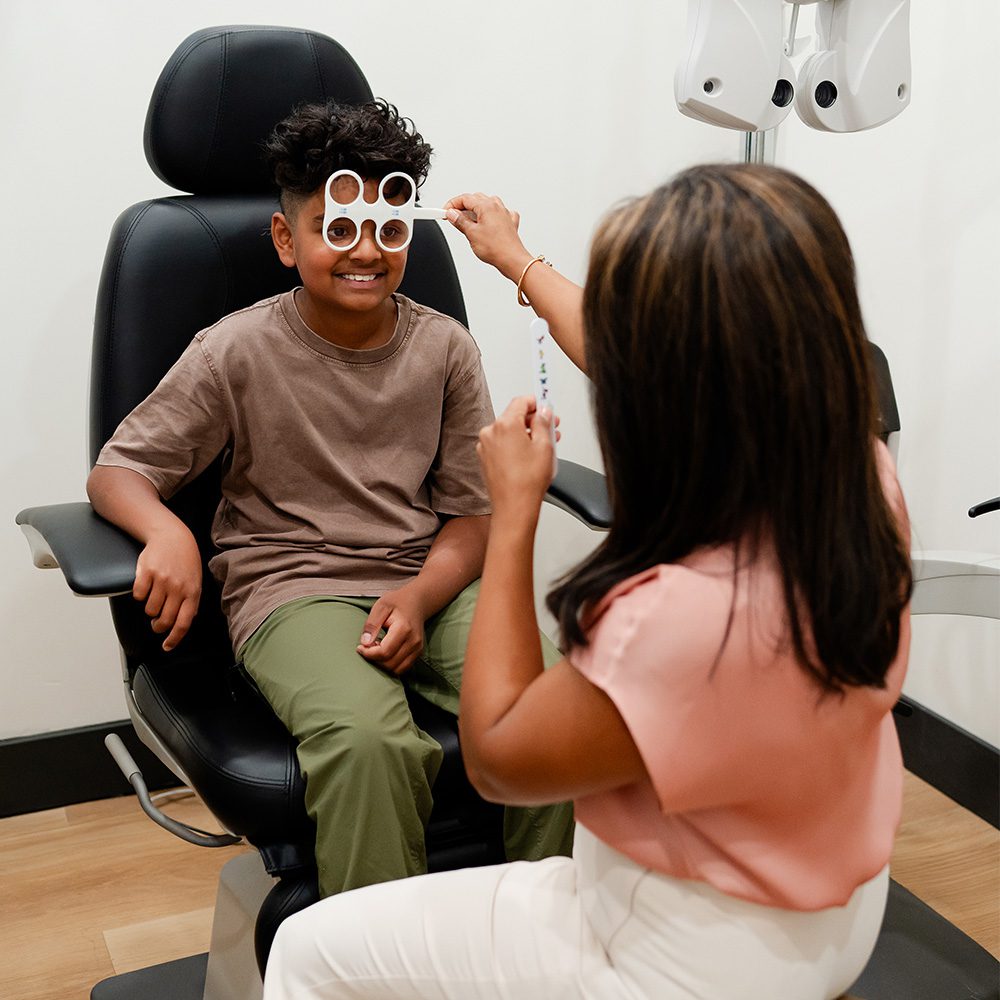
Effective myopia management requires objective, precise data. Our clinic utilizes optical biometry to measure axial length accurately and reproducibly.
Just as a pediatrician tracks height and weight on a growth chart, we monitor changes in axial length over time. Because axial length provides a direct measure of eye growth, it gives us an additional objective measurement to follow alongside changes in prescription and visual acuity.
Comprehensive Treatment Options
Because every child’s lifestyle and visual needs are unique, our practice offers several evidence-based options for myopia management.
Myopia-Control Spectacle Lenses: Specialized everyday glasses designed to provide clear central vision while incorporating treatment zones intended to slow eye growth.
Myopia Control Soft Contact Lenses: Comfortable, daily-disposable soft contact lenses that simultaneously correct daytime sight and provide myopia-slowing optical cues.
Low-Dose Atropine Therapy: Prescription eye drops used once daily that can slow myopia progression in children. The appropriate concentration and treatment plan depend on the individual child.
Spotlight on Orthokeratology (Ortho-K): Clear Days Without Glasses
Orthokeratology, or Ortho-K, is an established option for myopia management with a substantial body of clinical evidence supporting its ability to slow axial eye growth.
Ortho-K uses custom-designed, highly oxygen-permeable therapeutic lenses worn exclusively while sleeping.
How Ortho-K Works
The concept is straightforward: while your child sleeps, these custom therapeutic lenses gently and temporarily reshape the cornea, the clear front surface of the eye. In the morning, the lenses are removed, leaving many children with clear vision during the day without the need for glasses or daytime contacts. The corneal reshaping also alters the pattern of peripheral retinal defocus and other optical signals that are believed to influence eye growth. This is thought to contribute to Ortho-K’s ability to slow axial elongation.
Why Families Love Ortho-K
Daytime Freedom: Many children can enjoy clear vision during the day without glasses or daytime contact lenses.
Active Lifestyles: Ortho-K can be particularly convenient for children involved in sports and other activities where glasses or daytime contact lenses can be cumbersome.
Parent-Supported Care: Because lenses are inserted and removed at home, parents can play an important role in supervising proper lens handling, cleaning and hygiene, particularly for younger children.
Clinical Evidence: Multiple randomized clinical trials have shown that Ortho-K can significantly slow axial elongation in children with myopia. Over two years, studies have generally reported approximately 40-50% less axial elongation compared with conventional single-vision correction, although the degree of benefit varies between individuals and studies.
Safety Matters
Ortho-K lenses are medical devices and, like all contact lenses, require careful hygiene and regular professional follow-up. Because these lenses are worn overnight, proper cleaning, disinfection and handling are particularly important. Parents and children should understand the signs of a potential eye infection and seek prompt professional attention if significant redness, pain, light sensitivity or sudden vision changes occur.
Investing in Your Child’s Visual Future
Childhood is an important time to monitor myopia progression. Once the eye has elongated, current myopia-management treatments are generally aimed at slowing further growth rather than reversing the structural change that has already occurred. By intervening early with precise axial length tracking and modern treatments, we may be able to slow the rate at which myopia progresses.
If your child’s prescription has been changing quickly, it may be worth asking not only “What glasses does my child need?” but also “Why is their prescription changing, and can we do anything to slow it down?”
At LaSalle Vision, we are now offering Ortho-K as part of our myopia management services. A consultation provides an opportunity to assess your child’s vision and eye health, discuss their individual risk factors and determine whether myopia management may be appropriate.
Myopia is becoming increasingly common, but parents have more options than ever before. Understanding those options is an important first step in helping your child maintain healthy vision as they grow.
Any content, resident submissions, guest columns, advertisements, and advertorials are not necessarily endorsed by or represent the views of Best Version Media LLC (BVM) or any municipality, homeowners associations, businesses, or organizations that this publication serves. BVM is not responsible for the reliability, suitability, or timeliness of any content submitted, inclusive of materials generated or composed through artificial intelligence (AI). All content submitted is done so at the sole discretion of the submitting party.