Most people think of their dentist as the person who checks for cavities and gum disease. But at Downers Dental in Westmont, my team and I see ourselves as something more: often the first line of defense against a disease that kills roughly one American every hour.
That disease is oral cancer, and it’s more common — and more dangerous — than most patients realize.
Oral Cancer, By the Numbers
The statistics tell a sobering story. According to the American Cancer Society’s most recent estimates, about 60,480 Americans will be diagnosed with oral cavity or oropharyngeal (throat) cancer this year, and the disease will cause an estimated 13,150 deaths. That works out to roughly one death every hour, every day, all year.
What makes oral cancer especially dangerous isn’t necessarily its aggressiveness — it’s how often it’s caught late. The five-year survival rate for oral and oropharyngeal cancer sits at around 40% when the disease has already spread by the time it’s diagnosed, but jumps dramatically when caught in its earliest, localized stage.
That gap is almost entirely a story about timing: early detection saves lives, and screening is how early detection happens.
A few other facts worth knowing:
- It’s not just an “older smoker’s disease” anymore. Just over 1 in 5 cases (about 20%) now occur in people younger than 55, even though the average age at diagnosis is still around 64.
- HPV has changed the risk landscape. Human papillomavirus is now linked to an estimated 70% of oropharyngeal cancers, and oropharyngeal cancer has surpassed cervical cancer as the most common HPV-related cancer in the U.S.
- A meaningful share of patients have no obvious risk factors. Tobacco and heavy alcohol use remain the two biggest risk drivers — and using both together multiplies the risk further — but a real portion of diagnoses occur in people who don’t smoke or drink heavily at all, which is exactly why routine screening for every adult patient matters.
Who’s at Higher Risk?
While oral cancer can affect anyone, certain factors raise the odds significantly:
- Tobacco use of any kind — cigarettes, cigars, pipes, chewing tobacco, and vaping
- Heavy or frequent alcohol use, especially in combination with tobacco
- HPV infection, now a leading driver of throat and tonsil cancers
- Excessive sun exposure, a risk factor specifically for lip cancer
- Age over 40, though diagnoses in younger adults are rising
- A history of previous oral lesions or precancerous changes
- Betel quid or paan chewing, a practice more common in some Asian and immigrant communities
The problem is that early-stage oral cancer and precancerous lesions often don’t hurt, and they can look like nothing more than a small white or red patch — easy to miss during a quick glance, and often invisible under normal exam-room lighting until the disease has progressed. That’s the gap ViziLite is designed to close.
What Is ViziLite, and How Does It Work?
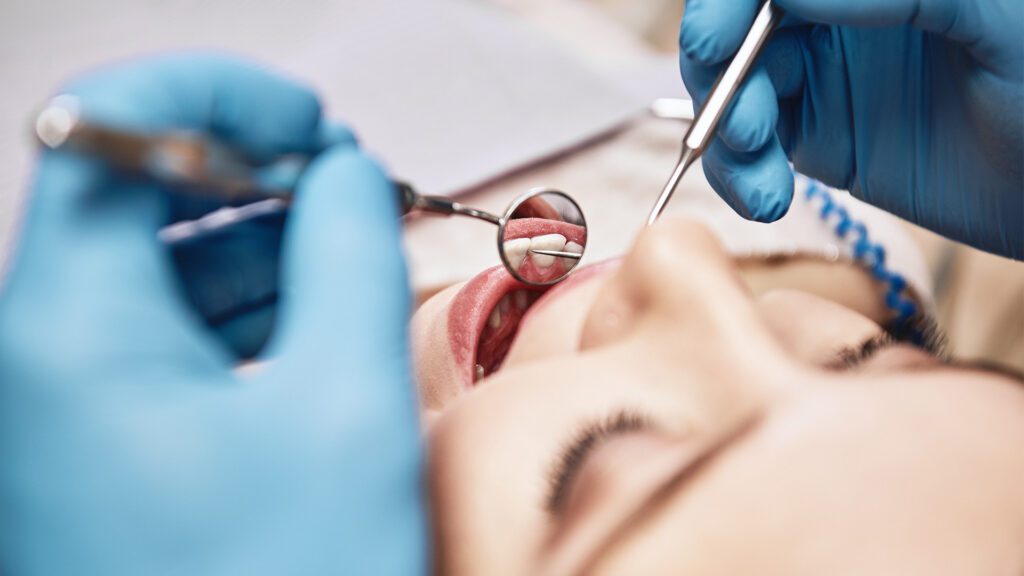
ViziLite Plus is an FDA-cleared oral cancer screening system used as an adjunct to — not a replacement for — the traditional visual and physical exam your dentist already performs. It’s built to catch tissue abnormalities that are difficult or impossible to see under regular exam lighting.
Here’s what the screening actually involves at Downers Dental:
- Rinse. After your normal exam, you’ll rinse with a mild cleansing solution for about a minute.
- Light exam. We dim the room lights and examine your mouth, cheeks, lips, tongue, and throat using the ViziLite wand, which emits a special chemiluminescent light.
- Interpretation. Healthy tissue absorbs the light and appears dark. Abnormal tissue reflects the light back and appears distinctly white, making it stand out from the surrounding healthy tissue.
- Marking, if needed. If a suspicious area is found, it can be marked with a special dye (T-Blue) so it can be tracked, documented, and monitored or referred for further evaluation.
The entire process typically adds only a few minutes to your visit. It’s painless, requires no needles or anesthesia, and gives immediate visual feedback — there’s no waiting days for lab results to know whether an area needs a closer look.
Why This Matters Coming From Your Dentist’s Chair
Most people see a dentist far more regularly than they see a doctor for a general checkup — which puts dental practices like Downers Dental in a uniquely powerful position for catching disease early. A soft-tissue screening takes just minutes and can be built right into a routine visit, with no separate appointment, referral, or specialty equipment required on the patient’s end.
My philosophy is straightforward: prevention and early detection are always better than treatment after the fact. Oral cancer screening fits naturally into that approach, alongside the cleanings, exams, and gum disease monitoring patients already expect at every visit.
A Free Screening for New Patients This October
In recognition of Oral Cancer Awareness Month this October, Downers Dental is offering a free oral cancer screening (an $89 value) to every new patient who completes a new patient appointment before October 31, 2026.
If you’re searching for a new dental home in Westmont or the surrounding area, this is a straightforward way to get established with a practice — and get a head start on protecting your health — at no added cost.
To take advantage of the offer:
- Schedule and complete a new patient appointment at Downers Dental
- Visit before October 31, 2026
- The oral cancer screening is included at no charge as part of your visit
Any content, resident submissions, guest columns, advertisements, and advertorials are not necessarily endorsed by or represent the views of Best Version Media LLC (BVM) or any municipality, homeowners associations, businesses, or organizations that this publication serves. BVM is not responsible for the reliability, suitability, or timeliness of any content submitted, inclusive of materials generated or composed through artificial intelligence (AI). All content submitted is done so at the sole discretion of the submitting party.