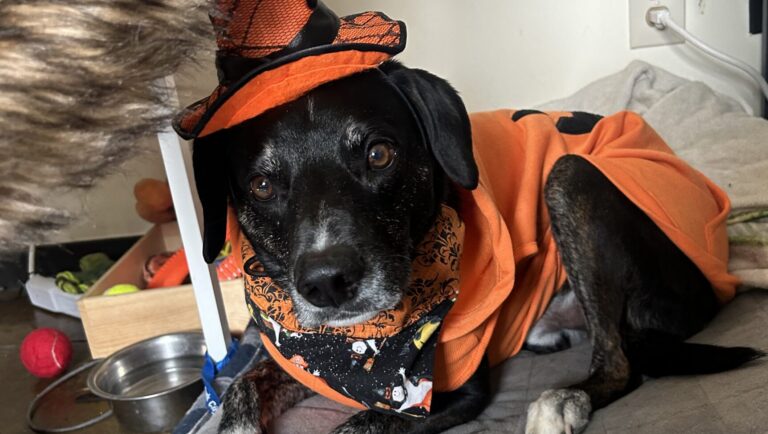
My dogs hear it before I do.
I’ll be having or doing something ordinary—coffee, emailing, one more thing before the day really starts—and Arbor and Flint will suddenly lift their heads in unison. Ears up. Then the grins, the tails, and finally the howling, which is a husky’s way of making an announcement to the entire neighborhood.
The Fetch van is coming. I have no idea how they know. They just do.
“Are your friends here?” I ask them, because apparently this is a thing I say out loud now. They’re already at the door.
They Come to You
Here’s the part that surprises people: I don’t drive my dogs to daycare. Fetch picks up all over the greater Park City area, which means most Fetch families never see where their dogs actually spend the day.
Go at least once. The ranch out on 248 toward Kamas explains the whole company in 30 seconds: acres upon acres of the Wasatch Back, open ground, and big sky.
Understanding why it was built that way meant sitting down with Tori Saylor, cofounder of Fetch Park City’
A Different Kind of Question
Most conversations about dog care start with logistics, as in hours, rates, and vaccination records. With Tori, it goes somewhere else immediately, because she isn’t answering as a business owner. She’s responding as someone who has spent her adult life in rooms where dogs don’t get a say.
“Somebody needs to speak for the dogs,” she tells me.
There’s a children’s book about this. In The Lorax, a small, aggressively orange creature appoints himself the voice of the trees, for the simple reason that the trees can’t speak for themselves, so somebody had better do so. Dr. Seuss doesn’t end with a resolution. Instead, a challenge: Nothing improves until someone cares enormously.
Tori is the Lorax of the dogs.
I mean that as the highest compliment I know how to give. Dogs don’t get to tell you the space is too small, or that they’re frightened. Somebody has to notice on their behalf—and care enough to build something different.
Where It Comes From
Tori didn’t set out to launch a company. She started as a volunteer at the SPCA in Virginia. “I was there so often that they decided to start paying me,” she says—which tells you most of what you need to know about her.
She stayed about two-and-a-half years. What she saw there has stayed considerably longer.
“I’ve seen dogs come in that are happy and joyful,” she says, “and then being kenneled for long periods of time, they legitimately go crazy. And then they end up euthanized because they’re crazy.”
Sit with that for a second. Because: It’s the whole thing.
The dog arrived fine. What broke it was the containment—and, at the end of that, a behavior problem serious enough to be fatal. A dog a family could have loved doesn’t make it out, not because of anything the dog did, but because of where it had to wait.
Then came seven-and-a-half years in the veterinary world, which taught the same lesson in a lower key. Not shelter dogs in crisis, but regular dogs on regular days. “Even if they’re just there for routine vaccines, they’re still terrified,” Tori says. “Like, what’s going on? I’m being put in this cage.”
Not the extreme case. The ordinary one. For an enormous number of dogs, the baseline experience of being cared for is fear.
So when Tori says Fetch is kennel-free, she isn’t describing an amenity—it’s a conclusion she reached the hard way. She built the place she’d spent a decade wishing existed.
What “Dogs Get to Be Dogs” Actually Means
It wasn’t a slogan they arrived at afterward—it was the assignment from the beginning.
“The whole point of Fetch was to have a place where dogs could be dogs,” she says.
Which meant turning down the easy version. Early on, she looked at storefronts—a commercial space like every other daycare in every other town—and walked away.
Acreage plus vans crossing the valley twice a day is the hard, expensive way to do this. They chose it because the easy way didn’t pass the test.
What’s there instead is space and permission.
“At Fetch, they’re allowed to dig holes,” Tori says. “Where, like, at home, they’re not allowed to dig holes in their nice yards.”
Laughing out loud, I can see that it illustrates the whole philosophy. Digging isn’t a behavior problem to be corrected here. It’s a thing dogs do, relocated to a place where doing it is allowed.
Then there’s the harder proof: The dogs Fetch says yes to.
Not every dog. Every family starts with what I’ll call the “sniff test”—a meet-and-greet for dogs and humans both, and a real assessment rather than a formality. They’re looking at whether this particular dog will thrive out here, and they’ll tell you honestly if the answer is no. Putting a dog somewhere it can’t cope is the exact thing Tori built this place to prevent.
But the dogs who pass include plenty that other places won’t take. Dogs with medical needs and medications. Dogs recovering from something. Dogs who get overwhelmed in a crowded room and need more space than a building can give them. The dogs who made it through one trial day somewhere else and never got invited back.
I know this because two of those dogs live at my house.
The Dogs Who Weren’t Daycare Dogs
Arbor came to me first, and for a while she did fine at traditional daycares—a lot of dogs, not much room, everybody sorting it out in close quarters.
Then Flint came home.
Flint is, and I say this with total affection, a mischief-maker. He stirs the pot. And in a crowded room, his sister decided her job was to defend him from the consequences of his own choices—which, to be clear, he had absolutely earned. Arbor saw her brother in trouble, and she stepped in.
Eventually, I was told what many pet parents in the mountains and valley have: Your dogs aren’t really appropriate daycare dogs.
That was a hard thing to hear. Not because it was wrong—it wasn’t, given the rooms they were in—but because it sounded so final. Like the door closing on your dogs ever getting to have friends.
Enter Fetch.
The space did some of the work—it’s hard to stage a standoff on acres of open ground where everyone can walk away. The people did more, because they read dog behavior instead of just supervising it, and they saw a bonded pair and a pot-stirrer rather than two problem dogs.
But the part I didn’t understand until later is the van. That ride isn’t just transportation. It’s decompression—an anxious dog gets to settle and arrive already regulated, instead of going from zero to a hundred dogs in the length of a parking lot. It’s just built into how the day works, quietly and on purpose, for reasons that come straight from the dog’s point of view.
Seven years later, Arbor and Flint go play with their friends a couple days a week.
What You Can Expect
Fetch is a family business—Tori runs it with her brother, Tony, and their mom, PJ, who oversees the nonprofit side, Fetch Cares. The company caring for my bonded brother-and-sister pair is itself run by a brother and sister. I don’t think Arbor would find that surprising.
They know my dogs. Not “we have them in the system.” They know Arbor from Flint, they know exactly which one is going to start something, and they’ve known it for seven years.
Fetch is a place my dogs are so glad to go that they announce the van before it’s in my driveway—and after everything I’ve learned about why it was built this way, I understand exactly what that reaction means.
Somebody needed to speak for the dogs. And somebody did.
Any content, resident submissions, guest columns, advertisements, and advertorials are not necessarily endorsed by or represent the views of Best Version Media LLC (BVM) or any municipality, homeowners associations, businesses, or organizations that this publication serves. BVM is not responsible for the reliability, suitability, or timeliness of any content submitted, inclusive of materials generated or composed through artificial intelligence (AI). All content submitted is done so at the sole discretion of the submitting party.