We live in a world that prizes immediacy and treats waiting as a failure. And yet the objects we admire most tend to come from the opposite instinct. A mechanical watch, a bottle of wine that spent a decade becoming itself, a chair somebody built by hand: all of them are defined by restraint rather than speed.
That restraint is not inefficiency. It is intention, and I think most of us can feel the difference even when we can’t articulate it.
A fine watch impresses us less with what it is on day one than for what its maker decided about year forty. A great wine is not valuable for having sat on a shelf; it was tended carefully while it became what it was meant to be. In both cases, the time was not spent so much as used, which strikes me as a useful distinction to carry around.
Craftsmanship has not rejected technology, and I don’t think it should. Watchmakers cut metal to microscopic tolerance with machines, and winemakers rely on sensors and controlled environments to protect what they are growing. The tools don’t replace judgment so much as allow it to be applied more consistently. In my experience, things go wrong less because we moved quickly and more because we moved before we had thought carefully.
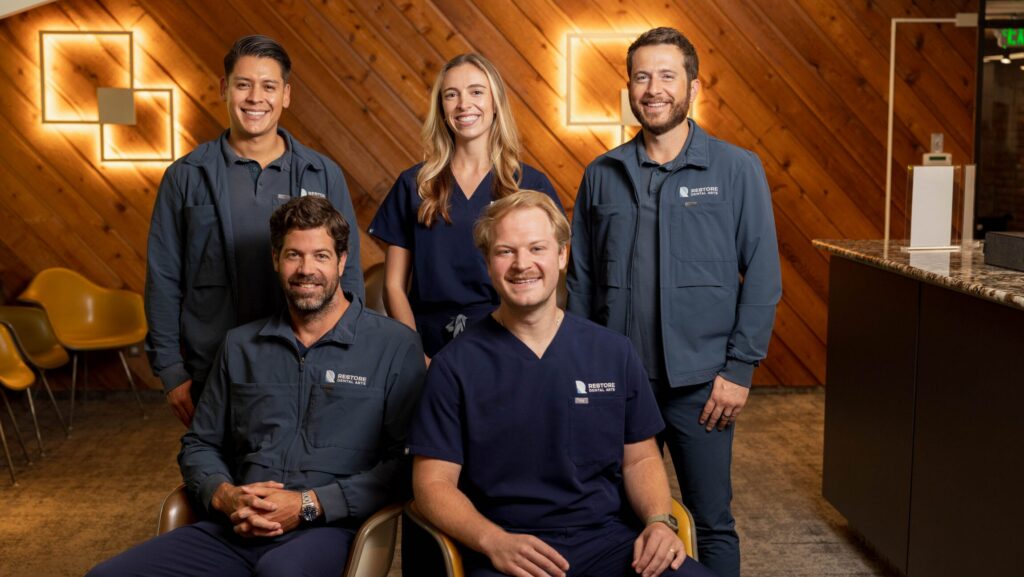
Dentistry is a field many people don’t associate with craft. But down the hall from our operatories there is a bench with very good light, a row of very fine brushes, and a technician building a crown with artistry and excellence. He will painstakingly adjust for the translucency at the biting edge, the faint warmth near the gumline, sometimes a stain or a craze line to better match its neighbors. It is a somewhat cruel truth that excellence in this domain means the work blends in and goes unnoticed.
The tolerances involved are closer to watchmaking than most patients would guess. The fit of a crown is measured in microns, and a gap invisible to the naked eye is wide enough for bacteria to invade. That gap is the difference between a restoration that lasts twenty years and one that fails in four. You cannot see a margin, but time will reveal a poor one.
The same principle governs the larger cases. When somebody comes to us needing an entire arch rebuilt, the visible part of that process is a single day. But the real work happened weeks earlier in a room with no patient. With a three-dimensional scan of the jaw, we plan where every implant will sit relative to bone, nerve, and sinus. We print a surgical guide that holds the drill within a fraction of a millimeter of that plan. We design the final teeth before anyone picks up an instrument. By the time the patient arrives, most of the uncertainty has already been resolved, which is why the day itself tends to feel calm. We take our time, and we do it quickly.
There is a temptation, in any field that has gotten more technical, to assume efficiency means cutting corners. But there is a second kind of efficiency that comes from foresight, and it matters more. We mill certain crowns in-house now, so a patient who once needed two appointments and left with a temporary, can sometimes finish in a single visit. This is the same level of care delivered more efficiently, and gives back an afternoon to the patient.
Our practice has been serving patients for almost 80 years, across three generations. I have had the privilege to treat patients whose great-grandparents were treated by my grandfather. That continuity is not only sentimental. It is the same design principle applied to an institution instead of an object. We build it carefully, so that it can be maintained, passed on, and stewarded by people who were not there at the beginning.
The pattern holds across it all: watches, wine, and the work that touches people most directly. What endures tends to be what was planned with care, built with precision, and shaped by people who value a lasting legacy. Patience is not a relic of some earlier era. Paired with the right tools, it is faster now than it has ever been.
Restore Dental Arts | 1213 E Coolspring Ave., Michigan City, IN 46360
restoredentalarts.com | (219) 879-4210
Any content, resident submissions, guest columns, advertisements, and advertorials are not necessarily endorsed by or represent the views of Best Version Media LLC (BVM) or any municipality, homeowners associations, businesses, or organizations that this publication serves. BVM is not responsible for the reliability, suitability, or timeliness of any content submitted, inclusive of materials generated or composed through artificial intelligence (AI). All content submitted is done so at the sole discretion of the submitting party.