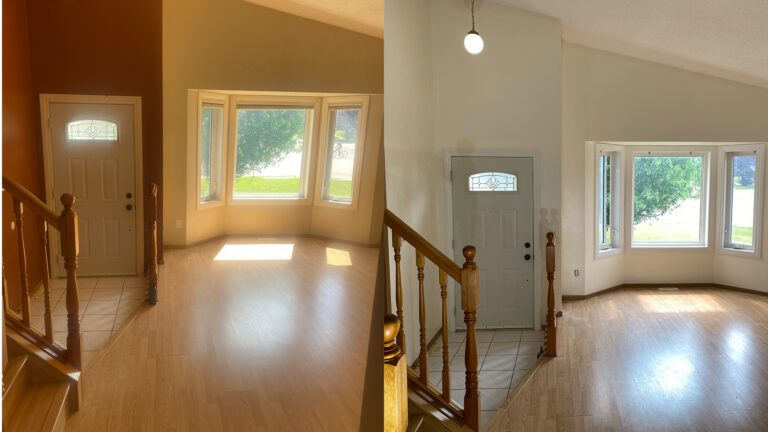
When homeowners think about a great paint job, they picture the final coat – the smooth colour, the crisp lines, the flawless finish. The reality – the beauty of a paint job is built long before the brush ever touches the wall. Preparation is the foundation, and it determines whether the result looks exceptional or just “okay.”
There are five important steps to achieve a professional finish:
1. Cleaning: The First Step to Adhesion
Paint doesn’t stick to dirt, grease, or residue. Walls collect everything – cooking oils, fingerprints, dust, pet dander, even old cleaning products. If these contaminants aren’t removed, the paint will fail early: peeling, bubbling, or looking blotchy. Clean walls allow paint to bond properly, creating a finish that lasts years longer.
2. Sanding: Where Smoothness Is Made
Even brand-new drywall has texture variations, and older surfaces have bumps, scratches, and uneven patches. Sanding levels everything out so the paint can lay down evenly.
A wall that hasn’t been sanded might look fine from a distance, but once the light hits it, every imperfection shows. Sanding is what creates that “buttery smooth” look.
3. Patching: Repairing the Story a Wall Tells
Walls collect dents, nail holes, cracks, and settlement lines over time. If these flaws aren’t patched correctly, they’ll telegraph right through the paint. Using high-quality fillers, allowing proper drying times, and sanding between layers ensures the surface is truly flat – not just covered. A flawless paint job is impossible without proper patching.
4. Priming: The Secret Weapon of Durability
Primer isn’t just “extra paint.” It’s a bonding agent, a stain blocker, and a colour stabilizer. Primer is used to seal patched areas, prevent stains from bleeding through, ensure consistent sheen, and help the topcoat adhere evenly.
Skipping primer can lead to uneven colour, flashing, and premature wear. Primer is what makes the final coat look uniform and stay that way.
5. The Final Coat Only Looks as Good as the Prep Beneath It
A painter can use the best paint on the market and still get a mediocre result if the surface wasn’t prepared correctly. Alternatively, a well-prepared surface can make even mid-range paint look fantastic. Prep is 80% of the job. Painting is the easy part.
In Summary
The quality of a paint job is mostly preparation because:
-
Cleaning ensures adhesion.
-
Sanding creates smoothness.
-
Patching removes visible flaws.
-
Priming stabilizes and protects the surface.
When these steps are done thoroughly, the final coat goes on beautifully and lasts for years. That’s why professional painters invest most of their time in prep – it’s where the real craftsmanship happens.
Any content, resident submissions, guest columns, advertisements, and advertorials are not necessarily endorsed by or represent the views of Best Version Media LLC (BVM) or any municipality, homeowners associations, businesses, or organizations that this publication serves. BVM is not responsible for the reliability, suitability, or timeliness of any content submitted, inclusive of materials generated or composed through artificial intelligence (AI). All content submitted is done so at the sole discretion of the submitting party.