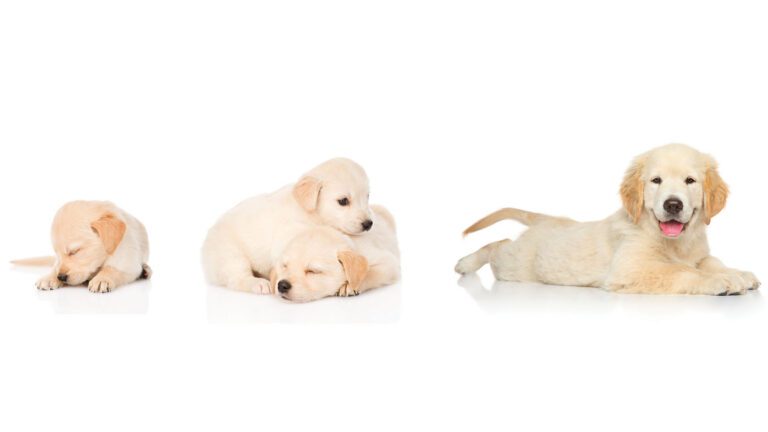
A puppy’s first 12 weeks are some of the most important in its life. During this time, rapid physical and behavioral development lays the foundation for confidence, social skills, and lifelong habits.
Neonatal Period: 1-13 days
Newborn stage, 90% of the time they are sleeping in order to have proper development of their brain and nervous system in general. They have frequent need for mother’s milk so will only wake to nurse or if their mother assists in their urination/defecation by cleaning them. Keeping them warm is of utmost importance and is assisted by the presence of mother and the other pups close to their body. The presence of the other pups keeps them used to various sensations of touching and creates mild “stress” that helps them to be more tolerant of handling later in life.
Fun fact: They move their limbs during sleep! Some dogs roll on their back as a submissive behavior reminiscent of this stage of puppyhood when they did this so mother could keep them clean. This work of the mom to keep them clean makes them associate their sleeping area with cleanliness, which helps when crate-training for potty training- this is why it is unusual for a pet to eliminate where they sleep! On day 12 the eyes open, though vision is still not very clear! Vision is much better around 28 days old.
Transitional Period: 13-20 Days
The eyes are opening around day 13, but vision is still blurry and will sharpen by 28 days old. Because they can see they will start walking and moving about the nest. Sense of smell is improving day by day. During end of this period the canine teeth start to emerge, and their caloric needs vastly increase which makes it likely the mother will start to reject them nursing and they will start to eat solid food around 4-6 weeks old for this reason. Naturally the mother will offer regurgitated food for them to eat. Their hearing develops at 20 days old. During end of this phase the mother will start to feel comfortable leaving them for short periods of time.
Socialization Period 4-12 weeks
No puppy should be adopted prior to 7 weeks old, as that is important to give them enough time interacting with the other pups in their nest to learn how to behave properly toward the species and can deeply affect their future social skills or lack thereof with other dogs. Increasing contact/handling and interaction with people starting at 4 weeks old and especially between 5-12 weeks is vital to their future imprinting and lack of fear around people. This is what domesticates them. If a puppy has had lack of human interaction for the first 7 weeks of his life, it will be very hard to undo the fearful mindset that will have developed. This is why an adult wolf is impossible to domesticate.
A puppy raised with too much time in a kennel during this time period, especially in an environment soiled with feces/urine will be conditioned to this and many times harder to potty train. The same puppy may also have missed out on opportunities for proper socialization.
We hope you have a better understanding of how the first several weeks of a puppy’s life shapes them and the importance of human socialization prior to 12 weeks old.
For more information on this topic, refer to The Art of Raising a Puppy written by the Monks of New Skete. This group devotes their days to raising and training companion dogs.
Any content, resident submissions, guest columns, advertisements, and advertorials are not necessarily endorsed by or represent the views of Best Version Media LLC (BVM) or any municipality, homeowners associations, businesses, or organizations that this publication serves. BVM is not responsible for the reliability, suitability, or timeliness of any content submitted, inclusive of materials generated or composed through artificial intelligence (AI). All content submitted is done so at the sole discretion of the submitting party.