“I like that boulder, that is a nice boulder.”
A classic line from Dreamworks hit movie Shrek, to be sure, but it is also a relatable one for any self-respecting water feature builder.
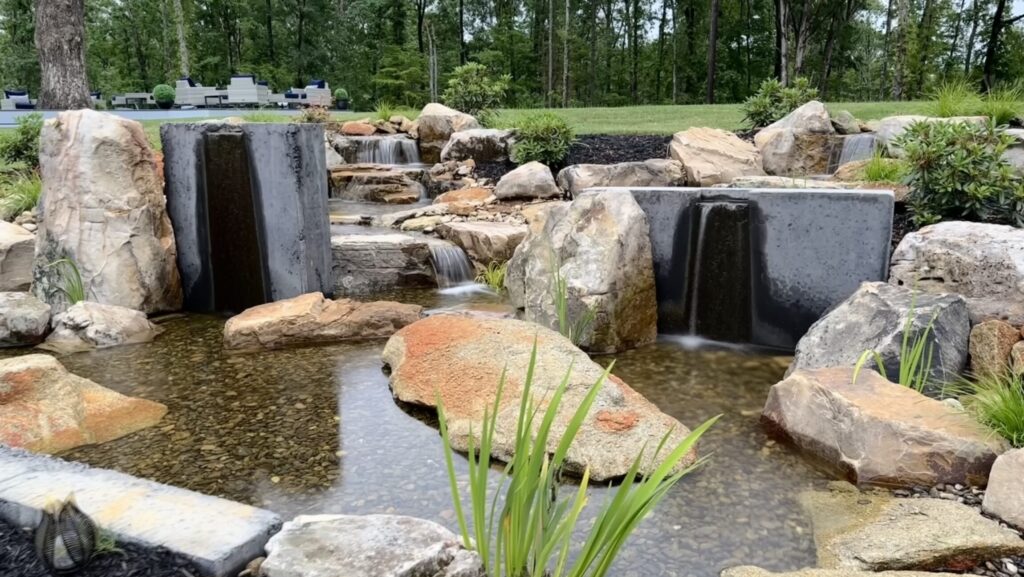
Boulders are the frame of a water feature– its skeleton, if you will. And every truly beautiful flowing body of water, natural or man-made, simply must have a well crafted skeleton. Intentional use of rocks is instrumental for creating a visually beautiful, durable, and environmentally congruent water feature that will last for ages and look good doing so. Proper use of boulders means selecting large boulders that vary in size, shape, texture, and unique features to build the system’s structure, rather than using mostly small, uninteresting, chintzy rocks for the water feature’s walls, waterfalls, and artistic accents.
A water feature’s frame of boulders tells the story of the system. A system that utilizes bold, round rocks tells the story of heavy water flow that washed away all but the most massive of boulders. Mossy rocks make a system look ancient and alive, like our incredible Appalachian Mountains. Moss also gives the system softness and a sense of comfort, balancing out the harshness of the rocks. And of course, boulders also tell the geological story of the region. Many boulders have grooves, bubbles, nubs, flow lines, color gradients, and unique shapes that guide our curiosity toward questions about our environment’s fascinating, alien ancient past.

Submitted photo
On a more artistic note, boulders are typically the only medium that we use to give a water feature structure a sense of depth, texture, perspective, and layers. It is a unique art form because the goal is to be felt, but not noticed. Invisible engineering is a term that we like to use to describe the work we do, because we work hard to make every water feature look as natural as possible. We think that facilitates the feeling of connection to nature that we strive to provide.
Functionally, large rocks don’t move. A water feature made of large rocks is solid; the walls don’t collapse, the falls don’t wash away, and animals can’t displace them. This is essential for water features like recreation ponds, whose rocks need to be unmovable despite swimming, jumping, and playing on them. That said, large rocks are a nice-to-have perk in every water feature. Who wants to spend a significant amount of their precious free time stacking the same wall over and over again? Not me.
In summary, boulders are a critical part of a water feature, and rocks are misused to the dismay of its owner. It takes more thought up front to build a water feature properly, but once completed, it is a source of beauty, as opposed to a poorly built and expensive mess in your yard that you never truly enjoy. Do it right the first time, and you will be rewarded with decades of low-effort serenity.
Any content, resident submissions, guest columns, advertisements, and advertorials are not necessarily endorsed by or represent the views of Best Version Media LLC (BVM) or any municipality, homeowners associations, businesses, or organizations that this publication serves. BVM is not responsible for the reliability, suitability, or timeliness of any content submitted, inclusive of materials generated or composed through artificial intelligence (AI). All content submitted is done so at the sole discretion of the submitting party.