I often meet patients who tell me the same thing: “I know my teeth are bad, but I don’t even know where to start.”
Sometimes they are missing one tooth. Sometimes they have several broken or failing teeth. Others have spent years dealing with pain, loose teeth, old dental work, or dentures they simply cannot get comfortable wearing.
Wherever someone is starting, my goal is the same: help them understand their options and give them a path forward.
Modern dentistry gives us more ways than ever to replace missing teeth. Depending on the situation, that may mean replacing a single tooth with a dental implant, restoring several teeth with implant-supported dentistry, or rebuilding an entire smile with a fixed full-arch solution.
Submitted photo
One principle we strongly believe is that everyone deserves to know if a fixed option is available to them.
Traditional removable dentures can still be appropriate for some patients, but they are no longer the only choice. Dental implants have changed the way we think about tooth replacement because they allow us to create restorations that are supported by the jaw rather than simply resting on the gums.
For a patient missing a single tooth, an implant can replace that tooth without relying on the neighboring teeth for support. For someone missing several teeth, implants can often support a larger restoration and reduce or eliminate the need for a removable partial denture.
For patients whose teeth can no longer be predictably saved, we can also use dental implants to support an entire fixed arch of teeth.
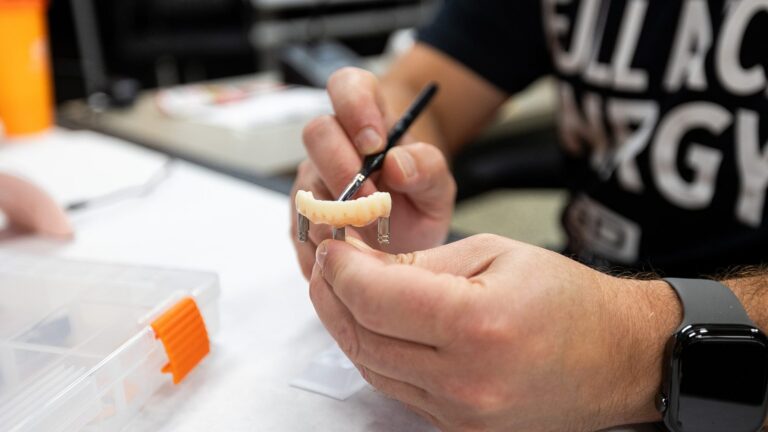
This treatment is often called All-on-X, full-arch implant treatment, or a fixed implant bridge. Instead of wearing a denture that comes in and out, a fixed restoration is secured to dental implants and designed to function much more like natural teeth.
The process has also become significantly more precise.
Submitted photo
Using 3D imaging, digital scans, virtual treatment planning, and modern digital design technology, we can plan implant position and tooth position before treatment begins. Photogrammetry and other digital tools can also help us accurately capture implant positions as patients move through their healing, prototype, and final restorations.
Technology is important, but the technology itself is not the goal.
The goal is to make treatment more predictable, more comfortable, and easier for the patient to understand.
One of the most important conversations we have with patients is deciding what should be saved and what should be replaced. The answer is not always the same. Sometimes saving a tooth is absolutely the right decision. Sometimes replacing one tooth is the better long-term option. And sometimes a patient reaches a point where rebuilding an entire smile creates the most predictable path forward.
Our job is not to push every patient toward the biggest treatment.
It is to help each person understand what is possible, what makes sense for their health, and what will give them the confidence to eat, smile, and live without constantly worrying about their teeth.
No matter where you are starting, there are options. And often, the first step is simply finding out what those options are.
Any content, resident submissions, guest columns, advertisements, and advertorials are not necessarily endorsed by or represent the views of Best Version Media LLC (BVM) or any municipality, homeowners associations, businesses, or organizations that this publication serves. BVM is not responsible for the reliability, suitability, or timeliness of any content submitted, inclusive of materials generated or composed through artificial intelligence (AI). All content submitted is done so at the sole discretion of the submitting party.