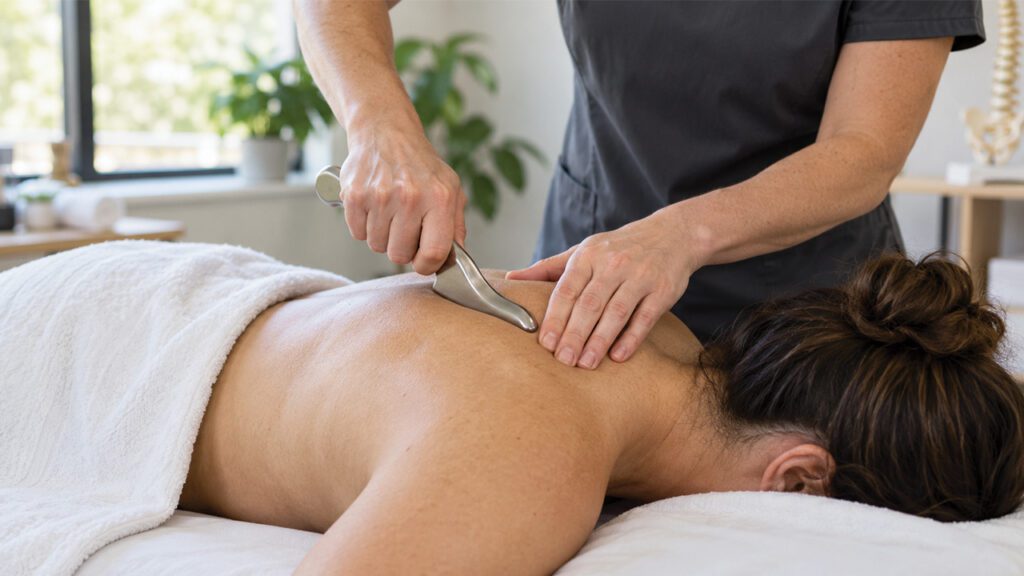
Did you know that our office offers Instrument Assisted Soft Tissue Massage (IASTM)? You may have heard this technique referred to as Graston, scraping, or blading. IASTM is a hands-on soft tissue technique that uses a specialized instrument, often made of stainless steel, to help a provider address areas of muscle and soft tissue tension.
One of the benefits of using an instrument is that it allows the provider to apply targeted pressure to areas of restricted or tight tissue while reducing the strain placed on the provider’s hands. IASTM may be used to help improve soft tissue mobility, decrease areas of muscle tension, and support normal movement.
What Are Myofascial Adhesions and Scar Tissue?
To understand IASTM, it helps to first understand fascia. Fascia is a thin layer of connective tissue that surrounds and separates muscles, organs, nerves, and other structures throughout the body. Healthy fascia allows tissues to move and glide smoothly as we move.
Injury, surgery, repetitive stress, or prolonged periods of limited movement can contribute to changes in the soft tissues. During the healing process, the body produces fibrous connective tissue that can contribute to scar tissue formation. In some cases, changes in the tissues can contribute to areas of stiffness or restricted movement.
These areas are sometimes described as myofascial adhesions or “knots.” You may notice them as tight, tender areas that feel restricted when you move. While stretching and regular movement can be helpful, persistent areas of soft tissue restriction may benefit from additional hands-on techniques.
How Can IASTM Help?
This is where IASTM can be a useful addition to care. By using a specialized instrument, we can apply targeted pressure and movement to areas of soft tissue restriction. The technique may help improve tissue mobility and stimulate circulation in the treated area.
It is also common to experience temporary redness or bruising following IASTM. This response, known as ecchymosis, can occur as a result of the pressure applied during treatment. Not everyone will bruise, and the amount of redness or bruising can vary from person to person.
Because IASTM can produce bruising more easily in some individuals, treatment may need to be modified for people taking blood-thinning medications or those with certain medical conditions. Be sure to tell your provider about any medications or health conditions before treatment.
IASTM + Rehabilitation
At our office, we often pair soft tissue techniques with rehabilitative exercises and movement. Addressing soft tissue restrictions is only one part of helping your body move well. Combining hands-on care with appropriate exercises can help restore movement, improve strength, and reduce the likelihood of the same problem returning.
If you’re dealing with persistent muscle tightness, restricted movement, or those frustrating “knots” that just won’t seem to go away, IASTM may be a great addition to your care plan.
Ask us about our Instrument Assisted Soft Tissue Massage technique at your next appointment! Schedule at HealthSource of Medina Today!
Any content, resident submissions, guest columns, advertisements, and advertorials are not necessarily endorsed by or represent the views of Best Version Media LLC (BVM) or any municipality, homeowners associations, businesses, or organizations that this publication serves. BVM is not responsible for the reliability, suitability, or timeliness of any content submitted, inclusive of materials generated or composed through artificial intelligence (AI). All content submitted is done so at the sole discretion of the submitting party.