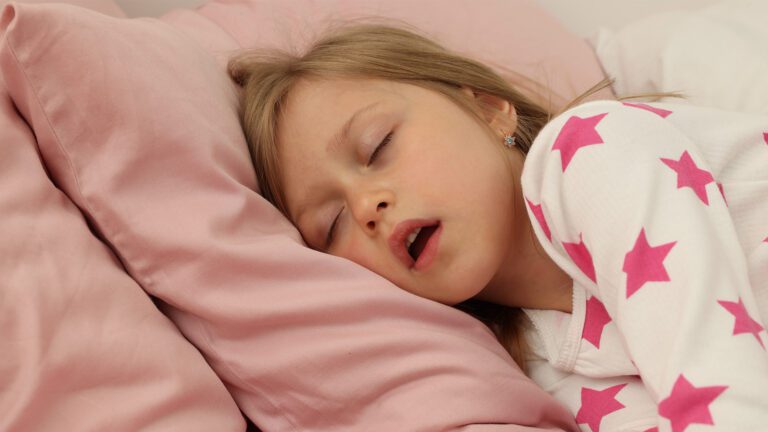
As parents, we want the best for our children: for them to grow right, into self-sufficient and well-adjusted individuals. Towards this goal, a well-rested child grows to his/her best potential and can get the best of all the world has to offer.
Hence, it becomes imperative that your child gets a full night’s peaceful sleep, for at least 10 hours if possible, without snoring, waking up in between, or moving around too much in bed. Disturbed sleep patterns in children, if left undiagnosed and untreated, have been shown to cause drowsiness and inattentiveness in the classroom, behavioral and mood changes, and neurocognitive dysfunction that can significantly affect scholastic performance. Studies show that sleep deprivation causes such a detrimental effect on a child’s behavior so as to lead to a misdiagnosis of ADHD. Growth hormone, crucial for the overall development and tissue repair for the child, is generated during deep sleep, so interrupted sleep can potentially lower the secretion of this hormone.
Here is a quick check-list to make sure that your child is sleeping right – does your child:
- Make sounds/snore or snort or gasp for air while sleeping?
- Grind his/her teeth while asleep?
- Move a lot in bed or wake up frequently at night?
- Experience night terrors or nightmares?
- Still have bedwetting accidents?
- Have difficulty sitting still in school?
- Show signs of being tired most of the time?
- Fall asleep in the middle of the day?
- Have difficulty focusing or finishing tasks?
These are some of the signs of what could be interpreted as Pediatric Sleep-Disordered Breathing (SDB) – due to airway problems, which, depending on the severity of the obstruction, can be exhibited as simply loud and noisy breathing to snoring and gasping.
Obstructive Sleep Apnea (OSA) is defined as the partial or complete obstruction of the upper airway during sleep. Simple snoring may not mean that the child has OSA; the diagnosis is made only by accurate sleep studies and determined by the number of times during the night the child actually slows down or stops breathing. It has been shown that approximately 10% of children snore regularly and according to the American Academy of Otolaryngology, about 3-4% of children exhibit OSA.
OSA in adults can cause daytime sleepiness, poor work performance, and going as far as being the potential cause of railroad and road traffic accidents. Therefore, if you see your child exhibiting any of the signs mentioned, your child should be evaluated by a team of specialists comprised of a pediatrician, an ENT specialist, a sleep specialist, and a pediatric dentist. The ENT specialist will evaluate the nasal passages and the pharyngeal tissues to rule out any causes of airway obstruction. The sleep specialist will perform a sleep study, considered the gold standard for diagnosis of sleep apnea, sometimes a challenge in very young children.
It is the specifically trained pediatric dentist who will evaluate the proper growth and development of the orofacial complex, take a comprehensive history and do an examination, and then, if needed, refer to the rest of the team to rule out causes and confirm the diagnosis. It is also a pediatric dentist and an orthodontist who can provide the treatment to correct orofacial structures with the help of oral appliances, which have been proven to successfully address airway issues and help eliminate mouth breathing. In 2017, the American Dental Association passed a resolution that dentists are the only health care providers who have the knowledge and the expertise to provide oral appliance therapy.
What are the possible causes of sleep–disordered breathing?
Upper airway obstruction is one of the main causes, possibly as a result of any frequent nasal congestion in response to environmental pollutants and allergens, sinus infections, or anatomical obstructions in the airway such as enlarged tonsils and/or adenoids. In fact, studies have shown that removal of enlarged and inflamed tonsils and/or adenoids could have a significantly favorable impact in helping the child breathe and sleep better.
Mouth breathing, a significant cause of and also a result of impaired growth of the mouth and the face, namely the orofacial structures, is significantly less favorable than nasal breathing because it potentially delivers much less oxygen and also does not have the mechanism to fight bacteria and toxins as nasal breathing would. Impaired growth of the orofacial structures could be worsened by over retained habits such as using the bottle or breast or pacifier beyond the age of 1- 2 years, leading to poor muscle tone, open mouth posture and mouth breathing. Since almost 80-85% of facial growth is completed by the age of 7-8 years, in order to optimize a child’s facial growth, it is important that the child eats right, stops bad habits in time, and visits the pediatric dentist for regular check-ups.
So, if you notice your child exhibiting any of these signs of noisy breathing or disturbed rest, do not sleep on it! Do seek help from the right professionals to make sure your child is on the path for unimpaired growth and development.
Any content, resident submissions, guest columns, advertisements, and advertorials are not necessarily endorsed by or represent the views of Best Version Media LLC (BVM) or any municipality, homeowners associations, businesses, or organizations that this publication serves. BVM is not responsible for the reliability, suitability, or timeliness of any content submitted, inclusive of materials generated or composed through artificial intelligence (AI). All content submitted is done so at the sole discretion of the submitting party.