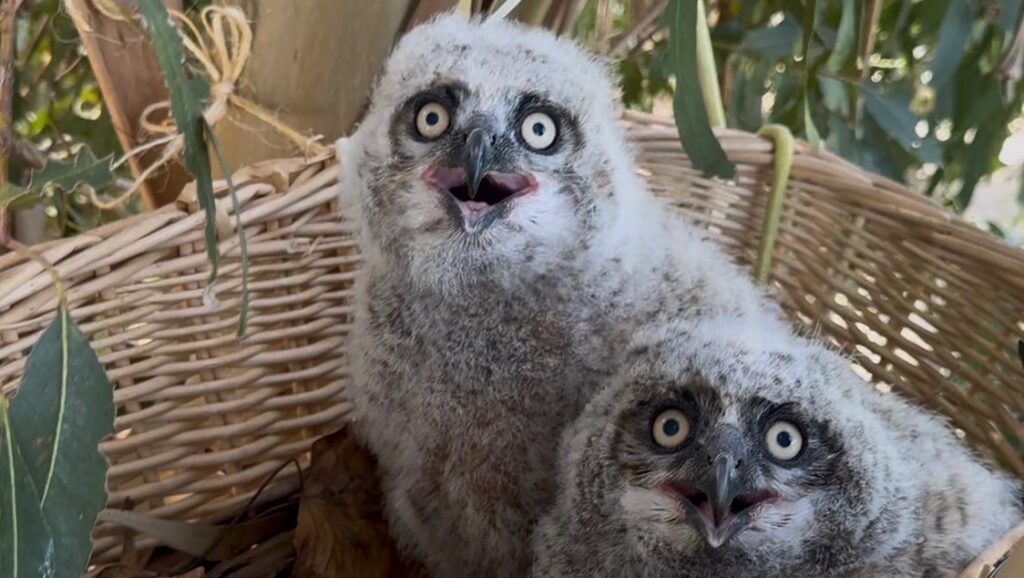
Owls are often heard before they are seen. A call from somewhere in the darkness, a shadow crossing a field, or a pair of eyes looking down from a tree can be a reminder that some of nature’s most effective predators live right here in the Tri-Valley.
As a local tree service, we have had the opportunity to see firsthand just how closely owls are connected to the trees and landscapes around us. We have encountered owl nests while working in trees, particularly palm trees, and have also had opportunities to help protect nesting birds and their young.
The Tri-Valley and greater East Bay support a surprising variety of owls. Among the species documented locally are the Great Horned Owl, American Barn Owl, Western Screech-Owl, Western Burrowing Owl, Short-eared Owl, Long-eared Owl, Northern Pygmy-Owl and Northern Saw-whet Owl. Some are common residents, while others are less frequently encountered or associated with particular habitats. (Alameda County Government (https://www.alamedacountyca.gov/cda/planning/landuseprojects/documents/apwra/Appendix_F.pdf?utm_source=chatgpt.com))
Each species fills its own place in the ecosystem. Some hunt from trees and other elevated perches, while others, such as the Burrowing Owl and Short-eared Owl, are associated with open grasslands and fields. The variety of owls found here reflects the variety of habitats throughout the Tri-Valley—from oak woodlands and riparian corridors to ranches, vineyards, agricultural land and suburban neighborhoods.
Nature’s Rodent Control
One of the most important contributions owls make is controlling populations of rodents and other small animals.
Barn Owls are particularly well known for hunting small mammals and are closely associated with agricultural and open landscapes. Great Horned Owls are larger and have a much broader diet, taking rats, mice, rabbits, squirrels, birds, reptiles and other prey.
The Western Screech-Owl, although much smaller and more difficult to spot, is another local predator associated with wooded and riparian areas. Western Burrowing Owls occupy a very different environment, relying on open ground and burrows rather than trees. The Tri-Valley and Altamont Hills remain important areas for these owls, although their numbers have faced significant pressures. (Alameda County Government (https://www.alamedacountyca.gov/cda/planning/landuseprojects/documents/apwra/Appendix_F.pdf?utm_source=chatgpt.com))
The remaining locally documented species—the Short-eared, Long-eared, Northern Pygmy and Northern Saw-whet Owls—are less commonly encountered in the Tri-Valley, but their presence adds to the remarkable diversity of owls found throughout the greater East Bay.
For us, these birds are more than wildlife we occasionally see while working. They are part of the landscape we work in and part of the natural balance of the communities we serve.
And sometimes, that means the work of a tree service intersects directly with the lives of these remarkable birds.
Any content, resident submissions, guest columns, advertisements, and advertorials are not necessarily endorsed by or represent the views of Best Version Media LLC (BVM) or any municipality, homeowners associations, businesses, or organizations that this publication serves. BVM is not responsible for the reliability, suitability, or timeliness of any content submitted, inclusive of materials generated or composed through artificial intelligence (AI). All content submitted is done so at the sole discretion of the submitting party.