
After more than two decades in the mortgage industry, I’ve learned that most homeowners think about mortgages essentially the same way: borrow money, make a payment every month, and hopefully pay the house off somewhere down the road.
For most people, that “somewhere” is 30 years from now.
But what if your mortgage worked completely differently?
What if the money already flowing through your household every month could help reduce the interest you pay, accelerate the reduction of your mortgage balance and potentially cut years, even decades, off the life of your loan, while that money remained accessible when you needed it?
That’s the concept behind the All In One Loan™, and it’s one of the most powerful financial tools I’ve worked with in my career.
Your Mortgage Meets Your Checking Account
The All In One is a first lien Home Equity Line of Credit, with banking functionality built directly into it.
Instead of having a traditional mortgage over here and your everyday checking account over there, the All In One essentially brings the two together.
Your paycheck and other income can be deposited directly into the account. Those deposits immediately reduce the outstanding principal balance on which interest is calculated.
Need the money to pay your credit cards, utilities, tuition, groceries or take a vacation? It remains immediately accessible.
The key is what happens before you spend it.
Interest with the All In One is calculated based on the loan’s daily outstanding balance. So while your income and excess cash are sitting against the mortgage, they’re helping reduce the balance subject to interest.
Think about the thousands of dollars that move through your checking account every month. With a traditional checking account, that money typically does very little for you while waiting to be spent.
With the All In One, those same dollars can be working every day against one of your largest lifetime expenses: mortgage interest.
The Real Power: Less Interest, Faster Payoff and Greater Control
This isn’t necessarily about making bigger mortgage payments.
It’s about making your existing cash flow work harder.
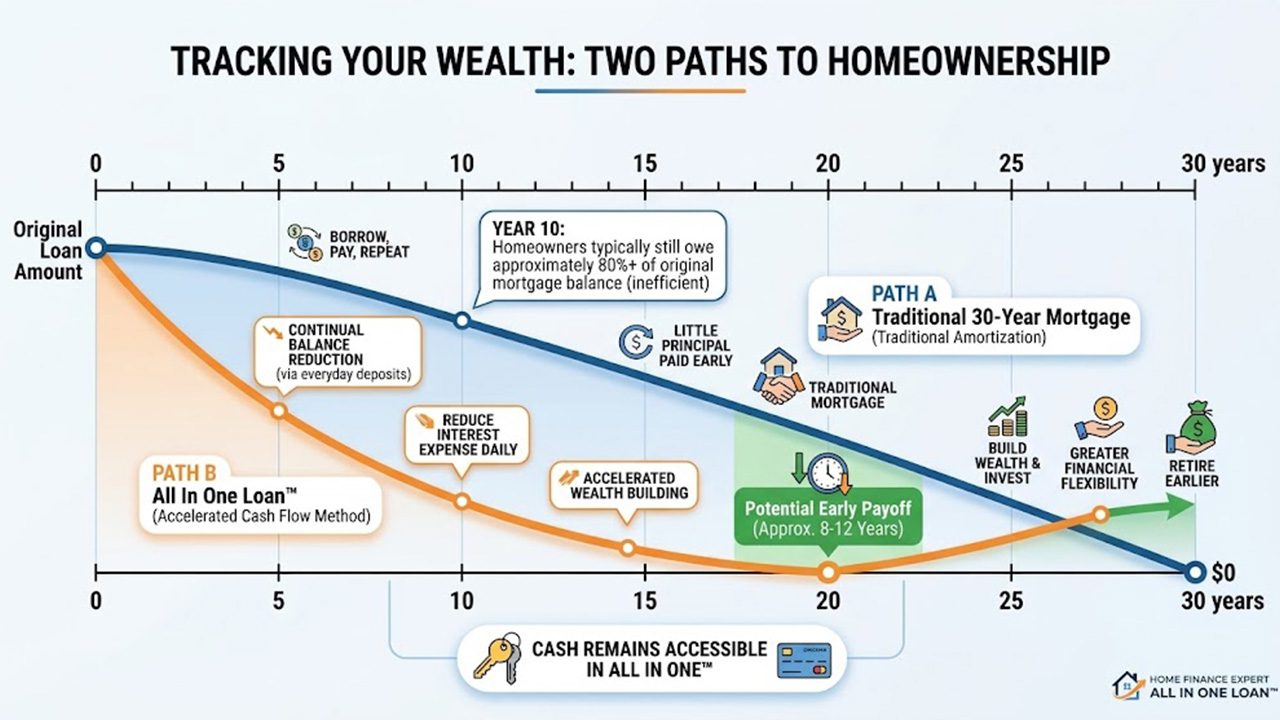
A traditional 30 year mortgage is designed to amortize over 360 monthly payments. Traditional amortization is surprisingly inefficient. After a decade of making payments, many homeowners still owe around 80% or more of their original mortgage, despite having sent their lender 120 monthly payments.
The All In One approaches the problem differently.
When a household consistently deposits more money than it ultimately spends, that positive cash flow continually reduces the outstanding loan balance. Because interest is calculated on the daily balance, a lower average balance means less interest charged. Less interest means more of your money can go toward reducing what you owe.
Over time, that creates a powerful compounding effect.
For homeowners with strong, consistent positive cash flow, modeling can sometimes show a mortgage being eliminated in approximately 8 to 12 years rather than 30, depending on the loan balance, interest rate, income, spending habits and how the account is managed.
Even when the result isn’t 8 to 12 years, potentially cutting 5, 10 or even 15 or more years from the life of a mortgage can translate into tens or even hundreds of thousands of dollars in interest savings.
And here’s what makes this strategy especially interesting: You don’t accomplish that by dramatically changing your lifestyle or sending enormous extra payments to your mortgage company.
You’re changing what your money does while you have it.
Unlike making additional principal payments on a traditional mortgage, money deposited into the All In One remains immediately accessible through the line of credit, subject to the terms of the loan.
That means the same cash that is helping reduce your mortgage balance and interest expense can potentially remain available when life or opportunity calls, whether that’s an emergency, college tuition, an investment, purchasing real estate or another major expense.
And the less money you ultimately spend on mortgage interest, the more of your future cash flow may remain available to build wealth, invest, fund college, purchase real estate or simply create greater financial flexibility.
That combination of interest savings, accelerated payoff, liquidity and control is what makes the All In One so unique and financially efficient.
It’s not simply about paying more toward your mortgage.
It’s about making more of the money you already earn work for you.
Case Study #1: The High Income Household
Imagine a Wall Township family brings home $20,000 per month after taxes and spends approximately $14,000.
With a traditional mortgage, their income goes into checking, their bills get paid and one mortgage payment is made each month.
With the All In One, the entire $20,000 initially reduces their outstanding loan balance.
As bills are paid throughout the month, the balance gradually increases again. But the approximately $6,000 they don’t spend remains against the mortgage.
Repeat that month after month and something significant begins to happen.
Their average mortgage balance can decline much faster, which reduces the amount of interest being charged. Depending on their starting balance, rate and future cash flow, a household like this could potentially model a payoff dramatically earlier than 30 years, in some scenarios approaching the 8 to 12 year range.
Now consider what happens after the mortgage is eliminated.
Instead of making mortgage payments for another 15 or 20 years, that household has those future dollars available through the line of credit for retirement, investments, college funding, real estate or simply enjoying life.
That’s where the long term wealth impact can become substantial.
Case Study #2: The Real Estate Investor
Now consider a homeowner or investor who has built substantial equity but wants to purchase another investment property.
With a traditional mortgage, accessing that equity may require a separate HELOC, home equity loan or cash out refinance.
With the All In One, available equity can potentially be accessed directly through the line of credit, subject to the terms and available credit.
Rental income, business income and household cash flow can then flow back through the account, helping reduce the outstanding balance.
The investor is potentially doing two things simultaneously: accelerating mortgage reduction while maintaining access to capital for future opportunities.
Instead of viewing home equity as money simply trapped inside the walls of a house, it can become part of a broader financial strategy.
So Why Haven’t You Heard About It?
That’s probably the question I hear most.
Most mortgages in America follow the traditional amortized model. It’s familiar, predictable and easy to understand. The AllIn One requires more education because it operates differently.
And it is important to understand that it isn’t right for everyone.
The loan typically carries a variable interest rate, and its greatest potential benefit generally comes from having consistent positive cash flow and disciplined money management. Rates can rise, spending patterns matter and borrowers need to understand how the line of credit works.
But for the right homeowner, it completely changes the mortgage conversation.
Instead of simply asking:
“What’s my mortgage rate?”
I encourage people to ask three bigger questions:
“How much interest will I actually pay?”
“How many years will I actually have a mortgage?”
“How much access and control will I have over my money along the way?”
Because the goal shouldn’t necessarily be to simply find a mortgage you can afford for 30 years.
It may be finding a smarter way to make sure you don’t have one for 30 years.
732-713-5020 | tdavid@cmghomeloans.com
Any content, resident submissions, guest columns, advertisements, and advertorials are not necessarily endorsed by or represent the views of Best Version Media LLC (BVM) or any municipality, homeowners associations, businesses, or organizations that this publication serves. BVM is not responsible for the reliability, suitability, or timeliness of any content submitted, inclusive of materials generated or composed through artificial intelligence (AI). All content submitted is done so at the sole discretion of the submitting party.