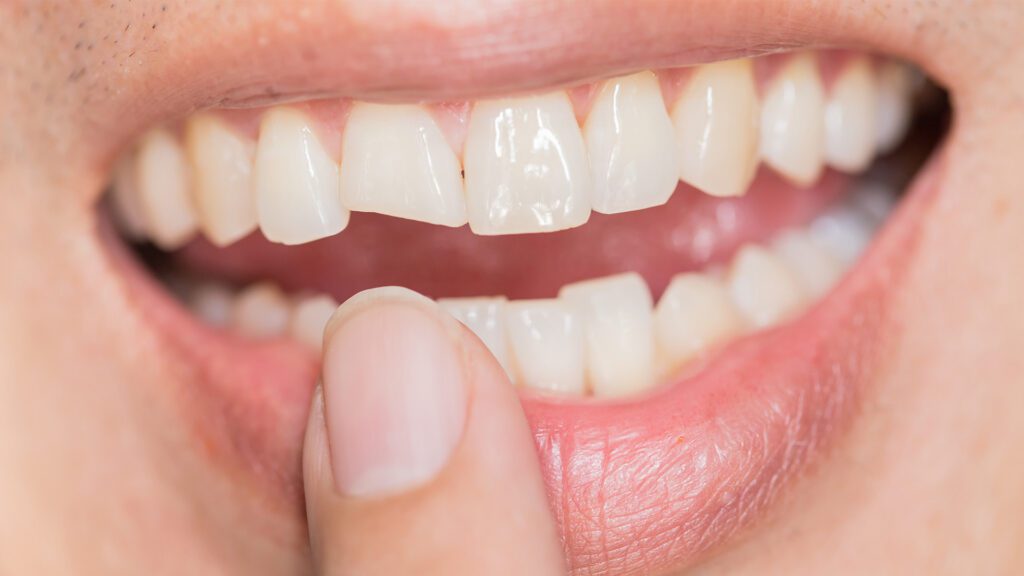
A tooth rarely breaks without warning. Long before a painful fracture, there may be a tiny crack, a weakening old filling, or an early area of decay quietly changing the strength of the tooth. Finding these changes early can mean the difference between a simple treatment and an unexpected dental emergency.
Why a healthy-looking tooth can become weak:
Teeth are remarkably strong, but they are not indestructible. Every day they absorb thousands of chewing forces. Grinding or clenching adds even more pressure. Over time, repeated stress can create microscopic lines in enamel and in the deeper layer of the tooth, called dentin. Most people cannot see or feel these early changes.
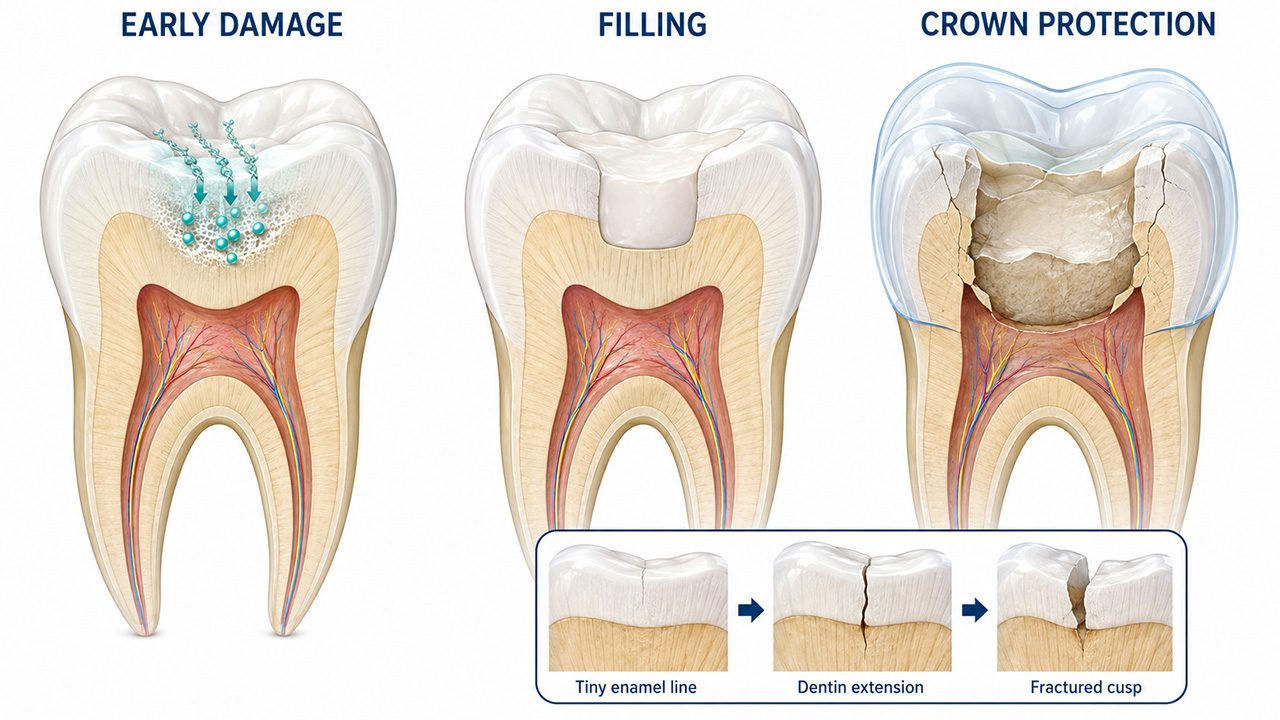
Old or large fillings can also change the way a tooth handles pressure. A filling replaces missing tooth structure, but it does not make the remaining walls thicker. If the walls or cusps the raised points on a back tooth become thin, they can flex each time you bite. That repeated movement may allow a small crack to grow.
Decay adds another problem. Bacteria use sugars and starches from food to make acid. Repeated acid attacks pull minerals from the tooth. Decay around the edge of an older filling may even develop where it is difficult to see. As more tooth structure is lost, the tooth becomes less able to withstand normal chewing forces.
Treatment depends on how much healthy tooth remains: early damage may be remineralized, a smaller defect may need a filling, and a severely weakened tooth may need protective coverage.
A filling or a crown?
This is one of the most common questions patients ask. The answer is not based only on the size of the cavity. We also look at where the damage is located, which walls and cusps remain, whether a crack is present, how heavily the tooth is used, and whether the nerve is healthy.
When a filling may be enough
A filling is usually appropriate when the damaged area is small to moderate and the main walls and cusps remain strong. The goal is to remove the unhealthy portion, restore the shape of the tooth, and preserve as much natural structure as possible.
When a crown may be the safer choice
A crown covers and braces the tooth so chewing forces are spread across the remaining structure. It may be recommended when there is a very large or failing filling, several damaged surfaces, a missing or cracked cusp, a deep crack, or major loss of tooth structure. Back teeth that have had root canal treatment often need this protection not simply because they had a root canal, but because decay, cracks, and the access opening may have already removed much of their supporting structure.
Signs that deserve attention
A crack can be difficult to locate. The discomfort may come and go, and the tooth may look normal. Call your dentist if you notice:
- a quick, sharp pain when biting or especially when releasing your bite;
- new sensitivity to cold or sweets that seems to come from one area;
- a rough edge, visible line, or movement of part of a tooth; or
- repeated sensitivity or food trapping around a large or older filling.
What you can do to protect your teeth
Regular examinations give us the best chance to find small problems before they become emergencies. Depending on the tooth, we may use X-rays, magnification, light passed through the tooth, or a gentle bite test. Large and older fillings should be checked for gaps, cracks, worn edges, and decay around or underneath them.
At home, brush twice a day with fluoride toothpaste, clean between your teeth daily, and avoid frequent sipping or snacking on sugary or acidic foods. If you grind or clench, a properly fitted nightguard may reduce repeated stress. Most importantly, do not ignore a new sharp bite pain. Earlier care usually allows us to preserve more of the natural tooth.
The goal is not simply to place the smallest or largest restoration. It is to choose the most conservative treatment that can predictably protect the tooth for years to come.
Selected references
- American Dental Association. Restorative Caries Treatment Guidelines.
- Schlee M., et al. Randomized clinical trials on P11-4 (Curodont) for initial caries; systematic reviews/meta-analyses on P11-4 effectiveness.
- Fejerskov O., Kidd E. Dental Caries: The Disease and Its Clinical Management.
- Cohen S., Burns R.C. Pathways of the Pulp diagnosis and management of cracked tooth syndrome.
- Operative dentistry literature on restoration size and crown indications (J Dent Res; operative dentistry reviews).
Any content, resident submissions, guest columns, advertisements, and advertorials are not necessarily endorsed by or represent the views of Best Version Media LLC (BVM) or any municipality, homeowners associations, businesses, or organizations that this publication serves. BVM is not responsible for the reliability, suitability, or timeliness of any content submitted, inclusive of materials generated or composed through artificial intelligence (AI). All content submitted is done so at the sole discretion of the submitting party.