What if you could stop a cavity before you needed a filling?
For many patients, that is now possible. Tooth decay does not happen overnight. It develops in stages, and when it is caught early, it can often be slowed, stopped, or even reversed without a drill or a needle. Modern, minimally invasive dentistry focuses on protecting as much of your natural tooth as possible, and early evaluation is what makes that possible.
Early demineralization vs. a true cavity
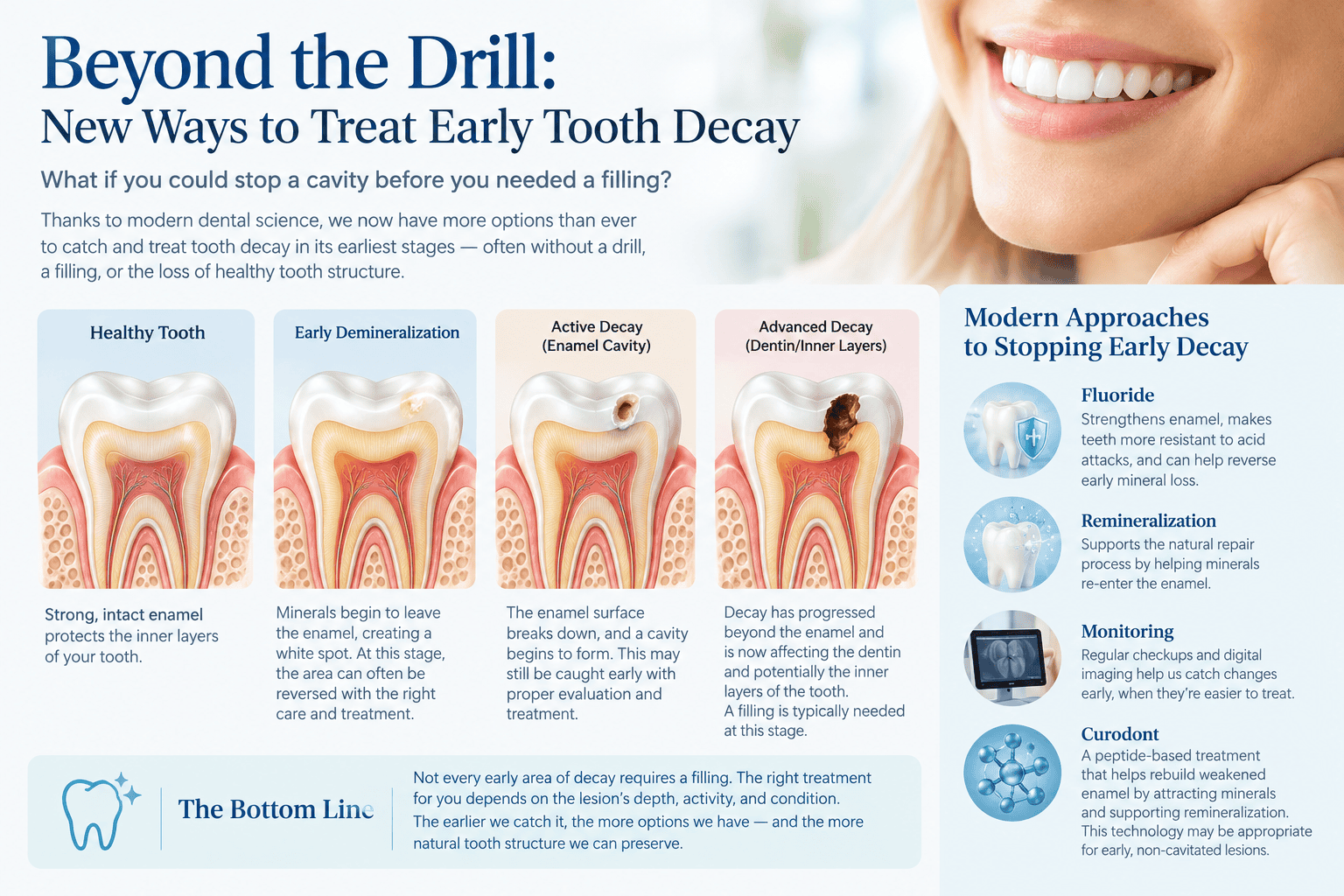
Enamel is constantly losing and regaining minerals. When bacteria in plaque feed on sugars, they produce acids that pull calcium and phosphate out of the enamel. If this happens faster than your saliva can replace those minerals, the enamel weakens beneath the surface.
This first stage is called demineralization. It often appears as a chalky white spot, and the surface of the tooth is still intact. A true cavity forms when the enamel breaks down and a hole, or cavitation, develops. Once that structural damage occurs, the tooth cannot rebuild itself, and a restoration is usually needed.
Remineralization and fluoride
Before a cavity forms, the balance can be tipped back in the tooth’s favor. This process, called remineralization, restores minerals to weakened enamel.
Fluoride is one of the most effective tools for this. It helps enamel absorb calcium and phosphate and forms a stronger, more acid-resistant surface. Depending on your risk level, your dentist may recommend in-office fluoride varnish, a prescription-strength fluoride toothpaste, or other remineralizing products. Reducing how often you snack on sugary foods and drinks, and keeping up with daily brushing and flossing, gives these treatments the best chance to work.
Watching instead of drilling
Some early lesions are best managed by careful monitoring. Your dentist may track a spot over time with photographs, radiographs, and clinical exams to see whether it is stable, improving, or progressing. An inactive lesion that stays the same may never need a filling. An active lesion that keeps growing calls for a different plan.
Peptide technology: helping enamel rebuild from within
One of the newest options for early decay is peptide-based treatment, such as Curodont Repair. It uses a self-assembling peptide that is painted onto the affected area. The peptide seeps into the tiny pores of the weakened enamel and forms a three-dimensional scaffold. That scaffold attracts calcium and phosphate from saliva, helping the enamel regenerate from the inside out.
The treatment is quick and comfortable, with no drilling and no anesthetic. It is designed for early, non-cavitated lesions, so it is not a replacement for a filling once a true cavity has formed. Your dentist will determine whether a particular spot is a good candidate.
The takeaway
Not every early area of decay requires a filling. The right treatment depends on the lesion’s depth, whether it is active, and the overall condition of the tooth. That is why timing matters: the earlier a weak spot is found, the more options you have to protect your natural tooth.
If it has been a while since your last exam, or if you have noticed white spots or sensitivity, schedule an evaluation.
Any content, resident submissions, guest columns, advertisements, and advertorials are not necessarily endorsed by or represent the views of Best Version Media LLC (BVM) or any municipality, homeowners associations, businesses, or organizations that this publication serves. BVM is not responsible for the reliability, suitability, or timeliness of any content submitted, inclusive of materials generated or composed through artificial intelligence (AI). All content submitted is done so at the sole discretion of the submitting party.