There is a very specific moment every fall when the humidity finally loosens its grip, the sweaters come out, and those of us in aesthetics collectively think the same thing: finally. Laser season.
Summer is wonderful for many things. Aggressive resurfacing is generally not one of them. Cooler months make it easier to protect healing skin from intense sun exposure, which means November is the perfect time to talk about one of my favorite concepts in skin rejuvenation: choosing the right amount of resurfacing for the result you actually want.
Not every patient needs the biggest laser in the building. And not every patient who wants a dramatic correction is going to get there with a lunchtime treatment. The trick is matching the technology, intensity and downtime to the problem.
Think of it as choosing your heat level: GLOW -> RESURFACE -> REBUILD.

Submitted photo
GLOW: ULTRA VAMP™
For patients who want brighter, smoother, healthier-looking skin without disappearing for a week, ULTRA VAMP™ is our regenerative starting point. We combine LaseMD Ultra thulium laser treatment with our trademark Vampire Facial® approach using SkinPen® microneedling and PRP.
LaseMD Ultra creates microscopic treatment channels while targeting pigment, texture and overall skin quality. Microneedling provides a second controlled stimulus, while platelet-rich plasma brings your own concentrated platelet-derived signaling factors into the recovery process. The goal is not to sand your face off. It is to create a carefully controlled injury that tells the skin, very politely but very firmly, to get back to work.
ULTRA VAMP™ is our glow end of the spectrum: meaningful stimulation, minimal downtime and a great option when the goal is fresher skin rather than a full resurfacing event.
RESURFACE: ERBIUM
When pigment, fine lines, rough texture and accumulated sun damage are more established, we can turn up the correction. Erbium resurfacing removes very thin layers of damaged skin with precise thermal injury, allowing us to address texture and photodamage more aggressively than a nonablative treatment.
More correction means more recovery. That is not a complication; it is part of the tradeoff. If you want a deeper reset, your skin needs time to rebuild.
REBUILD: FRACTIONAL CO₂
Then there is CO₂. Carbon dioxide laser resurfacing remains one of the benchmark technologies for ablative skin resurfacing because it can address wrinkles, laxity, scars, texture and significant photodamage while driving substantial collagen remodeling.
This is the end of the spectrum where we stop pretending downtime is a dirty word. Fractional CO₂ intentionally creates columns of ablation and thermal injury while leaving intervening tissue to support healing. The treatment can be customized, but patients choosing more aggressive correction should expect a real recovery period.
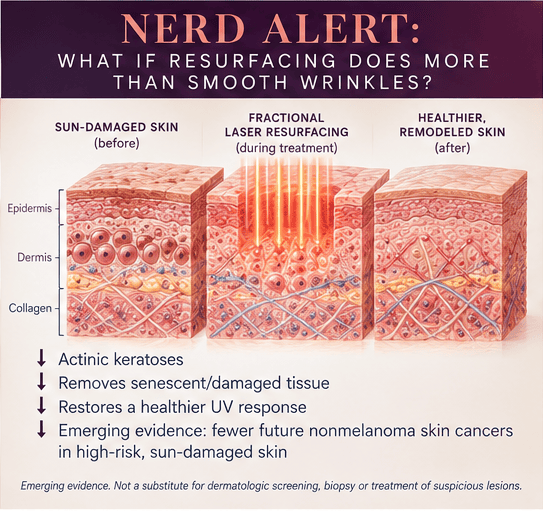
NERD ALERT: WHAT IF RESURFACING DOES MORE THAN SMOOTH WRINKLES?
This is where the story gets much more interesting than cosmetic rejuvenation.
Years of ultraviolet exposure do not always create one isolated bad spot. They can create an entire field of photodamaged skin containing visible actinic keratoses and microscopic cellular abnormalities. Dermatologists call this field cancerization. Actinic keratoses are precancerous lesions associated with the pathway to cutaneous squamous cell carcinoma, which is why suspicious or changing lesions still belong with dermatology.
But emerging research suggests that resurfacing an entire photodamaged field may influence more than appearance.
Submitted photo
In a prospective randomized clinical trial of adults 60 and older with significant actinic damage, researchers treated one forearm with fractionated laser resurfacing and left the other untreated. The treated arms developed fewer actinic keratoses over time and, during follow-up, only 2 nonmelanoma skin cancers occurred on treated arms compared with 24 on untreated arms. Researchers linked the effect to elimination of senescent fibroblasts and restoration of a healthier response to ultraviolet injury.
That is an extraordinary finding, but it needs context. This was a specific high-risk older population, and laser resurfacing is not currently a substitute for sunscreen, routine dermatologic screening, biopsy or treatment of a suspicious lesion. We also should not promise that a cosmetic CO₂ treatment will prevent skin cancer.
What the research does suggest is genuinely exciting: ablative and fractionated resurfacing may have a future role as a field-directed strategy for chronically sun-damaged skin, not simply as a wrinkle treatment. A 2025 systematic review likewise found that laser resurfacing, particularly ablative approaches, can reduce actinic keratoses, while emphasizing that more long-term research is needed to define its role in preventing nonmelanoma skin cancer.
And the science keeps moving. A 2026 review found that pretreatment with ablative fractional CO₂ or Er:YAG lasers improved outcomes when used with photodynamic therapy for actinic keratoses and field cancerization, particularly in thicker or treatment-resistant areas.
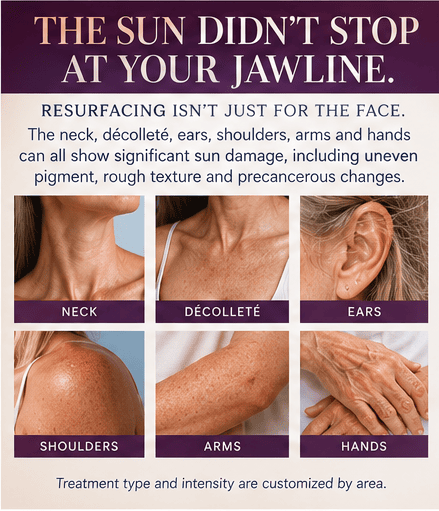
THE SUN DIDN’T STOP AT YOUR JAWLINE
One more thing: resurfacing is not just for the face.
The neck, décolleté, ears, shoulders, forearms and hands can carry decades of photodamage too, including mottled pigment, rough texture and actinic change. In fact, the randomized fractionated-laser study above was performed on forearms, not faces.
That does not mean we treat every body area exactly the way we treat facial skin. Healing characteristics vary by location, so laser type, density and intensity must be customized carefully. Same technology does not mean same treatment protocol.
Your skincare may have stopped at your jawline for twenty years. Unfortunately, the sun did not.
SO… HOW HOT SHOULD WE GO?
The answer is not “as hot as possible.” The answer is as much treatment as your skin needs, your goals justify and your schedule can realistically tolerate.
If you want glow with minimal downtime, start with ULTRA VAMP™. If you need more correction for pigment and texture, we can discuss Erbium. If significant wrinkles, texture, laxity or photodamage call for a more substantial reset, fractional CO₂ may be the better conversation.
And sometimes the smartest plan is staged. Skin rejuvenation is not a contest to see who can peel the hardest.
Submitted photo
At AnAesthetics Goldsboro, consultations are always complimentary because choosing a laser should involve more than pointing at a menu. We evaluate your skin, your history, the area being treated, your tolerance for downtime and what you actually want to change.
The heat is on. Laser season has officially arrived.
Research referenced
Spandau DF, et al. Randomized controlled trial of fractionated laser resurfacing on aged skin as prophylaxis against actinic neoplasia. Journal of Clinical Investigation. Prospective randomized trial; ClinicalTrials.gov NCT03906253.
Zhou MH, et al. Laser and chemical resurfacing as field treatment for actinic keratoses: a systematic review of the literature. Journal of Cosmetic and Laser Therapy. 2025.
Advances in enhancing photodynamic therapy for actinic keratoses and field-damage with laser pretreatments: a scoping review. 2026. Review of CO2, Er:YAG and 1927-nm thulium laser pretreatment before PDT.
Medical note: Laser resurfacing is not a substitute for dermatologic evaluation, biopsy, or treatment of suspicious lesions. Treatment selection and intensity should be individualized by anatomy, skin type, medical history and clinical findings.
Any content, resident submissions, guest columns, advertisements, and advertorials are not necessarily endorsed by or represent the views of Best Version Media LLC (BVM) or any municipality, homeowners associations, businesses, or organizations that this publication serves. BVM is not responsible for the reliability, suitability, or timeliness of any content submitted, inclusive of materials generated or composed through artificial intelligence (AI). All content submitted is done so at the sole discretion of the submitting party.