
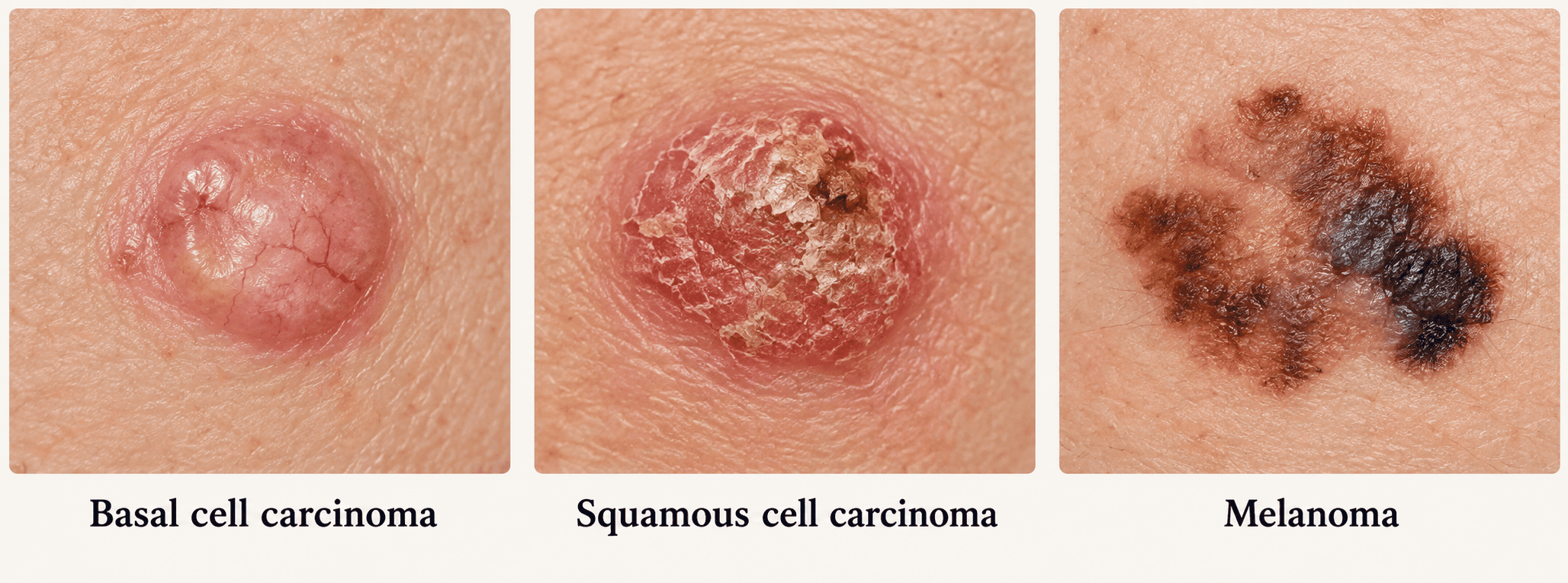
Skin cancer occurs when abnormal skin cells begin growing uncontrollably. The primary cause is damage from ultraviolet (UV) radiation, which comes from sunlight and tanning beds. The three most common types of skin cancer are basal cell carcinoma, squamous cell carcinoma, and melanoma. They develop from different skin cells and do not all carry the same level of risk.
Basal cell carcinoma is the most common type. It usually grows slowly and rarely spreads to distant organs, but it can damage nearby tissues if it is not treated. Squamous cell carcinoma is the second most common type. It can grow more aggressively and has a greater chance of spreading than basal cell carcinoma. Melanoma is less common than the other two, but it is the most dangerous because it is more likely to spread to other parts of the body. Squamous cell carcinoma and melanoma will be explored more fully in the next article; the remainder of this article focuses on basal cell carcinoma.
What Is Basal Cell Carcinoma?
Basal cell carcinoma, commonly shortened to BCC, begins in the basal cells near the bottom of the skin’s outer layer. These cells normally make new skin cells as older ones wear away. When their DNA is damaged—most often by UV radiation—they can begin growing abnormally.
BCC most commonly develops on areas that receive frequent sun exposure, including the face, ears, scalp, neck, shoulders, and arms. However, it can occur anywhere on the body. Risk increases with fair skin, repeated sunburns, tanning-bed use, older age, a weakened immune system, and a personal or family history of skin cancer.
What Does It Look Like?
Basal cell carcinoma can have several appearances. It may look like a shiny or pearly bump, a pink or red patch, or a sore that repeatedly bleeds, scabs over, and returns. Some growths contain visible blood vessels, while others appear pale and waxy like a scar. Pigmented BCC may be brown, blue, or black and can be mistaken for a mole.
Because BCC often grows slowly and may not hurt, people sometimes dismiss it as a pimple, scratch, or patch of eczema. A skin lesion that does not heal, repeatedly bleeds, or continues to change should be evaluated by a medical professional.
Treatment and Outlook
Basal cell carcinoma rarely spreads to distant parts of the body, but it is not harmless. Without treatment, it can grow deeper and damage surrounding skin, nerves, cartilage, or bone. Cancers near the eyes, nose, ears, and lips can become especially difficult to treat.
Most BCCs are highly curable when found early. Treatment depends on the tumor’s size, depth, location, and growth pattern. Standard surgical excision removes the tumor along with a small border of normal-looking skin. Mohs surgery removes and examines thin layers one at a time until no cancer remains. This method is commonly used for facial tumors, recurrent cancers, or growths with unclear borders. Certain superficial tumors may instead be treated with prescription creams, scraping and cauterization, freezing, or radiation.
After treatment, regular skin examinations remain important because developing one BCC increases the chance of developing another. Using broad-spectrum sunscreen, wearing protective clothing, seeking shade, and avoiding tanning beds can help reduce future risk.
Any content, resident submissions, guest columns, advertisements, and advertorials are not necessarily endorsed by or represent the views of Best Version Media LLC (BVM) or any municipality, homeowners associations, businesses, or organizations that this publication serves. BVM is not responsible for the reliability, suitability, or timeliness of any content submitted, inclusive of materials generated or composed through artificial intelligence (AI). All content submitted is done so at the sole discretion of the submitting party.