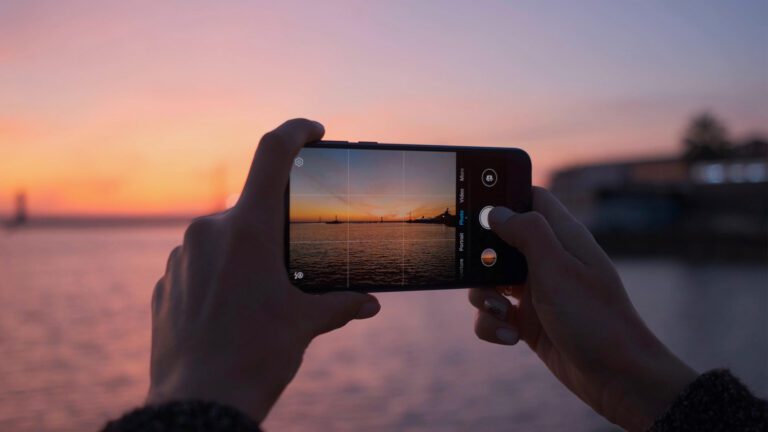
The best camera, photographers like to say, is the one you have with you. For almost all of us, that is a cell phone. I shoot for a living with professional gear, and I still take pictures of my cats doing ridiculous things with my phone, because the moment was there and so was my phone. The good news is that the phone in your pocket is genuinely capable. Most people just never learned the handful of small habits that separate a snapshot you scroll past from a picture you actually want to keep.
None of this requires an app, an upgrade, or a single technical term. It is mostly about paying attention to a few things before you tap the shutter.
Light is something you can see before you shoot.
Here is a photo nearly everyone has taken: someone standing in front of a sunny window, coming out as a dark shape with no face, because the light was behind them instead of on them. The fix is simple – just turn the person so the window is in front of them, lighting their face rather than falling behind them. And here is the part that is unique to a phone: you can watch it happen. As they turn, the face brightens right there on your screen, going from shadowed to lit in real time. The screen is quietly showing you the picture before you ever take it, which means you can simply wait until the face looks good and then snap that shutter.
Get closer with your feet, not the zoom.
When something is too far away, the natural move is to pinch the screen and zoom in. The trouble is what the phone is actually doing. Its main camera has a fixed lens that cannot truly reach out the way a dedicated zoom lens can, so past a certain point it stops magnifying and starts cropping, enlarging a smaller piece of the picture and filling in detail it never really captured. That is why a zoomed shot often looks softer or grainier than what your eye saw. Newer phones are getting better at this, with a second lens that handles a bit of zoom more gracefully, though even that has its limits. So when you can, walk in a few steps instead, and let the thing that matters – the face, the hands, the small detail – fill the frame on its own. Your screen will show you when you have arrived.
Come down to their level.
Here is something you already know without realizing it: when people take a selfie, they hold the phone up high and angle it down, because they have learned that angle is flattering. Yet the moment we turn the camera on someone else, we do the opposite without thinking, standing at our full height, phone at our chest, tilted down at whoever is below us. For children and pets, that is almost everyone. Looking down on someone that way is rarely flattering, and it quietly turns the picture into something seen from above rather than something shared. The fix costs nothing but your knees: crouch down so the phone meets them at their own eye level. A toddler photographed straight on, eye to eye, suddenly looks like a little person with a whole inner world, rather than a small shape on the floor. Because the phone is light and untethered, you can drop down low, hold it out, and use the screen to see their world the way they actually see it.
Wait for the moment after the moment.
When we point a phone at people, we ask them to say cheese, they freeze into a smile, we tap the shutter, and we stop. The trouble is that the cheese smile is almost never the keeper. It is the picture of people being photographed, not the picture of people. The real one usually comes a half-second later, when the pose breaks and someone laughs for real, or glances at the person beside them, or rolls their eyes at the whole production. So take the posed shot if you must, and then simply keep going. This is where the phone hands you a real advantage: a feature called burst mode, which fires off a rapid run of photos, often around ten a second, for as long as you hold the shutter. It is worth taking a minute to learn how yours turns it on, since it differs from phone to phone. Point it at the kids right as the pose falls apart and let it run, and instead of one stiff frame you will have a whole sequence to scroll through, almost always with one or two where someone is genuinely, unmistakably themselves. The genuine expression is always worth more than the tidy one, and burst mode gives you the room to wait for it.
None of this is about expensive gear or getting it perfect. The phone in your pocket is a genuinely good camera, better than most people give it credit for, and its greatest trick is simply that it is always with you, ready for the moment that would have been gone by the time you fetched anything else. So keep it light and have fun with it. Take too many pics, laugh at the bad ones, and every so often you will catch an image that stops you in your tracks, the real smile, the soft light, the whole afternoon held in a single frame. That is the joy of it, and it is right there in your pocket.
Deborah Heinlen is a Hebron-based photographer specializing in professional headshots and family portraits, serving Northern Kentucky and Greater Cincinnati. She can be reached at deborahheinlenphotography.com.
Any content, resident submissions, guest columns, advertisements, and advertorials are not necessarily endorsed by or represent the views of Best Version Media LLC (BVM) or any municipality, homeowners associations, businesses, or organizations that this publication serves. BVM is not responsible for the reliability, suitability, or timeliness of any content submitted, inclusive of materials generated or composed through artificial intelligence (AI). All content submitted is done so at the sole discretion of the submitting party.