In our 30 years of working in clients’ homes, one concern comes up every fall without fail: “I can feel the cold coming right through my windows.” It’s one of the most common comfort complaints I hear, and one of the most solvable. You may not realize that the right window treatments can do far more than dress a room. They can meaningfully reduce heat loss, lower your heating load, and keep your home feeling warm and comfortable all winter. Here’s how to think about it, from a solid starting point to a fully layered solution.
Good: Cellular shades
If you’re looking for a single, high-performing solution, cellular shades (also called honeycomb shades) are the most effective window treatment for insulation. Their signature honeycomb construction traps air in pockets between the window and the room, creating a thermal barrier that works in both directions: keeping cold out in winter and heat out in summer. Double- and triple-cell options offer progressively better insulation. They’re a clean, streamlined solution that works beautifully on its own, and even better as the foundation of a layered treatment.
Better: Layer with draperies
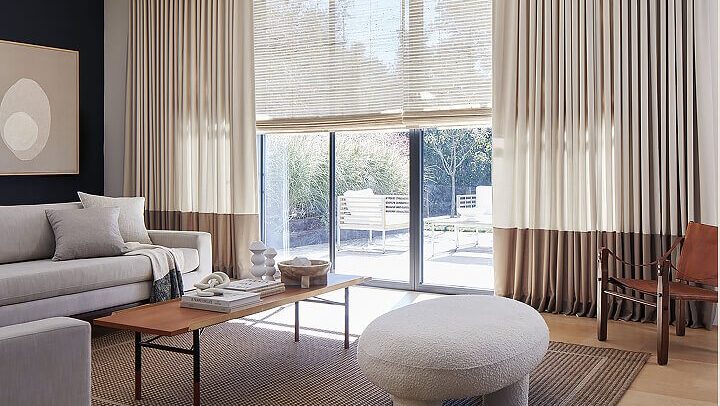
Adding drapery panels over a cellular shade takes your window’s thermal performance to another level. When draperies are closed, they create a second layer of insulation, trapping air between the shade and the panel, significantly reducing convective heat loss along the window wall. Beyond the practical benefit, the layered look is the design standard in well-appointed rooms, adding softness, height, and a finished quality that a shade alone can’t achieve.
Best: Drapery fabrication details that maximize warmth
When thermal performance is the priority, the construction of the draperies themselves matters. A blackout lining adds a dense, insulating layer to any panel. For maximum warmth, interlining—a soft, blanket-like fabric sewn between the face fabric and the lining—takes it further still, adding substantial weight, body, and insulating depth. Interlined draperies hang beautifully, feel luxurious, and perform like nothing else at a cold window.
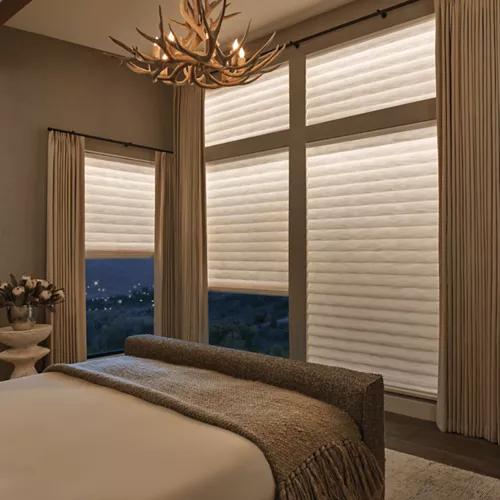
Submitted photo
One detail that makes a notable difference: draperies should be hung as close to the ceiling as possible and extend to the floor, with minimal gap at the sides. The better the seal around the window, the less cold air can circulate from behind the panel.
The smart layer: motorization
Even the best window treatments only work when they’re closed. Motorized shades and draperies can be programmed to close automatically at sunset, when heat loss through windows accelerates, and open again in the morning to let passive solar heat in. It’s one of the most practical arguments for automation: your home manages its own heat gain and loss without any effort on your part.
Windows can be the weakest link in a home’s insulation, but they don’t have to be. The right treatment, thoughtfully chosen and properly installed, transforms a source of heat loss into a beautifully dressed, well-insulated part of your home.
Designer Draperies
1425 Lark Lane, Hainesport, NJ 08036
(609) 702-1261 designerdraperies.net
Any content, resident submissions, guest columns, advertisements, and advertorials are not necessarily endorsed by or represent the views of Best Version Media LLC (BVM) or any municipality, homeowners associations, businesses, or organizations that this publication serves. BVM is not responsible for the reliability, suitability, or timeliness of any content submitted, inclusive of materials generated or composed through artificial intelligence (AI). All content submitted is done so at the sole discretion of the submitting party.