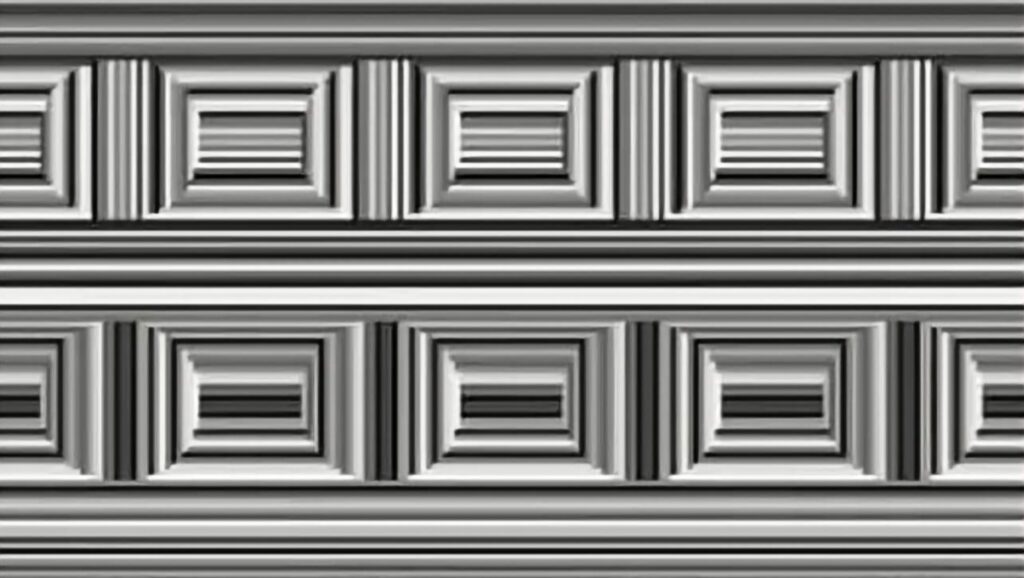
I sat in front of a group of teachers and said, “I want to play a game.” I projected an image onto the screen and told them to take a moment to notice it.
“People usually only see one of two shapes: circles or squares.”
“Those are rectangles. There’s a difference.” One teacher interjected.
I smiled, “What shapes do you see?”
The answers came quickly. “Squares!”
“I see circles!” a teacher said.
“How do you see circles?”
“I see both.”
“Are we looking at the same picture? What did you take?”
There were confused chuckles and facial expressions in the room. I took the image off the screen and asked them, “By a show of hands, who saw squares?” Most of the room raised their hands.
“Who saw circles?” Three teachers raised their hands.
There was much chatter back and forth among all the square-seeing people, trying to figure out how the three teachers saw circles. I put the image back onto the screen and said, “Look again.”
All the people who originally saw squares continued to see only squares.
At this point, there was a quiet kind of insistence in the room, not argumentative, though firm. Each person was certain that the shape that they saw in the image was correct.
“We are all looking at the same picture, yet people are seeing two completely different shapes. For those who saw squares, try softening your gaze. Don’t focus so hard on the edges.”
I sat back watching the circle-seeing people trying to show the square-seeing people what they were seeing. I notice some people squinting and some tilting their heads, striving to see what they are missing. At first, nothing changed. Then the perception-shift announcements started coming in waves.
“Oh… there they are.”
“I see them now.”
“There are circles!”
“I can see both now!”
Those who were certain, so clear, have now become open. The announcements were followed by a burst of enlightened laughter. One person was still having difficulty seeing the circles. “I do not know how all of you are seeing circles.”
I took out my laser pointer and moved the red dot around the line of the circles in the image. “Ah, there it is. I see it.”
Moments like that don’t just live in exercises like this; they also show up in our classrooms, in conversations with families, friends, or aggrieved acquaintances. It happens in small, common moments where we’re asked to make sense of what’s happening between people.
Parents and teachers experience these occasions all the time when children are in conflict. One child tells their version of a story. Another child tells theirs. An adult steps in, trying to understand and help, and, without realizing it, begins to piece together a version that feels clear and complete. Often, we’re standing in the same moment, holding different truths; each one real, each one partial.
The ability to shift how we see something doesn’t come naturally. Even in a room full of adults, it took time. It took pausing. It took letting go of their certainty that what we were seeing was the whole of it.
For children, this work is just beginning. They are learning how to hold more than one version of a moment. How to listen to someone else’s experience without losing their own. How to stay present in the discomfort of not being fully understood—and of not fully understanding.
Sometimes, what we can’t yet see… is right before our eyes.
Truth is—We are learning too.