As we continue celebrating 50 years of caring for our community, one of the most exciting changes we’ve witnessed is how technology is improving eye exams, our ability to catch diseases early, and our ability to identify the best solutions for you.
Imagine getting an eye exam and all the doctor does is hold up a chart, shine a light in your eyes, and send you on your way. No cameras. No scans. No computers. Just you, a chart, and a doctor with a good eye and a steady hand.
Believe it or not, that was a perfectly good eye exam — and not that long ago. Today, that same visit might involve cameras and computers that can spot health problems your regular doctor hasn’t caught yet. So how did a simple eye check turn into all of this?
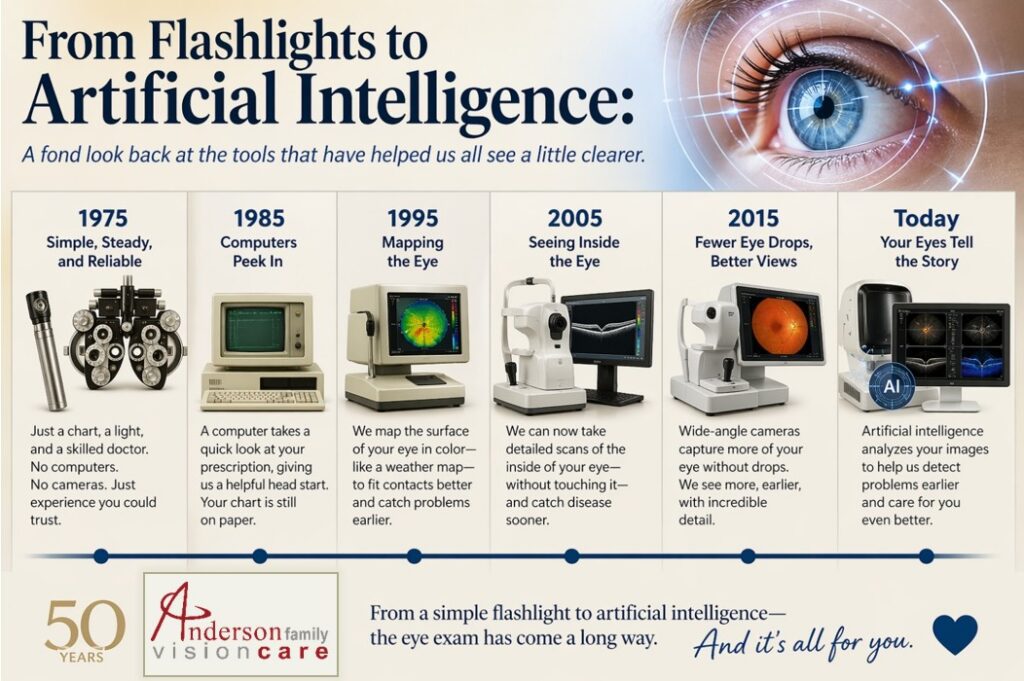
1975: Simple, Steady, and Reliable
The doctor slid lenses in front of your eyes and asked: “Better with one… or two?” Eye pressure was checked with that dreaded puff of air. To see the back of your eye, they used drops to open your pupils wide enough so a bright handheld light could help your doctor check for any signs of disease. No computers. No cameras. Just a skilled doctor and a lifetime of practice.
1985: Computers Peek In
A new machine arrived that could take a quick automated guess at your glasses prescription… not precise enough to replace the doctor, but a helpful head start. Your records? Still a paper chart in a manila folder. Progress was coming, just not to the front desk yet.
1995: Mapping the Eye
Doctors now had a tool that created a colour-coded map of the surface of your eye, like a weather map for your cornea. It helped fit contacts more precisely and catch problems early that were once impossible to see. A computer finally showed up at the front desk too, though it ran on dial-up and nobody was impressed.
2005: Seeing Inside the Eye
A breakthrough scan — think ultrasound, but using light — could now photograph the layers of tissue at the back of your eye without touching it at all. For the first time, doctors could catch early signs of macular degeneration and glaucoma before you noticed a single symptom. Digital cameras let them compare your eye year to year and actually show you what was changing.
2015: Fewer Eye Drops, Better Views
New wide-angle cameras could now photograph up to 80% of the back of your eye in a single shot, often without dilation drops. Patients everywhere rejoiced. Doctors could also see the tiny blood vessels inside the eye in remarkable detail to check for circulation problems, no injections required.
Today: Your Eyes Tell the Story
From a simple flashlight to artificial intelligence, the eye exam has come a long way. And every one of those advances exists for one simple reason: to help you see the world as clearly as possible, for as long as possible.
Dr. Matthew Anderson, Developmental Optometrist at Anderson Family Vision Care, provides vision care for the entire family and also provides specialized services in the diagnosis and treatment of vision problems that interfere with reading and learning. Dr. Anderson is a popular speaker with parents and professional groups and may be reached at 204-633-7482. For more information, visit www.andersonvisioncare.ca.