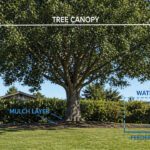
As we move out of spring and into early summer, Oak Bay is at its absolute best. Fresh green growth fills out the canopy, gardens are coming to life, and everything feels vibrant after the long winter months. It is the season where our landscapes feel the most alive.
It is also the time to start thinking ahead… Because while spring brings abundance, summer on the coast increasingly brings extended dry periods. Our trees are about to shift from a season of growth into a season of conservation and over the past few years, one thing has become increasingly clear: our trees are feeling the strain of drought.
In Oak Bay, we are fortunate to live among a beautiful canopy of mature trees. Garry oaks, cedars, maples, and ornamental species have defined the character of our streets for generations. But many of these trees established themselves in a very different climate pattern than what we are experiencing today.
Often, the signs are not dramatic at first.
Drought stress tends to show up quietly. Smaller leaves, early leaf drop, thinning canopies, or an increase in deadwood are all early indicators. By the time a tree looks obviously stressed, it has usually been struggling for a while.
The good news is there are practical, effective ways to help without wasting water or overcomplicating things.
Start With Structure: Why Deadwood Removal Matters
One of the simplest ways to support a tree during drought is proper pruning, specifically removing deadwood from an otherwise healthy canopy.
Dead branches do not contribute to the tree’s energy production, but they still draw on limited resources, specificly water. Removing them allows the tree to redirect energy and water to the living canopy that actually needs it.
Watering Smarter, Not More
When it comes to watering, the goal is not frequency. It is depth. Trees benefit far more from slow, deep watering than from frequent, shallow watering. Surface watering often evaporates quickly or encourages roots to stay near the surface, making trees more vulnerable to full failure. Soaker hoses and tree watering bags are excellent tools. They release water slowly, allowing it to reach deeper into the soil. For larger trees, lay a soaker hose in a wide ring around the dripline, not against the trunk, to mimic a slow soaking rainfall.
A Simple, Cost-Effective Trick
If you are looking for a low-cost option, there is a simple method we often recommend.
Take a garbage can or large tote, drill small holes in the bottom, and fill it with water. Place it near the dripline and let it drain slowly. Once empty, move it to a different section of the dripline the following week. It is an easy way to achieve deep, targeted watering without runoff, especially for larger trees.
Mulch and Moisture Retention
Mulch plays an important role as well. A proper layer helps retain soil moisture, regulate temperature, and reduce soil compaction over time. As organic mulch breaks down, it also adds nutrients back into the soil as a slow-release fertilizer. Just remember; keep mulch pulled back from the trunk. Think of a donut shape, not a volcano.
Supporting Trees for the Long Term
Drought is something we are likely to continue navigating.
The goal is not to eliminate stress entirely, but to give our trees the support they need to cope and recover. With thoughtful pruning, efficient watering, and simple strategies, we can help maintain the canopy that makes Oak Bay the gem that it is!
Any content, resident submissions, guest columns, advertisements, and advertorials are not necessarily endorsed by or represent the views of Best Version Media LLC (BVM) or any municipality, homeowners associations, businesses, or organizations that this publication serves. BVM is not responsible for the reliability, suitability, or timeliness of any content submitted, inclusive of materials generated or composed through artificial intelligence (AI). All content submitted is done so at the sole discretion of the submitting party.