If you’ve ever thought about straightening your teeth but hesitated at the idea of metal braces, Invisalign may already be on your radar. But what does “clear aligners” really mean—and are they the right choice for you?
This is the first in a series of articles providing the in-depth information you need before deciding if it’s right for you. In this series, we’ll cover:
- Invisalign basics
- Key benefits
- Who makes a good candidate
- What to expect during treatment
What Is Invisalign?
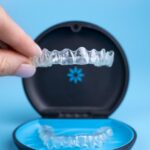
Invisalign is a system of custom-made, clear plastic aligners designed to gradually straighten teeth over time. Instead of metal brackets affixed to the teeth and connected by wires, Invisalign uses a series of removable trays that fit snugly over your teeth.
Each set of aligners is slightly different. You move from one set to the next, usually every one or two weeks, and as you do so, your teeth shift in small, controlled increments toward their final position.
It’s orthodontic treatment—just delivered in a more discreet, modern format.
How It’s Different From Braces
Both Invisalign and traditional braces aim to improve the alignment of your teeth and your bite function, which is how your upper and lower teeth meet when closing, chewing, or resting. The difference between the two methods lies in how that movement happens.
Traditional braces rely on fixed brackets and wires that are adjusted periodically. Invisalign uses clear, removable aligners that are replaced throughout treatment. For many patients, the appeal is obvious.
That said, removable also means the responsibility shifts to the patient, and Invisalign must be worn 20 to 22 hours a day to be effective. So, consistency matters.
What Invisalign Can Address
At its core, Invisalign is designed to correct a range of alignment issues, including:
- Crowded teeth
- Gaps between teeth
- Overbites
- Underbites
- Crossbites
- Mild to moderate bite irregularities
While many people think of orthodontics as cosmetic, the benefits go well beyond appearance. Straighter teeth are easier to clean, and a balanced bite can reduce uneven wear and strain on the jaw, which supports long-term oral health.
However, Invisalign isn’t suitable for everyone. More complex cases may still require traditional braces or a combined approach, which is why a thorough assessment is always the first step.
What Treatment Typically Involves
We’ll explore the full treatment process in a future article; here’s a high-level overview.
Treatment begins with a consultation and digital scans of your teeth. Using specialized planning software, we map out the precise movements required and design a series of aligners unique to you.
You’ll wear each set for about one to two weeks before moving to the next. Periodic check-ins ensure everything is progressing as planned.
Some patients complete their plan in six months. Others may take 12 to 18 months or longer, depending on the complexity of the movements and the consistency of the wearer.
What It Feels Like
A common question is whether Invisalign hurts.
Most patients describe a feeling of pressure when switching to a new set of aligners. That pressure usually lasts a few days and is a sign that the aligners are working. It’s generally considered mild and manageable, and because there are no wires or brackets, many patients find Invisalign more comfortable overall.
Is It Just for Teens?
Not at all.
While Invisalign is popular among teens, adults make up a significant portion of our patient base. In fact, many adults who didn’t have orthodontic treatment earlier in life, or whose teeth have shifted over time, choose Invisalign because it fits more seamlessly into work and social settings.
Clear aligners make orthodontic treatment feel less noticeable, which can make the decision easier for busy professionals and parents alike.
A Foundation for What’s Ahead
Invisalign is a made-to-measure, clinically guided orthodontic system that requires professional planning, monitoring, and patient commitment.
In the coming months, we’ll take a closer look at Invisalign. For now, the takeaway is simple: Invisalign offers a modern, discreet way to straighten teeth – when it’s properly planned and consistently worn.
If you’ve been curious about what’s possible for your smile, consider this your starting point. A personalized consultation at Edge Dental can help map out the most effective treatment approach for you.
Any content, resident submissions, guest columns, advertisements, and advertorials are not necessarily endorsed by or represent the views of Best Version Media LLC (BVM) or any municipality, homeowners associations, businesses, or organizations that this publication serves. BVM is not responsible for the reliability, suitability, or timeliness of any content submitted, inclusive of materials generated or composed through artificial intelligence (AI). All content submitted is done so at the sole discretion of the submitting party.