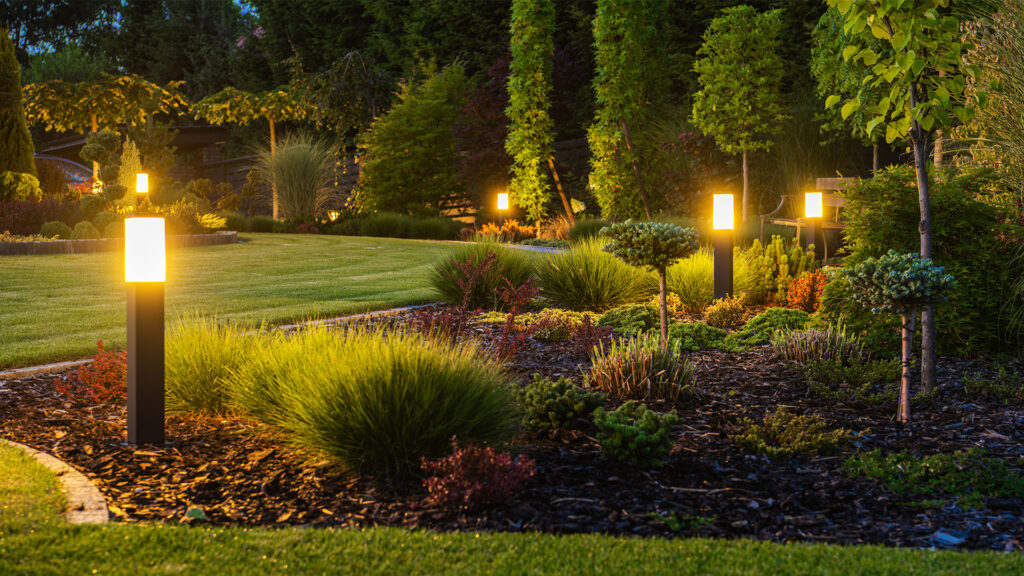
Designing a beautiful garden involves a combination of creativity, planning, and understanding of plants and their needs.
Here are some secrets to help you create a stunning garden:
Know Your Space: Understand the characteristics of your garden space, such as sunlight exposure, soil type, and drainage. This knowledge will help you choose the right plants and design elements.
Create a Focal Point: Every garden needs a focal point, whether it’s a stunning tree, a sculpture, a water feature, or a seating area. This draws the eye and adds interest to the space. Even a pool can be a focal point. I like to take a pool and envision the space as a lakefront, and then theme the rest of the landscape around it.
Consider Scale and Proportion: Choose plants and features that are appropriate in scale to your garden. For example, if you have a large-scale backyard, plants that are further away from the house should include larger plants such as shrubs, that you can see from a distance. For gardens that are close to your home, or if you have a small yard, you can play with the delicate details with a swath of perennials.
Plan for Year-Round Interest: Choose a combination of plants that will provide interest throughout the year, including evergreens for winter structure, spring bulbs for early colour, perennials for summer blooms, and plants with attractive fall foliage.
Use Colour Wisely: When choosing from the variety of plants above, be sure to implement colour theory to create harmonious or contrasting colour schemes—it doesn’t have to be static! Think about how colours will interact throughout the seasons as different plants bloom and fade. Often, we might design a garden to change in colour pallet as it goes through the seasons. You can begin with reds in the spring and splashes of purple for contrast. In the summer, you can enjoy pale pastels and various shades of pink, and then in the fall, your garden can go back to brilliant reds, oranges, and yellows and also be accompanied by the blues of the evergreens for the contrasting colour.
Add Texture: Incorporate a variety of textures in your garden, from the lacy frauns of ferns to the smooth, broad variegated leaves of hostas. This contrast adds depth and visual interest.
Integrate Gardens Around Your Hardscaping: Gardens do not only have to be on the periphery. Imagine feeling like the fairy in your own garden! Integrating gardens around your hardscaping, not only softens patio and deck edges, but it also allows you to be seated within the garden area.
Balance Symmetry and Asymmetry: While symmetrical designs can be formal and pleasing, asymmetrical designs can add a sense of movement and naturalness. Asymmetry has a way of drawing the eye further into your landscape.
Embrace Your Style: Let your garden reflect your personality and style. Whether you prefer a formal, structured garden or a wild, cottage-style oasis, designing a garden that speaks to you will bring the most joy.
A well-designed garden can grow and adapt over time, and come into its full splendour, year after year.