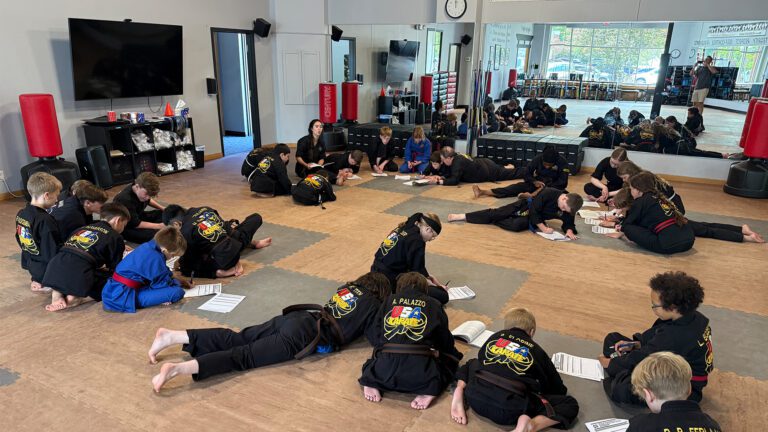
Walk into most martial arts schools during a class and you’ll see kicking drills, focus mitts, orderly lines of students practicing techniques with their eyes focused on the instructor. But if you pay closer attention, you’ll notice something deeper happening beneath the surface.
You’ll see a child who struggled with anxiety finally making eye contact. A shy child smiling because they finally feel capable. A student who once melted down under pressure learning to breathe and reset when faced with a challenge. A teenager discovering confidence without needing approval or “likes” from a screen. These are huge wins for life!
For many families today, martial arts class is no longer just an extracurricular activity. It has become an essential part of their lives to serve as a counterbalance to a culture that is overwhelming children emotionally, socially, and mentally. And the timing could not be more important.
Social psychologist Jonathan Haidt, author of The Anxious Generation, describes what he calls “the great rewiring of childhood.” He argues that childhood shifted dramatically in the early 2010s as smartphones, social media, and screen-based living replaced face-to-face interaction, physical play, and real-world independence.
Haidt writes:
“My central claim in this book is that these two trends—overprotection in the real world and underprotection in the virtual world—are the major reasons why children born after 1995 became the anxious generation.”
One of the hidden dangers of modern childhood is that many children are building their identity almost entirely through external validation of likes, views, and followers. They are looking for approval from external sources. Constantly comparing how they measure up to others. This is not healthy!
Parents are seeing the impact firsthand in their children. Rising anxiety. Emotional fragility. Difficulty focusing. Social withdrawal. Low confidence. Constant comparison. Children who are digitally connected but emotionally disconnected.
The numbers surrounding youth mental health continue to climb, but the deeper issue may be what children are missing. Movement, physical challenge, a sense of belonging, and the ability to keep going in the face of adversity. These are learned through real human connection, not a screen.
Children Need Experience, Not Just Information
One of Haidt’s most important observations is simple but powerful:
“Experience, not information, is the key to emotional development.”
Children do not build confidence by hearing motivational speeches or watching videos.
They build confidence by doing difficult things repeatedly until they discover they can handle discomfort, frustration, correction, and challenge. Martial arts provides that environment naturally.
Every class asks students to focus under pressure. To try again after mistakes. To learn to manage emotions and practice self-control. To work with partners respectfully.
To fail and continue anyway. That process matters because emotional strength is not developed through comfort. It is developed through guided struggle.
The Mental Health Value of Structure and Predictability
Children today live in an environment filled with constant stimulation and emotional unpredictability. Non-stop notifications, social pressure, endless scrolling, and comparison-driven platforms keep many kids mentally overstimulated and emotionally unsettled and unsure of themselves.
Many children struggling with anxiety are not looking for unlimited freedom. They are looking for stability. They want environments where expectations are clear. The martial arts floor becomes a place where children know exactly what is expected of them and exactly how to improve. That predictability builds emotional security.
Physical Movement Changes Emotional State
Children were not designed to sit for hours staring at screens. Yet much of modern childhood revolves around passive consumption.
Haidt warns that today’s children are living increasingly “phone-based” childhoods rather than “play-based” childhoods.
Martial arts interrupts that cycle immediately. Training activates the body and mind together. Students move, react, sweat, balance, breathe, and engage physically with their environment. That physical engagement matters because movement directly affects emotional regulation.
Martial Arts Teaches Emotional Regulation in Real Time
Many parents today are searching for ways to help children manage emotions more effectively. What often gets overlooked is that emotional control cannot be taught only through conversation. It must be practiced physically and emotionally under stress.
Martial arts gives children opportunities to regulate emotions in real time. A student loses balance, feels embarrassed, and must recover. Feels frustrated and must figure out a way to continue trying. Those moments become emotional repetitions that builds their emotional endurance. These are life skills not just on the mat, but also at school, and at home.
The Need for Real-World Human Connection
Perhaps the greatest gift martial arts offers children today is something increasingly rare, real human interaction!
Haidt notes:
“Synchronous, face-to-face, physical interactions and rituals are a deep, ancient, and underappreciated part of human evolution.”
Martial arts schools create those real interactions every day. Students bow together, stretch together, train together. They learn to support and encourage each other. They learn how to lead and follow. They experience community in a physical, grounded environment instead of through online identities. That connection helps children feel less alone. And in a world increasingly dominated by screens, that may be one of the most important forms of mental health support we can offer.
In many ways, the martial arts floor has become one of the last places in today’s society where children can still practice becoming emotionally strong in the real world. I hope to see your family on the mat soon!
Any content, resident submissions, guest columns, advertisements, and advertorials are not necessarily endorsed by or represent the views of Best Version Media LLC (BVM) or any municipality, homeowners associations, businesses, or organizations that this publication serves. BVM is not responsible for the reliability, suitability, or timeliness of any content submitted, inclusive of materials generated or composed through artificial intelligence (AI). All content submitted is done so at the sole discretion of the submitting party.