When we talk about food security, we tend to picture food banks and hampers. Those are essential. But after sitting down with Meghan Derkach earlier this year, I came away convinced that food is rarely just about food. It’s a doorway. And in our rural communities, sometimes it’s the only door open.
Meghan is the Executive Director of the Cherryville Community Food & Resource Society (CCFRS), and the story behind it is one every rural community could learn from. It started with her mother.
Sharon Harvey grew up experiencing food insecurity and lived it again raising her own family. In 2008, she took over her local church’s annual Christmas Hamper program when about 20 hampers went out that year. But Sharon noticed something else; that families were driving 30 kilometres to Lumby every month for a food hamper. So she started filling the gap herself, three or four hampers at a time. By 2010, she’d registered the Cherryville Food Bank as a non-profit. By 2017, demand had grown enough that the community needed a proper warehouse, and the Community Foundation North Okanagan stepped in as the lead funder.
But the real story is what happened next.
Meghan grew up volunteering alongside her mother, but her own passion was supporting older adults. When COVID hit, isolation in the community became urgent, and Meghan and the team began checking in on aging neighbours, delivering drive-thru meals, and stitching together what supports they could. By 2021, the organization had changed its name to reflect a broader mission spanning five interwoven needs: financial, practical, mental, physical, and social.
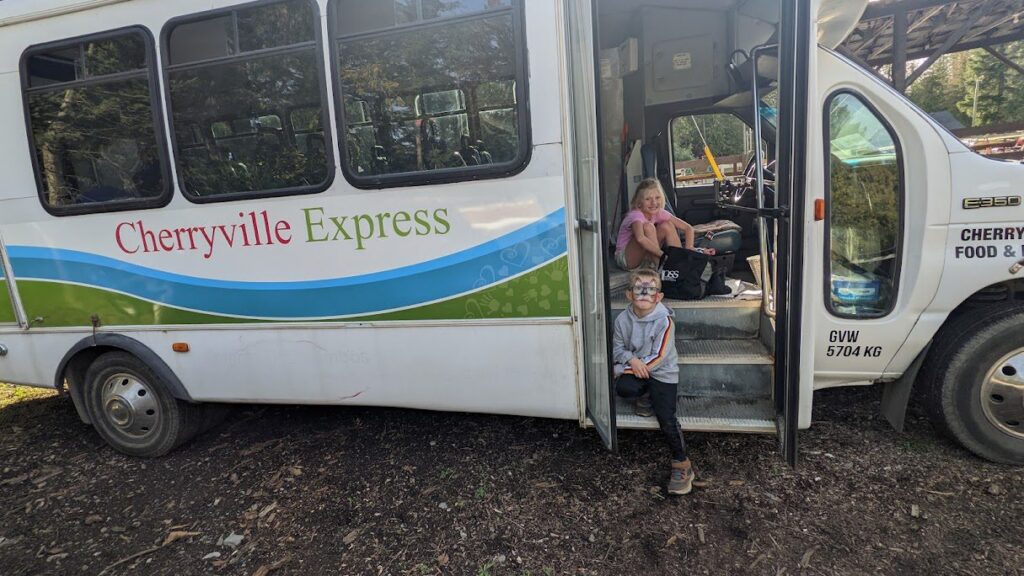
Cherryville is what Meghan calls a “service-area desert.” Most supports are 30 to 60 kilometres away, a real barrier for low-income households, older adults who no longer drive, and anyone facing compounding stress. CCFRS fills that gap not by replacing specialized services but by being the first, manageable step: a familiar face, a central building, a neighbour who has lived what you’re living.
In 2025 alone, CCFRS supported roughly 456 unique people across its food bank, youth programs, senior services, and Resource Centre. The Resource Centre drop-in service alone served 82 clients– a 63% jump from the year before. “We have yet to plateau,” Meghan says. Their tagline, Families Helping Families, has held steady through it all.
From where I sit at the Community Foundation North Okanagan, this is exactly the kind of work we want to see thriving in our region. CCFRS was a 2024–2025 recipient of our Smart & Caring Community Grants, joining 49 other organizations in a record-setting $467,000 distribution, the latest chapter in a relationship that goes back to that 2017 warehouse build. Stories like Cherryville’s show what becomes possible when local people are trusted, resourced, and given room to lead. Meghan’s hope is that CCFRS becomes a blueprint for other rural communities. After spending time with her, I think she’s right, and the rest of us have a role to play in making sure the blueprint travels. Learn more at cfno.org.
Any content, resident submissions, guest columns, advertisements, and advertorials are not necessarily endorsed by or represent the views of Best Version Media LLC (BVM) or any municipality, homeowners associations, businesses, or organizations that this publication serves. BVM is not responsible for the reliability, suitability, or timeliness of any content submitted, inclusive of materials generated or composed through artificial intelligence (AI). All content submitted is done so at the sole discretion of the submitting party.