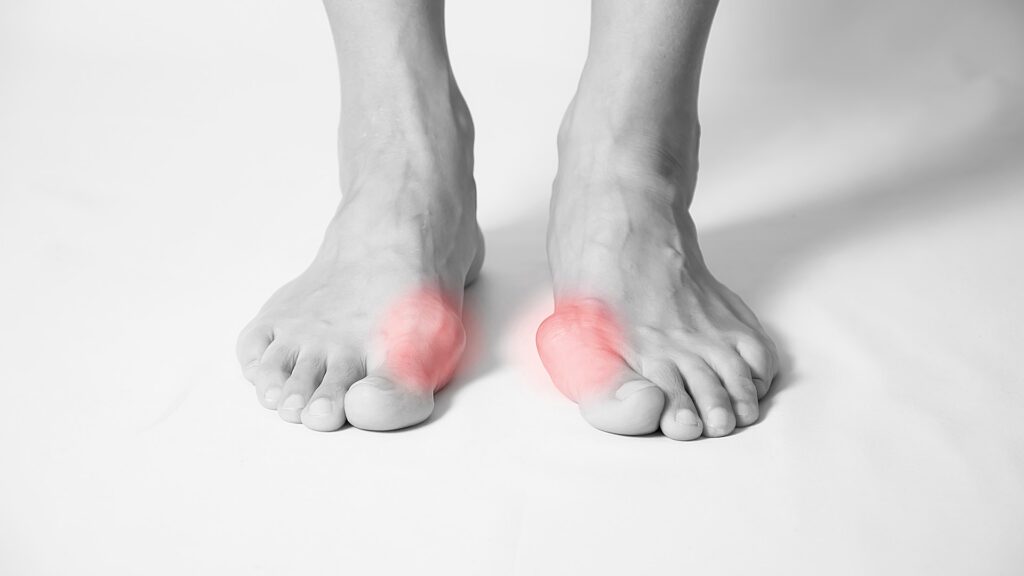
A bunion is a “bump” that forms at the base/side of the big toe when the joint drifts out of alignment and the toe starts angling toward the second toe. It can be a major source of irritation, causing pain, swelling, and trouble wearing shoes.
What is a Bunion?
A bunion is not just a “bump” on the side of the foot; it reflects a change in the position of the bones in the front of the foot. As the big toe shifts inward, the joint at its base becomes prominent and can rub against shoes, causing the area to become sore and inflamed. People often misconstrue bunions as “growths” of bone, but they are, in fact, the bone changing positions and essentially pushing outward instead of aligning straight with your big toe. Bunions often develop gradually over time, and they may be related to inherited foot structure (genetic component), pressure on the forefoot, and other mechanical factors. In children and teenagers, bunions can also be associated with foot mechanics such as flatfoot or hypermobility (increased motion of joints).
Common symptoms
People with bunions often notice a visible bump, pain at the big toe joint, redness, swelling, and difficulty finding comfortable shoes. Some also develop calluses or corns where the foot rubs inside the shoe gear.
Symptoms may be mild at first and become more noticeable with standing, walking, or wearing narrow shoes. Not every bunion is painful, but the larger or more irritated ones are more likely to cause daily discomfort.
Non-surgical treatment
Treatment usually starts with symptom relief rather than trying to “make the bump disappear”. Helpful measures include wider shoes with a wider toe box, padding over the bump, shoe inserts or orthotics (which can biomechanically correct the foot and slow down progression of the deformity, taping, and icing after prolonged activity. Some clinicians also use corticosteroid injections (Cortisone) for inflammation to relieve pain symptoms.
When surgery is considered
Surgery is generally considered when pain persists, shoes are hard to wear, or conservative treatment no longer provides enough relief. The goal of surgery is to realign the bones and correct the deformity, not just remove the bump.
Different operations are used depending on the severity and shape of the deformity, but many procedures involve cutting and repositioning bone to restore alignment, with the insertion of hardware (screws and plates) to keep everything in place. In simpler terms, surgery is the only way to truly correct the bunion, while non-surgical care mainly eases symptoms. Most procedures require minimal time off the feet, as you can wear a walking boot to ambulate for several weeks after surgery, then transition to a smaller surgical shoe, and ultimately to sneakers/comfortable, supportive shoes.
Practical advice for patients
If a bunion is mild, start with orthotics (inserts) and shoes that have a wide toe box and good support. Add padding if the area rubs, and try ice and anti-inflammatory medication when it flares up.
Early evaluation with X-rays and a physical exam at a podiatrist’s office can show how far along the deformity is and determine when surgery is necessary. No harm in getting it checked out! Seeing a podiatrist does not mean you have to schedule surgery immediately – it’s an opportunity to evaluate and discuss options!
Spur Podiatry
625 Parkview Drive, SUITE 102
Trophy Club, TX 76262
(817) 527-6537
Any content, resident submissions, guest columns, advertisements, and advertorials are not necessarily endorsed by or represent the views of Best Version Media LLC (BVM) or any municipality, homeowners associations, businesses, or organizations that this publication serves. BVM is not responsible for the reliability, suitability, or timeliness of any content submitted, inclusive of materials generated or composed through artificial intelligence (AI). All content submitted is done so at the sole discretion of the submitting party.