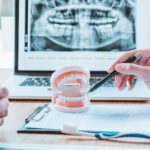
When I look inside a patient’s mouth, I’m not just counting teeth. I’m reading a story — one written in bone, tissue, and the architecture of the jaw. And that story almost always begins the same way: with breathing.
The mouth is the most overlooked diagnostic window in medicine. What I see there reveals how someone sleeps, how their nervous system is functioning, whether their brain is receiving adequate oxygen at night, and whether their heart is quietly under siege.
Scalloped edges on the tongue tell me the tongue is pressing against the teeth — compensating for an airway too narrow to hold it properly. A high, vaulted palate tells me the tongue was never doing its job of shaping the arch from the inside. Flat, worn teeth tell me the brain spent the night fighting to reopen a collapsing airway. Every sign has a story. Every story has a root.
The nose was designed as the primary airway for good reason. It warms, filters, and delivers nitric oxide — the body’s built-in antimicrobial defense — with every single breath. When we bypass it, we bypass the design. And we pay for that bypass in ways most people have never been told to connect.
The symptoms people accept as normal — fatigue, anxiety, headaches, high blood pressure, brain fog — are often not random. They are downstream consequences of a single upstream problem: the airway.
Your mouth has been trying to tell you. It’s time to listen.
Any content, resident submissions, guest columns, advertisements, and advertorials are not necessarily endorsed by or represent the views of Best Version Media LLC (BVM) or any municipality, homeowners associations, businesses, or organizations that this publication serves. BVM is not responsible for the reliability, suitability, or timeliness of any content submitted, inclusive of materials generated or composed through artificial intelligence (AI). All content submitted is done so at the sole discretion of the submitting party.