As San Mateo continues to evolve as a vibrant hub for young families, our local educational landscape is changing too. A recent addition to our neighborhood, Stemtree of San Mateo, highlights a growing local demand for deeply personalized, hands-on learning outside the classroom environment.
But as STEM (Science, Technology, Engineering, and Math) options expand, parents are often forced to navigate a sea of conflicting advice.
When it comes to preparing our children for a tech-driven world, what actually works? One of the single biggest misconceptions I encounter is that STEM education is synonymous with “screen time.”
As parents in the Bay Area, we face an exhausting paradox. We are told our children must be tech-literate to thrive in tomorrow’s economy, yet every pediatrician and parenting blog warns us to restrict screen time, and to avoid hours of passive tablet scrolling or competitive video gaming. This leaves families stuck in a guilt-inducing loop: wanting to foster STEM skills, but dreading the digital fatigue that comes with it. The good news? True STEM training doesn’t require a compromise.
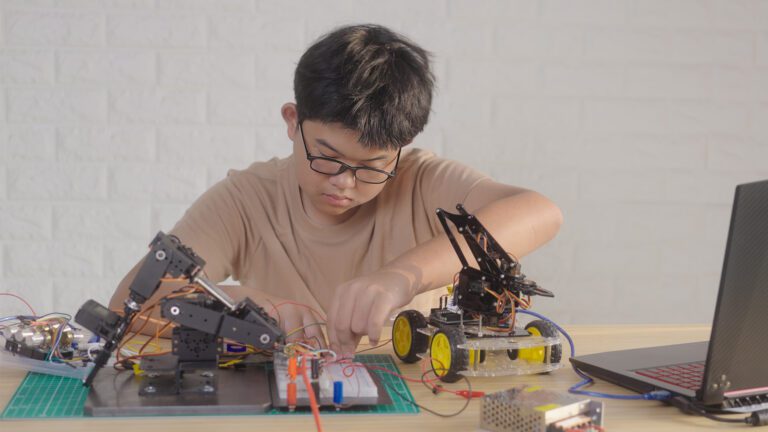
In reality, authentic STEM education is deeply tactile and interactive. True proficiency doesn’t come from consuming digital content; it comes from treating tech as a tool to create, build, and solve real-world problems. When a child learns STEM concepts effectively—whether exploring the flow of electricity, building a mechanical gear assembly, or testing a basic coding loop—they are using physical materials and spatial reasoning. It is an active, messy, trial-and-error process, not a static virtual experience.
If you want to cultivate a genuine analytical mindset at home, try shifting the focus from digital consumption to physical creation. Here is how you can start today:
- Audit your child’s tech: Prioritize open-ended creations (like basic logic games or introductory robotics kits) over closed, passive entertainment apps.
- Encourage the “Why”: When things break around the house, involve your child in diagnosing the issue before calling a professional or buying a replacement.
- Embrace the friction: If a child gets frustrated by a challenging logic puzzle or a construction toy, resist the urge to step in immediately. The cognitive growth happens in the struggle, not just the solution.
By shifting our focus from passive screens to active, customized exploration, we can help our kids build true confidence and critical thinking skills that last a lifetime.
About Stemtree: At Stemtree, we believe in hands-on, individualized learning. Our staff works with the learners on a one-on-one basis, in any of our 5 STEM subjects (math, science, coding, robotics, and electronics). Learners grasp concepts at their own pace, and develop a thorough understanding of the topics, and build a solid foundation which supplements their journey in the classroom.
Check out our website (https://www.stemtree.com/sanmateoca) for more information, and for a calendar of events covering a number of STEM topics, including science fair workshops, robotics teams/events, coding hackathons, and AI.
Any content, resident submissions, guest columns, advertisements, and advertorials are not necessarily endorsed by or represent the views of Best Version Media LLC (BVM) or any municipality, homeowners associations, businesses, or organizations that this publication serves. BVM is not responsible for the reliability, suitability, or timeliness of any content submitted, inclusive of materials generated or composed through artificial intelligence (AI). All content submitted is done so at the sole discretion of the submitting party.