October has meant something different to me since August 2023.
I was 47 years old, a chiropractor, wife, mother of two children—then 8 and 15—and a solo business owner when I was diagnosed with Stage 2 breast cancer that had spread to a lymph node.
Suddenly, the doctor became the patient.
My surgery was in September. What followed was pain, recurring infection and four rounds of chemotherapy. After my first round, I became dangerously ill and was hospitalized, nearly septic. One week after leaving the hospital, I walked back in for round two.
After chemotherapy came 20 radiation treatments, burns and a level of fatigue that is difficult to describe unless you have experienced it.
And through all of it, life was still happening.
We had to tell our children that their mom had cancer. My husband became my caretaker and my rock. He held me at my worst, cried with me and for me, and carried so much when I couldn’t.
Our family, friends and community surrounded us with meals, phone calls, financial support and love. I learned very quickly that while one person receives the diagnosis, cancer happens to an entire family.
I also learned something that would ultimately change the way I understood healing and the way I practice chiropractic:
Finishing treatment and being finished with healing are two very different things.
When Treatment Ends, Healing Doesn’t
In January 2024, I returned to my chiropractic office while I was still in treatment.
As a solo business owner, there was certainly a practical reality to that decision—I needed to work. But returning to the office also gave me something I hadn’t expected. After months of appointments, procedures and treatments where so much of my life revolved around being a cancer patient, I was able to step back into a part of myself that felt familiar.
I was Dr. Mason again.
I could care for people. I could use my hands and my knowledge. I could do work that mattered to me. I wasn’t only the person receiving treatment anymore.
But my body was nowhere near finished healing.
My active cancer treatment ended in March 2024, after surgery, complications, chemotherapy and radiation. In many ways, though, that marked the beginning of a different kind of recovery.
Physical therapy has been an important part of restoring my range of motion and managing fibrotic tissue, nerve pain and numbness. Chiropractic care has also been a key part of my recovery, helping address changes in movement, mobility and compensation that developed as my body went through surgery and treatment.
I experienced firsthand something I had explained to patients for years: when one part of the body isn’t moving or functioning well, we adapt. We protect. We compensate. Other areas begin doing work differently to keep us moving.
Only now, I wasn’t explaining it from the other side of an exam table.
I was living it.
And recovery continues to evolve.
One of the realities of survivorship for me is that although chemotherapy and radiation are behind me, cancer still influences my everyday health. As part of my ongoing treatment, I take estrogen-blocking medication, which has put me into chemical menopause.
That has brought a new set of challenges—fatigue, joint and muscle pain, brain fog and many of the symptoms women experience during menopause. It has changed how my body feels, how quickly I recover and, at times, how much energy I have to give.
So I have had to learn a different way of caring for myself.
Instead of measuring recovery by whether I can get back to the body I had before cancer, I focus on supporting the body I have now.
That shift in perspective has profoundly changed the way I care for my patients.
“I Just Want to Feel Like Myself Again”
I have heard versions of that sentence throughout my career.
Before cancer, I understood it as a doctor.
Now I understand it as a patient.
As a chiropractor, I have always looked beyond the place that hurts to understand how the body is moving and functioning as a whole. My own recovery deepened that belief.
Our bodies are incredibly adaptive. Pain, surgery, scar tissue, restricted range of motion, weakness and injury can all change the way we move. So can pregnancy, postpartum recovery, hormonal changes, menopause, repetitive work and aging.
When movement changes in one area, the body often finds another way to accomplish the task.
Maybe your shoulder doesn’t move the way it once did, so your neck and upper back begin compensating. Maybe restriction in your hip changes the way you walk. Maybe an old injury you learned to “live with” begins affecting another part of your body.
That is why I don’t believe good care should simply chase the symptom.
I want to know how your body is functioning. Where has movement been lost? Where are you compensating? What has your body been through?
And then there is the question I care about most:
What is this keeping you from doing?
Because most people aren’t coming into my office because they want a better range-of-motion measurement.
They want to reach overhead without pain. Turn their head comfortably while driving. Exercise again. Pick up their child or grandchild. Garden. Travel. Sleep comfortably. Get through a workday without constantly thinking about what hurts.
They want to participate fully in their own lives.
That is the outcome that matters.
The Mission Behind Second Bloom Wellness
My experience with cancer didn’t change my commitment to providing innovative, research-backed chiropractic care.
It gave that care a deeper purpose.
At Second Bloom Wellness, my approach is gentle, specific and individualized. Depending on what a patient needs, care may incorporate instrument-assisted chiropractic adjustments, myofascial release, SoftWave TRT, Erchonia cold laser and individualized home exercise recommendations.
These are tools. They aren’t the goal.
The goal is to improve biomechanical and functional movement—to help your body move and function as well as possible so you can get back to the things that matter to you.
And no two bodies arrive with the same story.
A woman recovering from a major health event may need something very different from a new mother, an active woman dealing with an injury, or someone navigating perimenopause, menopause and the physical changes of midlife.
My experience as a breast cancer survivor has given me an even deeper appreciation for that individuality.
I know what it is like when your body changes faster than you can emotionally process those changes. I know what it is like to be exhausted and still have people depending on you. I know what it is like to work at regaining movement that you once took for granted.
Most importantly, I know how much it matters to have healthcare providers who see the person—not just the symptom.
That has become a central part of the mission at Second Bloom Wellness: helping women through the many stages and changes of life feel supported in their bodies and empowered to move, function and live well.
Maybe We Don’t Need to “Get Back” to Who We Were
We often talk about recovery as getting “back to normal.”
Cancer changed that idea for me.
There are things I would gladly erase from those months. I would never choose cancer, and I would never romanticize what it put my body or my family through.
But I cannot deny what it taught me.
It taught me to understand vulnerability differently. To appreciate community differently. To listen to my body differently. And to recognize just how much strength can coexist with struggle.
It also taught me that healing doesn’t always mean returning to the person you were before something happened.
Sometimes the better question is:
What does my body need now, and what do I want my life to look like from here?
That question has become deeply personal to me.
It is also the heart behind the name Second Bloom Wellness.
A second bloom isn’t about pretending the first chapter didn’t happen. It is about taking everything your body and your life have been through and caring for yourself as you move into what comes next.
This October, Don’t Put Yourself Last
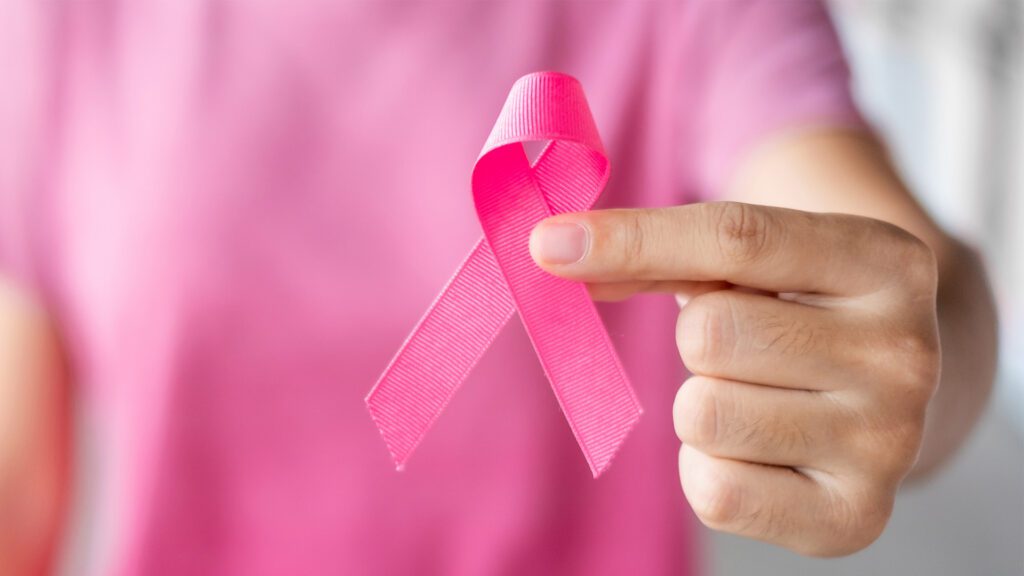
During Breast Cancer Awareness Month, talk with your healthcare provider about breast cancer screening that is appropriate for you and pay attention to changes in your body.
But as a chiropractor, wife, mom and breast cancer survivor, I hope October can be a reminder of something bigger, too.
Don’t wait for a crisis to make your health important.
Listen when your body is telling you something has changed. Don’t normalize pain simply because you’ve learned how to work around it. Pay attention when you stop moving the way you used to. Ask for help when you need it.
And please don’t become so busy caring for everyone else that you disappear from your own list.
I know what it is like to have my body change in ways I never asked for.
I also know what it is like to discover how much that same body is capable of surviving, adapting to and rebuilding from.
There is life after the hard chapter.
There is movement after restriction.
There is strength after vulnerability.
And healing doesn’t always mean becoming who you were before.
Sometimes, it is your opportunity to bloom again.
Dr. Cassandra Mason, DC
Second Bloom Wellness
Voted Best Chiropractor of San Mateo Area 2024, 2025 and 2026
650-571-1122 (call or text)
Dr. Mason, DC is also a certified Know Your Lemons® Lemonista and encourages women to know what is normal for their breasts and become familiar with the signs of breast cancer. The free Know Your Lemons® app provides breast health education, screening guidance and tools to help you stay on top of your breast health.
Learn more and download the Know Your Lemons® app:
Any content, resident submissions, guest columns, advertisements, and advertorials are not necessarily endorsed by or represent the views of Best Version Media LLC (BVM) or any municipality, homeowners associations, businesses, or organizations that this publication serves. BVM is not responsible for the reliability, suitability, or timeliness of any content submitted, inclusive of materials generated or composed through artificial intelligence (AI). All content submitted is done so at the sole discretion of the submitting party.