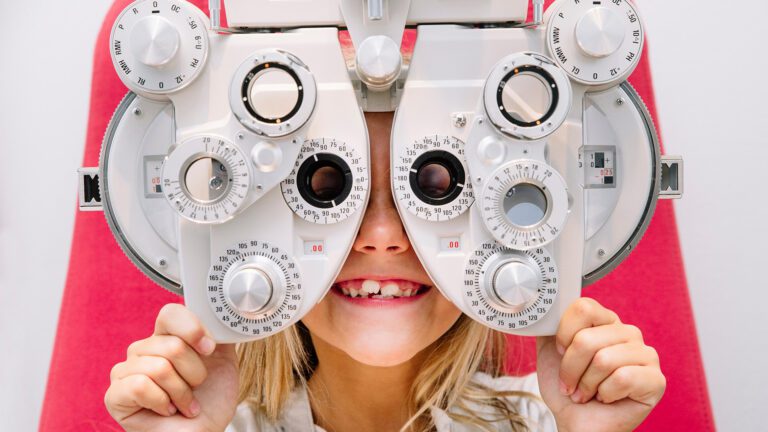
For many patients, those four simple words can instantly trigger anxiety. I’ve seen it countless times. A patient sits comfortably through the eye health exam, but the moment we begin the refraction, the part where we determine the glasses prescription, the pressure seems to rise. Suddenly they’re worried about giving the wrong answer. They apologize for being indecisive. Some start guessing. Others become visibly stressed.
If you’ve ever felt this way during an eye exam, let me reassure you of one thing: There is no wrong answer. The refraction process isn’t a test of intelligence, memory, or decision-making. It’s simply a conversation between your eyes, your brain, and your doctor.
Why Does It Feel So Stressful?
Most of us aren’t accustomed to making judgments between images that are nearly identical. When I ask whether “1 or 2” looks better, the difference may be incredibly subtle. Sometimes the choices are intentionally very close because we’re fine-tuning your prescription to provide the clearest and most comfortable vision possible.
Patients often think they’re expected to immediately know the correct answer. In reality, we’re looking for your perception. If the images look the same, that’s valuable information too. One of the most common things I hear is: “Can you show me that again?” Absolutely. In fact, many times that’s exactly what I want you to say.
What Your Eye Doctor Is Actually Thinking
When I perform a refraction, I’m not relying solely on your answers. I’m combining your responses with years of training, objective measurements, and patterns that help me understand how your eyes focus. Your responses are only one piece of the puzzle. If you’re uncertain, saying “they look the same” or “I’m not sure” is often more helpful than taking a random guess. Believe it or not, some of the best refractions happen when patients stop trying so hard.
Tips for a Better Refraction Experience
1. Don’t Rush. Take your time. A good eye exam isn’t a speed competition. If you need another comparison, ask.
2. “Same” Is a Perfectly Acceptable Answer. Not every choice will have a clear winner. Sometimes there is no meaningful difference, and that’s important information.
3. Describe What You See. Instead of focusing only on “better,” tell your doctor if one image looks sharper, darker, brighter, clearer, or more comfortable.
4. Blink. Dry eyes can make letters fluctuate and blur. A simple blink can often clear things up.
5. Don’t Worry About Being Wrong. The biggest mistake isn’t choosing the wrong number; it’s becoming so anxious that you stop communicating what you’re actually seeing.
A Final Thought
The next time you’re sitting in the exam chair and hear, “1 or 2?” remember that you’re not being graded. There are no points, no passing score, and no wrong answers. So, relax, take a breath, and answer honestly. And if you need to see number 1 and number 2 five more times, that’s okay too. We ask because we want to get it right—not because we expect you to.
Any content, resident submissions, guest columns, advertisements, and advertorials are not necessarily endorsed by or represent the views of Best Version Media LLC (BVM) or any municipality, homeowners associations, businesses, or organizations that this publication serves. BVM is not responsible for the reliability, suitability, or timeliness of any content submitted, inclusive of materials generated or composed through artificial intelligence (AI). All content submitted is done so at the sole discretion of the submitting party.