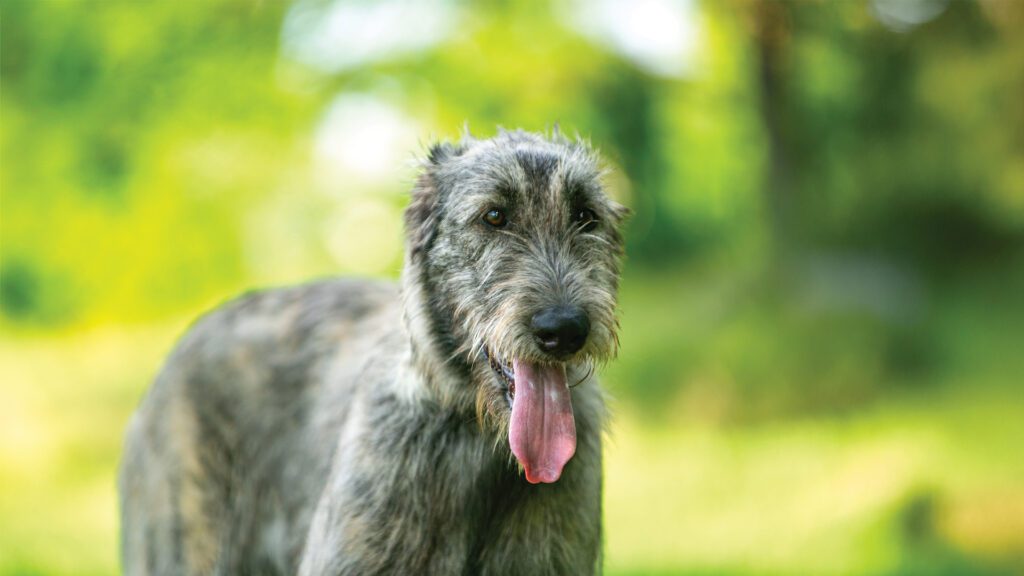
If the phrase, “Gentle Giant,” had a picture next to the definition in the dictionary (yes, I’m that old), it would have to be the lovable visage of one of the largest dogs you will meet. Irish wolfhounds in our modern era have an interesting historic pedigree, and have their roots in the ancient world.
In 391 A.D. the Roman Consul, Quintus Aurelius Symmachus, received as a gift seven hounds from the furthest reaches of the Empire–a small, verdant island off the west coast of Brittania–what we call today, as Ireland. The Consul wrote, “All Rome viewed them with wonder.” They were gifted to Rome to fight lions and bears, and apparently left an indelible mark in their physicality and ability. These sighthounds were bred from the same stock that gave rise to greyhounds and Scottish deerhounds. Some say the deerhound is a direct descendant of the original Irish wolfhound. Originally bred to hunt the vicious wolves that used to populate the Emerald Isle, they became a symbol of status and wealth amongst Irish Nobility and minor landholders alike. They were prized for their hunting ability and great strength as much as their tremendous speed at a gallop.
Lord Oliver Cromwell at one point forbid the export of the dogs from Ireland due primarily to their scarcity, to protect them from becoming extinct altogether, which even with those protections nearly occurred. Thankfully, in the late 1800s, British Army Captain George Augustus Graham revitalized the breed and officially formed the Irish Wolfhound Club, devoted to keeping the breed extant. Today, though they may have become somewhat rare, Irish Wolfhounds still have several healthy and devoted breeding lineages that keep the name alive and well.
Wolfhounds are characterized by a large body, somewhat longer than they are tall, and stand between 34 and 38 inches at the shoulder, though they tower over six foot if they rear on their hind quarters. A large male can weigh as much as 180 lbs, though typically dogs will be between 120 to 160 lbs. They have soft expressive eyes set in a long skull and ears that tend to be small and triangular, like their smaller greyhound cousins. A wolfhound’s coat is shaggy and rough, and their coloring is most often grey or buff. They can run the whole gamut, though, from flashy tricolor and brindling to almost white. Wolfhounds are more powerfully built than their smaller sighthound family, but they are still driven by that instinct to course after running prey.
Their personalities are very soft, and they tend to want to be with their handlers most of the time. If you know what it is like to have a “velcro” dog, you can see that training from puppyhood is a must with this animal, unless you like having 150 pounds of lapdog. They tend to be very patient and kind with small children, but as with any animal, you should always supervise interaction closely. They are not great as watch dogs as they often come off as affable, if not somewhat shy, but they can be protective of their family if they feel imminent threatening behavior. They don’t tend to be as protective of property, likely from their history of land-roaming to hunt predators and patrol distant borders.
All in all, the wolfhound is a loveable, shy, somewhat mysterious, gentle giant. They can make excellent companion dogs, but as with many giant breeds, they don’t have a lot of longevity. Expect 7-9 years out of this dog in total, and anything extra you get with them is just gravy. If you don’t mind spending a quarter of your monthly salary feeding a dog, and you want an enormous lap-dog, look for a reputable breeder of wolfhound lines, and prepare to have your heart stolen the moment you bring that very expensive puppy into your home.
Any content, resident submissions, guest columns, advertisements, and advertorials are not necessarily endorsed by or represent the views of Best Version Media LLC (BVM) or any municipality, homeowners associations, businesses, or organizations that this publication serves. BVM is not responsible for the reliability, suitability, or timeliness of any content submitted, inclusive of materials generated or composed through artificial intelligence (AI). All content submitted is done so at the sole discretion of the submitting party.