If you’ve ever stepped outside on a warm Minnesota summer day and heard that unmistakable buzz, you’ve probably wondered what exactly is flying around your yard. A wasp? A hornet? Something else entirely? And, more importantly, should you be worried?
Knowing what you’re looking at can help you decide whether to leave it alone—or call the experts.
Wasp or Hornet?
Here’s the easiest place to start: All hornets are wasps, but not all wasps are hornets.
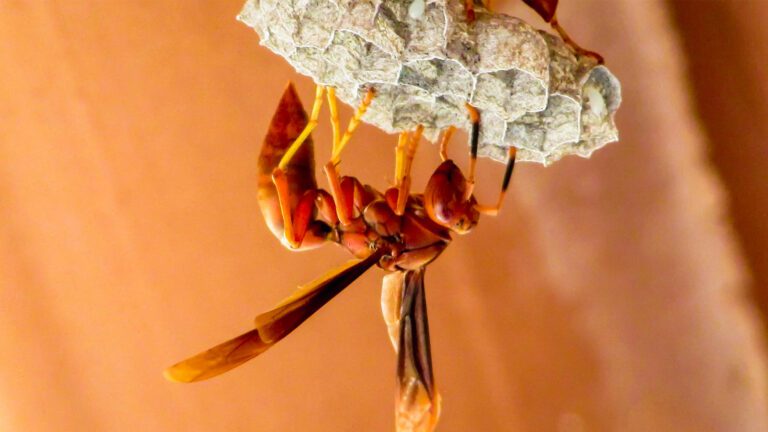
Wasps include paper wasps, yellowjackets, mud daubers and many other species. They are generally slender, with narrow waists and smooth bodies marked with yellow, black, or reddish coloring. Depending on the species, they can range from about ½ to 1 inch long.
Hornets are a specific type of wasp. They tend to be larger and bulkier, with more rounded abdomens. They can reach about 1 to 1½ inches long and may have black-and-white or brown-and-yellow markings. They can also be more defensive when their nests are disturbed.
Of course, when something is buzzing around your head, you probably won’t have time to pull out a measuring tape!
Check Out the Nest
The nest itself can offer some clues.
Paper wasps build open, umbrella-shaped nests with visible honeycomb-like cells. You’ll often find them tucked under eaves, decks, porch ceilings, or other protected spots.
Yellowjackets build enclosed paper nests, and some species build underground. They’re also attracted to sugary foods, meat, garbage, and other food sources, making them particularly unwelcome guests at summer picnics.
Mud daubers create small, tube-shaped structures out of mud, often on walls or sheltered areas around buildings.
Hornet nests are generally larger and round or football-shaped. They’re commonly found high in trees or attached to buildings.
Leave It Alone—or Call for Help?
Wasps and hornets aren’t simply looking for people to sting. Many are beneficial predators that help control other insects, and they also visit flowers and contribute to pollination.
The bigger concern is where the nest is located. A nest tucked away in a quiet corner of the yard may not cause a problem. A nest near a doorway, deck, playground, or other high-traffic area is another story.
Yellowjackets, in particular, can become defensive when their nests are disturbed. Accidentally stepping on an underground nest or getting too close can result in multiple stings.
Before attempting to remove a nest, take a moment to observe. If the insects aren’t bothering anyone and the nest is out of the way, leaving it alone may be the best choice. If it’s in a busy area or appears to contain defensive insects, keep your distance and consider professional removal.
The team at Brothers Pest Management knows that not every buzzing visitor is cause for concern. If you’ve discovered a nest in an inconvenient—or potentially unsafe—spot, our experienced team can help identify the pest and determine the best way to handle it, so you can get back to enjoying your yard with peace of mind.
Any content, resident submissions, guest columns, advertisements, and advertorials are not necessarily endorsed by or represent the views of Best Version Media LLC (BVM) or any municipality, homeowners associations, businesses, or organizations that this publication serves. BVM is not responsible for the reliability, suitability, or timeliness of any content submitted, inclusive of materials generated or composed through artificial intelligence (AI). All content submitted is done so at the sole discretion of the submitting party.