Every August and September, Piedmont changes its rhythm almost overnight. Mornings become earlier. Calendars fill. Drop-off lines return. Sports restart. Homework lands on the kitchen counter. Parents become logistics coordinators, children exchange summer freedom for structure, and teenagers somehow manage to carry a backpack, extracurriculars, academic expectations, and the emotional weather of an entire household at once.
We buy new shoes. We sharpen pencils. We schedule physicals. But almost no one asks: How well is the nervous system adapting to all of this?
That question matters because the nervous system is not simply where we “feel stress.“ It is part of the regulatory machinery coordinating how we respond to changing demands, influencing heart rate, breathing, muscle tone, digestion, attention, recovery, and the countless adjustments required to remain stable in an unpredictable world. Researchers increasingly study measures such as heart rate variability because adaptability itself can offer useful information about how the body regulates itself.
When demands increase, the body adapts. That is not a flaw. It is intelligence. The problem is that sometimes a useful adaptation becomes a habit. “Getting through the day“ quietly becomes the body‘s default setting. You may recognize it as shoulders that live near the ears, a jaw that clenches during homework, a child who crashes after school, a teenager who is simultaneously exhausted and wired, or a parent who finally sits down at night and realizes they have barely taken a full breath all day.
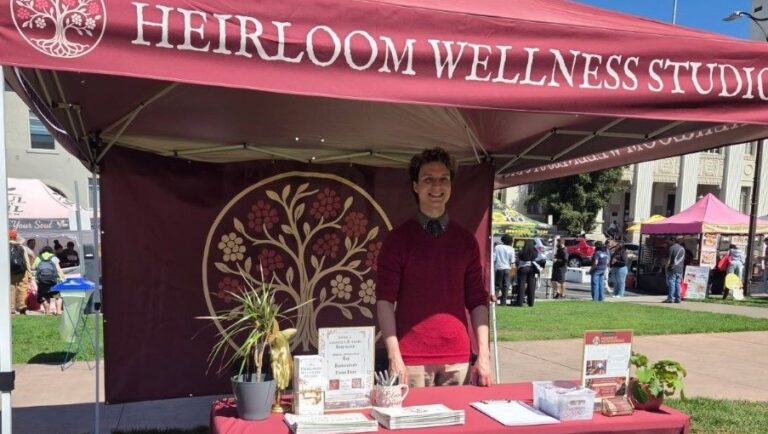
At Heirloom Wellness Studio, we are interested in the system underneath those individual experiences. Instead of assuming the body needs to be forced, fixed, or corrected, we ask what it has learned — and whether it can access a more efficient strategy. Through gentle, specific spinal contacts, nervous-system-centered care, objective assessments, and increased body awareness, we explore how the body is organizing and adapting.
This raises a more interesting question than simply, “How do I get rid of this tension?“ What becomes possible when the body has greater capacity to respond, recover, and reorganize?
Perhaps it is a student who can meet a demanding school day without feeling completely depleted. A teenager with greater awareness of what their body is telling them. An athlete who moves with more adaptability. A parent who still has enough energy at dinner to enjoy being with the people they have worked so hard to care for.
Health, after all, is not merely the absence of discomfort. It is capacity: the capacity to adapt, recover, connect, learn, participate, create, and remain present for the life you are building.
Fall is a season of reorganization. The light changes. Routines return. Children enter new classrooms, and families enter new chapters. Perhaps this is an opportunity to consider something beyond organizing the calendar: how is the body organizing for the life brought upon it?
That question is one we spend a great deal of time exploring at Heirloom Wellness Studio. Sometimes becoming curious about the system underneath the symptoms changes the conversation entirely.
Perhaps the missing back-to-school supply was never something you could buy. It was capacity — and your body may have more of it waiting than you think.
Any content, resident submissions, guest columns, advertisements, and advertorials are not necessarily endorsed by or represent the views of Best Version Media LLC (BVM) or any municipality, homeowners associations, businesses, or organizations that this publication serves. BVM is not responsible for the reliability, suitability, or timeliness of any content submitted, inclusive of materials generated or composed through artificial intelligence (AI). All content submitted is done so at the sole discretion of the submitting party.